
 Search Articles


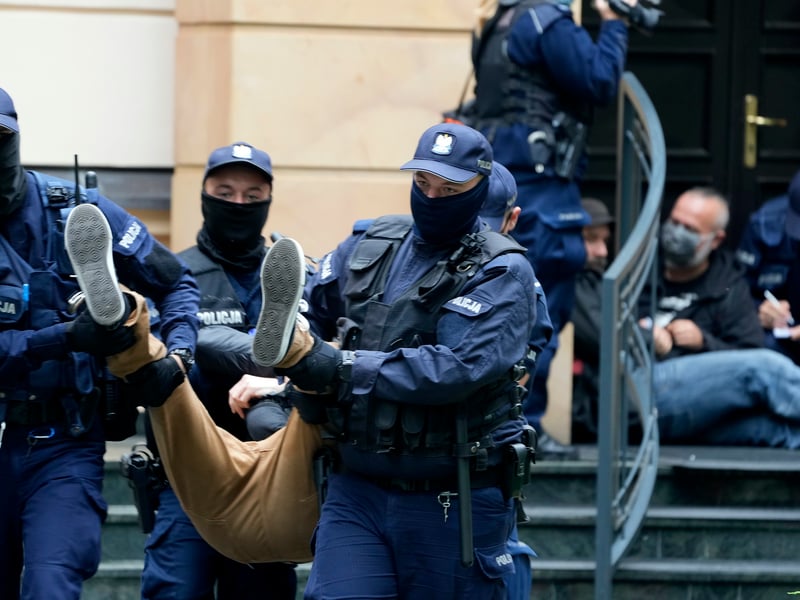
(CN) — A prominent Polish journalist has won her case at the European Court of Human Rights, where judges found that police crossed the line when they held her for hours during a 2017 protest and unlawfully curbed her right to peaceful assembly.
Ewa Siedlecka, a columnist and longtime legal affairs reporter, brought the case after police stopped her during a counter-demonstration in Warsaw. The protest targeted a political march organized by supporters of Poland’s ruling party, Law and Justice.
On June 10, 2017, Siedlecka joined a quiet sit-in staged along the planned route of a monthly nationalist march. The event commemorated the 2010 Smolensk plane crash that killed President Lech Kaczyński and other senior officials.
Under a controversial law introduced by the ruling party, government-aligned events were granted automatic priority over public space — effectively shutting out counter-protests. Critics warned the rule left no room for dissent in public squares.
The sit-in, organized by the civic group Citizens of the Republic of Poland, was a direct pushback against that restriction. Human rights groups like Amnesty International and the Helsinki Foundation warned that the changes posed a serious threat to calm and unarmed assembly, especially in politically sensitive contexts.
During that day of the rally, police picked up the protesters and took them to a nearby courtyard, where they were kept for about two hours. Although officers said they weren’t under arrest, the group wasn’t allowed to leave or contact a lawyer. Siedlecka was told she “remained at the disposal of the police.” She later challenged the legality of the incident in Polish courts, and when that failed, she brought her case to the human rights court in Strasbourg.
On Thursday, the judges ruled in her favor.
Polish authorities called it a routine identity check. But the judges didn’t buy it. They pointed to the length of her detention and the lack of any clear legal rule justifying such treatment, saying it went far beyond a simple administrative measure.
The judges also emphasized that Siedlecka and the other demonstrators had been peaceful and posed no threat to public order.
“The protesters had decided to express their dissent symbolically by sitting down on the street and had passively awaited removal by the police,” the court wrote, adding that “Their actions had had a minimal impact on the conduct of the commemorative march as it had only delayed it by a few minutes.”
In a written response to Courthouse News, Siedlecka said she was very pleased with the outcome.
“When I filed the complaint, my aim was to eliminate the practice of the police: prolonged questioning as harassment involving illegal deprivation,” she wrote. “I will use the court’s ruling to press the authorities to change the law to eliminate this practice.”
She warned that such tactics remain common — long detentions without formal arrest or charges.
“Harassment by means of prolonged pre-trial detention is still used to repress the participants of various assemblies,” she said, recalling similar treatment during more recent episodes in Warsaw.
The court awarded her €3,000 in damages, which she said will go to the Citizens of the Republic of Poland — the group she had joined during the rally.
Thursday’s ruling made one thing clear: police powers need sharper rules. The judges said the laws Poland relied on were too vague, leaving people in the dark about when and how officers could step in.
Dr. Marcin Szwed, a human rights lawyer at the Helsinki Foundation for Human Rights, pointed to a key issue the judges left untouched. Although the demonstration directly challenged a law granting privileged status to so-called recurrent assemblies, the judges declined to engage with that part of the case.
“Contrary to my expectations, the court did not consider the problem of recurrent assemblies,” Szwed said. “It found that the applicant hadn’t taken the issue through the Polish court system first, since the issue wasn’t raised before Polish courts.”
Even so, he saw the ruling as a clear signal. “The court confirmed that police cannot use cordons or similar tactics to restrict protesters’ movement under the pretext of carrying out identity checks.”
Paweł Osik, who represented Siedlecka before the court, said this judgment should lead to institutional reform and stronger safeguards for nonviolent assemblies. He emphasized the need to circulate the court’s conclusions among law enforcement and review internal procedures. If necessary, he noted, that should include updated training and changes to the legal framework governing coercive measures.
“The judgment should lead to strengthen protection of the rights of participants of peaceful assemblies,” he wrote.
The ruling isn’t final just yet. Either side can ask for a referral to the Grand Chamber within three months. If no one does, it will stand as the court’s final say.
Subscribe to our free newsletters
Our weekly newsletter Closing Arguments offers the latest about ongoing trials, major litigation and rulings in courthouses around the U.S. and the world, while the monthly Under the Lights dishes the legal dirt from Hollywood, sports, Big Tech and the arts.