
 Search Articles


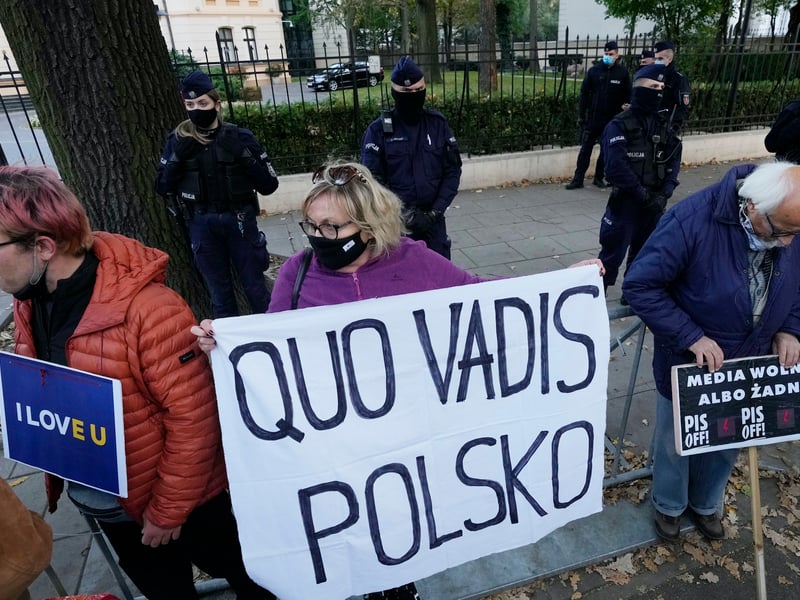
(CN) — A long-running clash between the European Union and Poland reached a turning point Thursday, as Europe’s highest court said the country broke EU law by allowing its constitutional court to sideline EU rulings and fall short of basic standards of judicial independence.
In a wide-ranging ruling, the Court of Justice of the European Union said Poland crossed the line by backing constitutional court decisions that brushed aside binding EU judgments, blocked national courts from applying EU law and relied on a tribunal whose own makeup was deeply compromised.
This was not, the court stressed, a technical squabble over legal theory but a challenge to the way EU law is meant to function inside member states and to whether national authorities can simply pick and choose which EU rules to follow.
A court that shut the door on EU law
The dispute traces back to two high-profile rulings handed down by Poland’s Constitutional Court in 2021, during a bitter confrontation over judicial reforms pushed through by the former Law and Justice, or PiS, government. Those reforms had already drawn criticism in Brussels for tightening political control over the courts.
In those rulings, Poland’s constitutional judges said key provisions of EU law, including rules meant to guarantee independent courts and effective legal protection, could not be applied if they conflicted with Poland’s constitution as interpreted by the constitutional court itself.
That position, the EU judges said, cuts against the basic logic of EU membership. EU law cannot operate, they stressed, if national courts are barred from enforcing binding EU judgments or from following interim orders meant to protect judicial independence while cases are still pending.
Put simply, the court said, member states have a duty to keep their courts free to apply EU law in practice, not just in theory. Blocking that duty is not a minor procedural issue but a direct hit to the legal framework that holds the EU together.
Poland’s Constitutional Court, however, moved in the opposite direction. It declared EU judgments issued by the Luxembourg-based court to be beyond the EU’s powers and ordered public authorities in Poland not to apply them, effectively shutting the door on EU legal oversight at home.
A tribunal not “established by law”
The ruling did not stop at what Poland’s Constitutional Court said. The judges also looked closely at who was sitting on that court in the first place and whether it met basic standards of independence under EU law.
On that point, the answer was no.
The trouble dates back to late 2015, after a fiercely contested parliamentary election and a change of government. In the final days of the outgoing parliament, lawmakers lawfully elected three judges to fill seats on the Constitutional Court that were about to become vacant. Poland’s own constitutional court later confirmed those appointments were valid and said the president had no discretion to block them.
That never happened. The president refused to swear the judges in. Instead, the new parliamentary majority moved to appoint its own candidates to the same seats and rushed them into office. Those judges later took part in deciding cases, even though the legality of their appointments remained unresolved.
The fallout was years of legal uncertainty, with rulings issued by panels that included judges whose right to sit on the court was in serious doubt. That history mattered, the EU judges said, because a court’s authority depends not only on what it decides, but on whether it is properly constituted.
In blunt terms, the court concluded that Poland failed to meet EU standards because its constitutional court “does not satisfy the requirements of an independent and impartial tribunal previously established by law.”
Dimitry Kochenov, lead researcher in the Rule of Law Group at the Central European University’s Democracy Institute, said the ruling marks a watershed moment in the EU’s rule-of-law case law.
For the first time, he said, the EU’s top court has squarely concluded that a member state’s constitutional court itself fails to qualify as a court “established by law” under EU standards because of serious and well-documented irregularities in how judges were appointed in 2015.
“To say that a Constitutional Tribunal is not a court established by law in the eyes of EU law is definitely a first,” he said, even if the outcome had long been anticipated by Polish legal experts.
That assessment was echoed by Wojciech Sadurski, Challis Professor in Jurisprudence at the University of Sydney and professor at the University of Warsaw, who said the real weight of the ruling lies not in repeating familiar principles about EU law, but in what it says about Poland’s constitutional court itself.
For Poland, he said, the decision confirms that the body calling itself the Constitutional Tribunal “cannot be characterized as an independent and impartial tribunal established by law,” echoing earlier findings from Europe’s human rights court.
That conclusion, Sadurski added, cuts to the core of the problem by weakening the authority of the tribunal’s past rulings and shifting the debate away from abstract constitutional theory toward the court’s basic legitimacy.
Why Brussels intervened
The European Commission stepped in after concluding that Poland’s constitutional rulings were no longer just an internal legal dispute, but a direct challenge to the authority of EU law itself.
By denying the primacy of EU rules and cutting off national judges from reviewing how other judges were appointed, Brussels argued, Poland’s constitutional court had effectively placed contested judicial reforms beyond any meaningful oversight, either at home or at the EU level.
The EU judges agreed. They found that Poland’s approach breached not only the duty to provide effective judicial protection, but also the core principles that allow EU law to function across the bloc, including its primacy, its uniform application and the binding nature of EU court judgments.
Crucially, the court rejected Poland’s attempt to frame the dispute as a matter of constitutional identity. Once a country joins the EU and accepts its treaties, the judges made clear, it cannot invoke its constitution to set aside obligations it has already agreed to follow.
A changing political backdrop
The judgment arrives at a moment of political transition in Poland. After eight years under the nationalist Law and Justice party, whose rule was marked by repeated clashes with Brussels over the courts, media and democratic checks, voters delivered a sharp reset in late 2023. A new, pro-EU coalition government took power, promising to rebuild the rule of law, repair relations with the EU and unlock billions of euros in frozen EU funds.
That pledge followed years of domestic tension. Large street protests, criticism from judges and lawyers and repeated warnings from EU institutions had turned judicial independence into a defining political issue inside Poland, not just an abstract legal dispute with Brussels. Restoring trust in the courts became a key test of whether the new government could deliver on its broader promise of democratic repair.
Against that backdrop, Warsaw’s stance in this case stood out. Poland’s current government did not try to defend the constitutional court rulings at issue. Instead, it formally accepted the commission’s complaints, an unusual step in EU infringement proceedings and a clear break from the confrontational approach of its predecessor.
Even so, the judges made clear that a change in political tone could not substitute for a legal ruling. Acceptance alone, the court said, was not enough. It still had to determine whether EU law had been breached and to spell out, in clear terms, what membership obligations require, both for Poland and for other member states watching closely.
What happens next, however, is likely to be far less straightforward.
Anna Wójcik, an assistant professor of law at Koźmiński University in Warsaw, said the ruling leaves Poland facing a messy and uncertain implementation phase.
While the government has said it intends to comply, she noted that the Constitutional Tribunal itself has already brushed the judgment aside, referring to it merely as a “decision” rather than a binding ruling, and that judges whose appointments are in question have shown no sign of stepping down.
Wójcik said a wave of upcoming vacancies on the tribunal could, in theory, create an opening to reshape its composition. But she cautioned that formal turnover alone will not automatically restore independence.
As long as the tribunal’s leadership structure remains intact, she said, political influence over how cases are assigned and handled may persist, leaving Poland with what she described as “a Constitutional Tribunal operating in the form of an institutional hybrid,” rather than a fully rebuilt and independent court.
What the judgment means
While the ruling does not come with fines, it raises the stakes for Poland. The judgment puts renewed pressure on authorities to deal with unfinished business from the 2015 crisis, including the unresolved status of judges whose appointments remain in doubt and the lasting damage to the constitutional court’s credibility. It also gives Brussels firmer legal ground as it weighs Poland’s ongoing judicial overhaul, making clear that the EU’s baseline rules have not moved.
Laurent Pech, professor of law and dean of the Sutherland School of Law at University College Dublin, said the implications go well beyond this single case, especially for disputes governed by EU law.
In his view, the ruling makes clear that Poland’s Constitutional Court stopped qualifying as a court under EU law years ago, meaning its outputs cannot be treated as valid judicial decisions in cases falling within the EU legal framework.
The precedent, Pech added, strengthens the EU’s hand in confronting similar rule-of-law backsliding elsewhere, where bodies “masquerading as courts” are deployed to shield governments by invoking constitutional identity.
Polish officials aligned with the current government welcomed the ruling as confirmation of long-standing criticism of the constitutional court.
Dariusz Mazur, a Polish deputy justice minister, said in a post on X that the EU court had confirmed the tribunal is not an independent or impartial court because of unlawful judicial appointments, and that its rulings rejecting parts of EU law violate EU obligations. “The conclusion is one,” Mazur wrote. “The Constitutional Tribunal must be rebuilt.”
A Commission spokesperson said Poland must now take the necessary steps to comply with the court’s ruling.
What comes next is less about penalties than responsibility. Polish authorities now face clear legal obligations to bring the constitutional framework back into line with EU law, including addressing the effects of the contested constitutional court rulings and restoring conditions for independent judicial review. How far and how fast that happens will depend on choices made in Warsaw, but the court has now made the boundaries unmistakable.
Courthouse News reporter Eunseo Hong is based in the Netherlands.
Subscribe to our free newsletters
Our weekly newsletter Closing Arguments offers the latest about ongoing trials, major litigation and rulings in courthouses around the U.S. and the world, while the monthly Under the Lights dishes the legal dirt from Hollywood, sports, Big Tech and the arts.