
 Search Articles


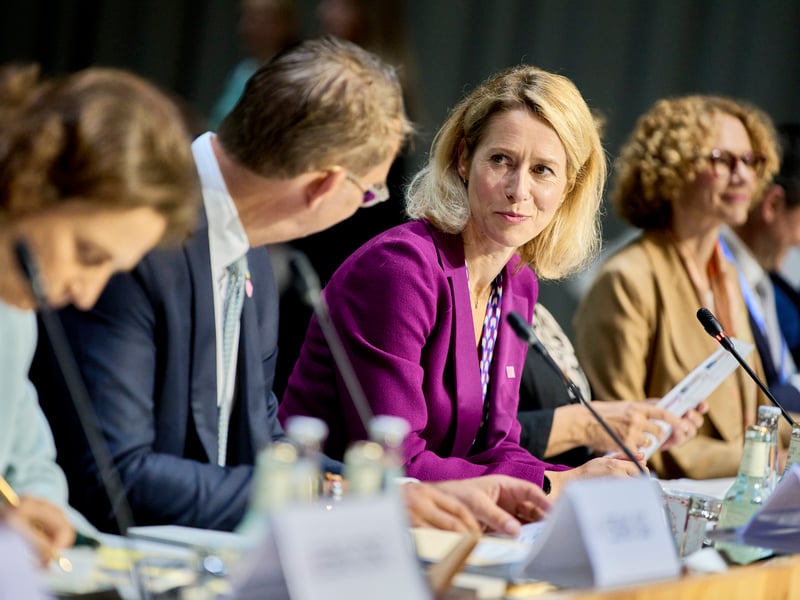
(CN) — European Union defense ministers met in Copenhagen on Friday for the first day of two-day informal meetings where the bloc’s top diplomat declared Russian President Vladimir Putin is “mocking” peace efforts afterThursday’s Russian strikes killed 23 in Kyiv and hit the EU’s own mission there.
Thursday’s attack was one of Russia’s biggest assaults on Ukraine in months, with missiles slamming into homes and power plants. The strikes also damaged EU and British diplomatic offices, crossing what European officials described as a red line — the first time Western diplomatic facilities in the Ukrainian capital had been hit since the war began in February 2022.
“Putin is just mocking any kind of peace efforts that are made,” said EU foreign policy chief Kaja Kallas in a joint press conference with Danish Defense Minister Troels Lund Poulsen after the meeting on Friday.
“Who doesn’t want peace is Russia. It is clear because Russia responds to these peace efforts with missile attacks.” Putin is “stalling by any means possible,” she added.
The European response came as Ukrainian Foreign Minister Andrii Sybiha requested an emergency UN Security Council session Friday evening to address Thursday’s attack.
Speaking in the Latvian capital of Riga on Friday, European Commission President Ursula von der Leyen called Putin “a predator,” adding that “Europe is only safe if the Eastern border is safe.” Von der Leyen is currently touring EU countries that border Russia and Belarus as part of a coordinated show of European resolve following Thursday’s strikes. She announced the EU’s 150-billion-euro ($163 billion) joint defense procurement program has reached full subscription, with 19 member states participating.
The scale of European involvement is massive: EU countries have provided over 63 billion euros in military support to Ukraine since 2022, with another 25 billion euros earmarked for this year. Ministers are now pushing to accelerate an ammunition program as Ukraine faces critical shortages of both ammunition and air defense systems.
According to Kallas, defense ministers also discussed post-war scenarios: “We have already heard that some Member States are saying they are ready to send their troops. [But others] are not ready,” she said.
Most EU countries support plans to train Ukrainian soldiers inside Ukraine once fighting ends.
The current training program, known as EUMAM, involves 23 EU countries plus Norway and Canada and has prepared about 80,000 Ukrainian soldiers. But expanding the mission to operate inside Ukraine would need unanimous approval from all 27 EU capitals — giving Hungary effective veto power over the proposal.
Instead, European officials are privately discussing sending troops — estimates range from 4,000 to 60,000 personnel — from neutral countries to monitor future buffer zones in Ukraine. One proposal involves a 25-mile buffer zone between front lines, though there’s disagreement on size, and it’s unclear if Kyiv would accept giving up territory.
The buffer zone discussions reflect growing European frustration with stalled diplomatic efforts, though similar peacekeeping proposals have repeatedly stalled over the past year. Officials worry that without credible peacekeeping arrangements, any ceasefire would simply give Russia time to regroup for another offensive.
The tough rhetoric marks the latest in a long line of European vows to punish Moscow, as the bloc prepares what would be its 19th round of sanctions since Russia’s invasion began. The discussions show European urgency as the conflict nears its fourth year.
Budapest stalls EU military aid
Getting all 27 EU countries to agree on anything is tough. Foreign policy requires unanimous consent, often producing watered-down compromises that try to satisfy everyone — from Hungary’s warmer ties with Russia to Eastern European countries pushing harder anti-Moscow policies.
Poland and other NATO countries along Russia’s border worry that sending large numbers of troops to Ukraine would weaken the alliance’s eastern defenses and actually increase risks to Ukrainian cities.
The calls for European unity come as Hungary continues to block 6.6 billion euros of the European Peace Facility (EPF) funds that could reimburse member states for weapons purchases for Ukraine, according to EU officials. The EPF is the EU’s main tool for financing military aid to partners outside the bloc.
Kallas said she’s trying to convince Hungarian Prime Minister Viktor Orbán, a Trump ally, by suggesting the money could go toward buying American weapons for Ukraine under recent agreements between U.S. President Donald Trump and NATO. “All the countries today were raising this issue of unblocking,” she said. “You don’t have to be part of it but let others do it.”
The standoff hampers Europe’s response even as leaders push to seize frozen Russian assets, impose fresh sanctions — due in early September — and boost military aid for Ukraine’s EU membership bid.
On Thursday, Hungarian Foreign Minister Péter Szijjártó announced Budapest would ban a Ukrainian military commander from entering Hungary and the broader European travel zone. This followed a Ukrainian strike on the Druzhba oil pipeline that Hungary relies on for energy — which Szijjártó called “an assault on Hungary’s sovereignty.”
“Ukraine knows very well that the Druzhba pipeline is vital for Hungary’s and Slovakia’s energy supply, and that such strikes harm us far more than Russia,” Szijjártó wrote on social media.
Lithuania’s Defense Minister Dovilė Šakalienė took the opposite view. Thursday’s Kyiv attack proves hoping for peace is “naive,” she said. “All Putin is doing is really stalling, actually cheaply buying time to kill more people.”
The Pentagon has made clear the U.S. would play a minimal role, leaving Europeans to carry the load. Kallas emphasized this shift: “The Americans have been clear that Europe needs to be leading, so that’s what we need to show.”
On Thursday, White House Press Secretary Karoline Leavitt suggested the recent attack was predictable Russian retaliation for Ukrainian strikes on Russian energy facilities. Trump “was not happy about this move, but he was also not surprised,” Leavitt said, expressing both countries carry the blame for the stalled peace process.
Trump’s team continues its diplomatic push, with special representative Steven Witkoff meeting Friday in New York with Andriy Yermak, Ukrainian President Volodymyr Zelenskyy’s chief of staff. The goal is setting up technical discussions between Russian and Ukrainian representatives on territory, security and other issues before any high-level summit. But Moscow has downplayed expectations for immediate talks.
Just before ministers gathered, the U.S. approved an $825 million weapons package for Ukraine including extended-range missiles.
The Copenhagen meetings bring together defense and foreign ministers from all 27 EU countries for what officials call a “Gymnich” format — informal sessions held twice a year for strategic discussions. Friday focused on defense issues, with foreign ministers joining Saturday for broader discussions on military aid to Ukraine and European defense.
Courthouse News correspondent Yuval Molina Obedman is based in Brussels.
Subscribe to our free newsletters
Our weekly newsletter Closing Arguments offers the latest about ongoing trials, major litigation and rulings in courthouses around the U.S. and the world, while the monthly Under the Lights dishes the legal dirt from Hollywood, sports, Big Tech and the arts.