
 Search Articles


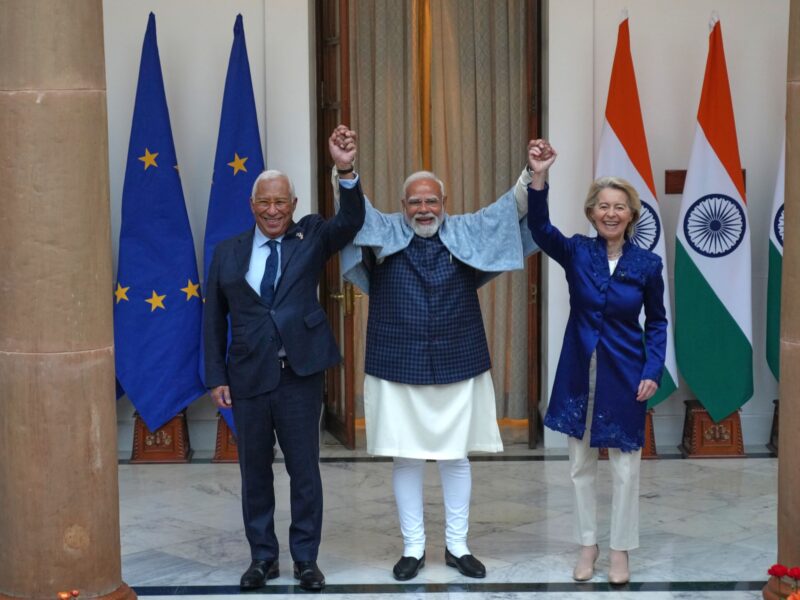
BRUSSELS (CN) — India and the European Unionclosed a free trade deal Tuesday, linking a quarter of the world’s economy after nearly two decades of haggling.
The deal comes at a critical moment: India faces Donald Trump’s 50% tariffs and just lost preferential access to EU markets on Jan. 1, while the EU watches its own trade pact with Washington sit frozen in the European Parliament over concerns about the U.S. president’s threats against Greenland and NATO allies.
“We did it. We delivered the mother of all deals,” European Commission President Ursula von der Leyen said in New Delhi alongside Indian Prime Minister Narendra Modi. “We are creating a market of 2 billion people — two giants who choose partnership in a true win-win fashion.”
The pact slashes tariffs on over 96% of EU exports to the world’s most populous nation and opens 144 service sectors, though agriculture got left out to satisfy political concerns on both sides. “It is the largest ever free trade agreement” in India’s history, said Modi, a “new blueprint for shared prosperity.”
The timing underscores a dramatic shift in global trade alignments. The EU is deepening ties with India while European lawmakers hold up the EU-U.S. deal signed by Trump and von der Leyen last July, demanding answers about the president’s Greenland rhetoric and NATO positions before they’ll move forward. Brussels has simultaneously sealed deals with Indonesia, Mexico, Switzerland and Mercosur as it hedges against U.S. unpredictability.
For India, the stakes are even higher. The country’s goods trade surplus with the U.S. hit $45.8 billion in 2024, compared to $25.8 billion with the EU — making Trump’s 50% tariff wall particularly painful. Trade experts say the EU deal, while big, can’t replace the importance of U.S.-India trade, but it provides critical diversification at a precarious moment.
The deal also offers crucial relief for Indian exporters. On Jan. 1, the country lost a sweetheart arrangement that had given its exports preferential access to European markets — just as new EU carbon taxes kicked in. The Global Trade Research Initiative, a New Delhi think tank, called it a “double hit” affecting 87% of Indian exports to Europe, warning that 2026 could be “one of the toughest years for Indian exports to Europe in more than a decade.”
The deal caps nearly two decades of on-and-off negotiations that got new life in 2022 after Russia’s invasion of Ukraine pushed both sides to diversify their trade relationships. EU officials have decided that deepening their economic and strategic partnership with New Delhi matters more than confronting India over its ties with Moscow — even as India’s oil purchases and defense cooperation with Russia have surged since 2022.
The calculation is straightforward: India is too important to risk pushing away.
“The EU and EU member states are pretty realistic about India’s relationship with Russia. This is a long-standing relationship. People in Europe understand that India, feeling insecure vis-à-vis China, wants to keep a relationship with Russia,” Jan Luykx, former Belgian ambassador to India, told Courthouse News.
Talks ran through the weekend before concluding Monday. Von der Leyen and Costa were feted as guests of honor at India’s Republic Day parade Monday — complete with military bands, horse and camel cavalry and fighter jets — before meeting Modi at Tuesday’s summit to seal the deal.
European engines for Indian fabric
Europe’s car industry comes out ahead, with Indian customs duties dropping from 110% to 10% for up to 250,000 vehicles a year. The deal also eliminates tariffs on machinery (facing duties up to 44%), aircraft and spacecraft (up to 11%), and pharmaceuticals (11%), while wine tariffs fall from 150% to 20% over several years and olive oil gets duty-free access.
The EU expects to double exports to India by 2032, saving 4 billion euros ($4.7 billion) annually in duties. Bilateral trade hit 120 billion euros in 2024, making the EU India’s biggest partner and India the EU’s ninth-largest.
On India’s side, textiles, gems and jewelry and leather goods get a boost. Tariff cuts will benefit nearly $33 billion in Indian exports, particularly labor-intensive sectors like apparel, footwear and pharmaceuticals, according to the Federation of Indian Export Organisations.
Despite the fanfare, some economists see the deal as more symbolic than transformative. It offers “large symbolic importance in a world of rising protectionism, rather than significantly boosting GDP,” according to Daniel Kral, lead economist at Oxford Economics. For India, where the EU accounts for 20% of exports, he said the main benefit comes from services liberalization.
The deal opens 144 service sectors with easier access for EU firms in finance and maritime services, and for India’s large IT industry, where the country runs an almost 10 billion-euro surplus with Europe. It also includes commitments on student mobility and post-study visas.
Both sides excluded sensitive agricultural products from negotiations — the EU keeping beef, chicken, rice and sugar off the table while India protected agriculture and dairy, which employ 44% of its workforce. A safeguard mechanism allows either side to suspend concessions if they cause market disruption.
It’s a lesson learned from the EU’s Mercosur deal with South America, signed just weeks ago, which triggered massive farmer protests — tens of thousands took to the streets with tractors — and is now stuck in court after Parliament challenged its legality, potentially delaying it for years.
Still, Luykx points to India’s shifting calculus on trade liberalization as the major factor driving the deal across the finish line. “The government has started realizing they do have to open the economy more for the Indian economy to grow faster. That has helped a lot to lead to this final conclusion,” he said.
Sustainability provisions proved thorny. India sought exemptions for EU regulations including the carbon border tax, anti-deforestation rules and due diligence requirements. The EU said no — “There will not be more favorable treatment,” an EU commission spokesperson said Tuesday — but pledged 500 million euros to help India comply and committed to cooperation on decarbonization. Brussels will also give India access to duty-free steel quotas.
The agreement won’t take effect for at least a year, meaning Indian exporters will face higher tariffs and carbon compliance costs in the interim. In price-sensitive sectors like garments, the Global Trade Research Initiative said, the tariff increases are already enough to push EU buyers toward duty-free suppliers like Bangladesh and Vietnam.
Beyond trade, the deal includes technology cooperation aimed at what Brussels calls “de-risking” from China. Europe gets 100% of its heavy rare earth elements from China and faces extreme dependence in critical minerals and clean technologies — vulnerabilities it’s trying to reduce. In return, India wants Europe’s advanced chip-making technology and capital for its own semiconductor ambitions. The two sides are creating innovation hubs and a startup partnership on semiconductors, AI and digital infrastructure, trading Europe’s technical know-how for India’s scale.
It’s part of a broader EU strategy that includes recent deals with Indonesia for minerals and $440 billion pledged for African infrastructure, all aimed at breaking Beijing’s grip on critical supply chains.
But Luykx cautioned against overstating the immediate impact. “Thinking geopolitically, it’s certainly an important step,” he said. “Whether it will help de-risk our trade relationship with China, in the short term it probably won’t make too much of a difference.”
The deal faces five to six months of legal vetting before formal signing, then ratification by the European Parliament and India’s government. Trade Commissioner Maros Sefcovic targets 2027 implementation, though separate negotiations continue on investment protection and geographical indications.
Courthouse News correspondent Yuval Molina is based in Brussels, Belgium.
Subscribe to our free newsletters
Our weekly newsletter Closing Arguments offers the latest about ongoing trials, major litigation and rulings in courthouses around the U.S. and the world, while the monthly Under the Lights dishes the legal dirt from Hollywood, sports, Big Tech and the arts.