
 Search Articles


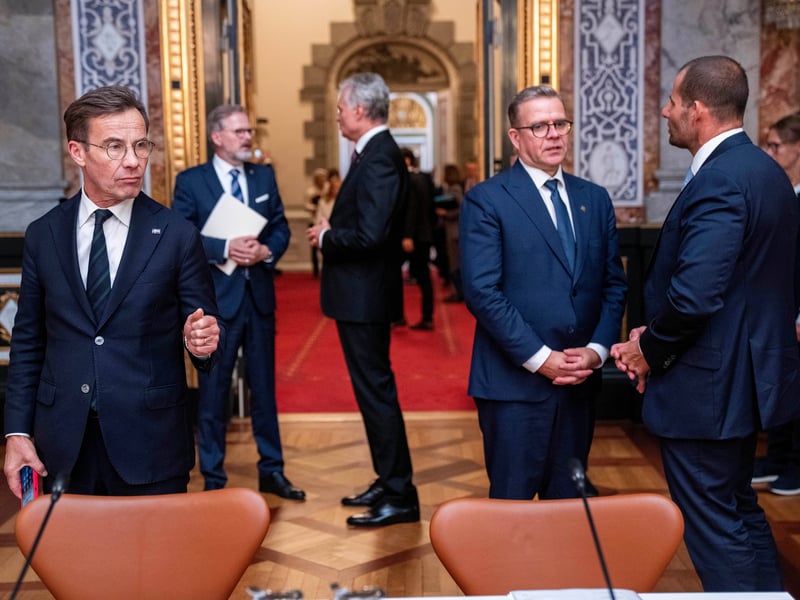
(CN) — European Union leaders backed proposals Wednesday to reshape European defense cooperation through a “lead nation” model for military priorities, but deferred until late October the harder question of whether to use frozen Russian assets to bankroll Ukraine.
The 27 leaders, meeting for four hours in an informal summit in heavily secured Copenhagen, agreed on a European “drone wall” and other security projects while Hungarian Prime Minister Viktor Orbán remained isolated as the sole opponent of Ukraine’s EU membership path. Yet, the meeting produced no mechanism to overcome Budapest’s veto, no agreement on tapping frozen Russian assets and no new funding beyond a previously scheduled 4-billion-euro ($4.4 billion) disbursement to Ukraine announced earlier that day.
They backed establishing “capability coalitions” for defense priorities and “tech alliances” connecting innovators with military users. The approach reflects a workaround to a fundamental problem: Defense isn’t an EU competence under the bloc’s treaties, forcing Brussels to coordinate national efforts rather than command them directly.
European Council President António Costa proposed a “lead nation” model where individual countries take charge of specific defense sectors, potentially triggering competition among major powers like Germany, France, Italy and Poland over who controls which areas. The structure could reshape European defense cooperation while sidestepping legal constraints on EU authority.
In a significant institutional shift, defense ministers will gain more autonomous power in the council — a co-legislative body along the European Parliament — not just meeting more frequently but making decisions between summits. European Commission President Ursula von der Leyen said they would track milestones and push work forward.
Still, leaders kicked the hardest questions to finance ministers meeting Oct. 10 and a formal summit three weeks away, leaving unresolved the central issue of sustaining military support for Kyiv.
“Ukraine is today Europe’s security guarantee,” Danish Prime Minister Mette Frederiksen said. “Our support to Ukraine is a direct investment in our own security.” That support remains caught between ambitious rhetoric and uncertain financing.
Von der Leyen proposed Wednesday a 140-billion-euro “reparations loan” backed by 300 billion euros in frozen Russian assets, with Ukraine repaying only if Russia pays war damages. “We are not confiscating the assets, but we are taking the cash balances for loan to Ukraine,” she said. Ukraine must repay “if Russia pays reparations because the perpetrator has to be held accountable.”
Hungary, Slovakia and Belgium oppose the plan — forcing the EU executive to argue it can proceed with majority approval rather than unanimity. Council lawyers told deputy finance ministers Tuesday that legal obstacles could be overcome, though the workaround has never been tested and would likely face court challenges. The EU has never successfully bypassed a member state veto on sanctions decisions.
Security concerns escalated across the region as the summit convened. Poland closed its airspace early Sunday, responding to Russian attacks on Ukraine, while Copenhagen experienced drone sightings the government calls a “hybrid attack.” Danish officials have not publicly attributed the incidents to Russia, though the Russian embassy denies involvement, calling them “a staged provocation.”
A German frigate sat docked in Copenhagen’s port, while Sweden deployed military anti-drone units to the Danish capital.
EU foreign policy chief Kaja Kallas, citing NATO Secretary General Mark Rutte, called the hybrid attacks “state-sponsored terrorism.” Von der Leyen said: “Russia tries to test us, but Russia also tries to sow division and anxiety in our societies.”
Orbán offered blunt advice on drone threats: “Shoot them down. That’s all.”
Orbán isolated as economic warnings mount
The other 26 leaders backed Ukraine’s accession process, with Costa noting “we all, except one,” support moving forward. Hungary retains veto power over membership negotiations.
Upon arrival at the summit, Orbán dismissed Ukraine as “not a sovereign country” that would “disappear as a state” without EU support. “No membership at all. That’s our position,” he said.
The summit also exposed broader European economic anxieties. Hours before leaders met, European business executives gathering at a Copenhagen industry event pledged to boost investments 50% by 2030 — potentially closing an 800-billion-euro annual gap.
The catch: They demanded Brussels slash regulations they say are driving companies overseas. The complaints about overregulation came as leaders proposed spending Ukrainian loan money on European weapons — effectively using the crisis to subsidize their own defense industries.
Polish Prime Minister Donald Tusk warned the world’s biggest steel producer told him Europe is no longer competitive due to high energy costs and overregulation, with the United States, Canada and Brazil now “radically more attractive.” “In the next few, not years but months, it will be too late,” Tusk said.
French President Emmanuel Macron called Europe “the unique crazy place where we don’t protect our domestic players,” noting that “in the U.S., you have a U.S. agenda. In China, it’s no more Chinese preference; it’s a Chinese exclusivity sometimes.”
The economic debate exposed tensions over how aggressively to roll back EU regulations. Tusk prefers the term “deregulation” over “simplification,” while Merz emphasizes limiting what he calls excessive Brussels rule-making. The semantic disagreement reflects deeper divisions over whether to maintain environmental and labor protections while pursuing competitiveness.
Geographic divisions over defense priorities
The commission put forward four defense projects — a drone wall to counter unmanned aircraft, an “Eastern Flank Watch” to spot hybrid threats and incursions, an air defense shield and a space monitoring system. All four need unanimous approval for EU funding — meaning Hungary could starve them of money even if leaders back the ideas.
Brussels didn’t say how much any of this would cost, suggesting only that a 1.5-billion-euro defense fund still being negotiated might cover part of the bill.
The flagship drone wall concept — an integrated detection and interception system along the EU’s eastern border drawing on Ukrainian expertise — immediately exposed a three-way split. Baltic frontline states embraced it, major powers dismissed it as oversimplified, and southern countries complained they’re being ignored.
Frederiksen offered her own reality check, warning that “no matter what kind of capabilities we are able to buy, to innovate, to build up, there will still be drones coming into Europe.” She said technology changes so rapidly “we cannot have one idea and believe that that will solve all our problems,” emphasizing instead building a broader European defense ecosystem learning from Ukraine.
Leaders failed to approve a 19th sanctions package introduced late September targeting Russian banks and energy firms, plus companies in China, the United Arab Emirates, Kyrgyzstan and Tajikistan that help Moscow evade restrictions.
Russia has weathered 18 previous rounds of sanctions while continuing military operations, and Western officials have repeatedly predicted economic pressures that have yet to force a change in Moscow’s strategy.
The EU has committed more than 100 billion euros in aid to Ukraine since Russia’s February 2022 invasion. Von der Leyen argued pressure on Russia is working, noting Russian forces captured just 1% of occupied Ukrainian territory over 1,000 days despite 250,000 casualties, with interest rates at 17% and inflation above 10%.
Leaders reconvene Thursday for the European Political Community summit, which includes non-EU European nations.
Courthouse News correspondent Yuval Molina is based in Brussels.
Subscribe to our free newsletters
Our weekly newsletter Closing Arguments offers the latest about ongoing trials, major litigation and rulings in courthouses around the U.S. and the world, while the monthly Under the Lights dishes the legal dirt from Hollywood, sports, Big Tech and the arts.