Search Articles


(CN) — Faced with threats from President Donald Trump, the European Union took a big step Wednesday toward allowing the U.S. to slap a 15% tariff on most EU products while letting American industrial products enter the EU tariff-free.
After late-night talks, the European Parliament and the European Council approved a contentious deal the bloc’s chief executive reached with Trump last July to avert a trade war.
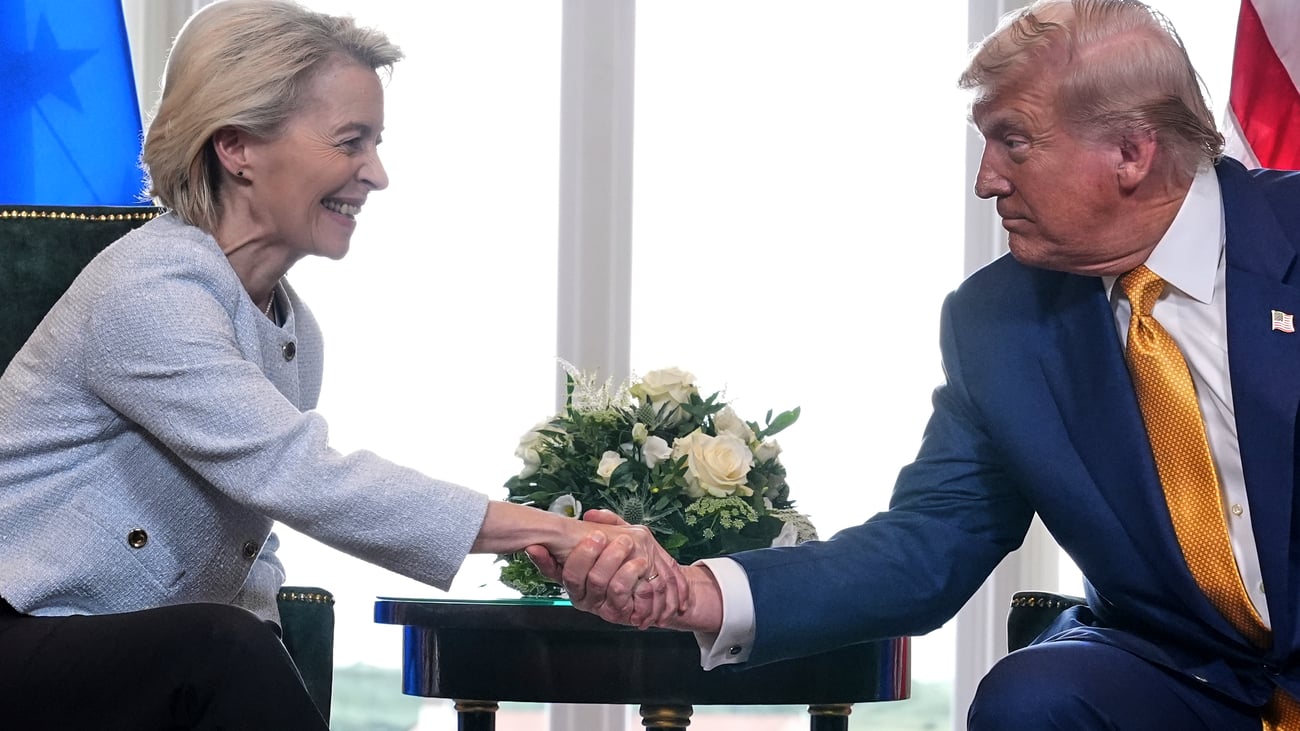
In what was seen as a humiliation for Europe, European Commission President Ursula von der Leyen flew to Scotland and shook hands with Trump at Turnberry, a golf course the president owns. At the time, Trump was destabilizing world affairs after imposing his so-called “Liberation Day” tariffs on most of the world.
Besides American industrial goods, the deal exempts some American agricultural and seafood from tariffs or reduces duties on them.
On Wednesday, EU lawmakers amended the agreement to make it more palatable for Europeans but potentially harder for the American side to swallow.
They included a suspension clause and demanded steel and aluminum come under the 15% flat tariff, down from the current 25% duty. Also, the EU included measures to prevent a flood of cheap American products.
The new suspension clause allows the EU to freeze the deal if Trump breaches the agreement, for example by imposing higher tariffs. EU lawmakers also set Dec. 31, 2029, as an end date for the deal, unless renewed.
The deal still must be ratified by both sides. A final deal, if one can be reached, could come by July.
Ian Hernandez, an analyst at the European Policy Center, a Brussels think tank, said he expected the agreement would get over the line despite American objections to the latest changes.
“On the U.S. side, there have been some clear complaints regarding new measures that were not part of what was agreed in Scotland,” Hernandez said in an email.
Still, he said U.S. trade officials appeared inclined to accept amendments as long they remained “limited in scope.”
“Since the sunset clause has effectively been extended beyond the end of the Trump administration, the key political signal for the U.S. side is that the commitment remains valid throughout Trump’s term,” he said.
Overall, though, he said the EU would come out on the losing side of the deal because it was “making significantly greater concessions.”
“It is indeed arguably one of the worst deals the EU has signed,” Hernandez said. “It risks institutionalizing a logic of subordination between the EU and the U.S.”
He also worried the deal made a “mockery” of World Trade Organization rules, thus undermining the EU’s reputation as a “champion of rules-based trade.”
He added the latest changes to the text did not make it much better.
For example, he called it a mistake for the EU to not include language allowing the bloc to break off the agreement if Trump attempts to lay claim to Greenland, a Danish territory he has repeatedly threatened to occupy. Lawmakers debated including such a clause in the deal, but decided against it.
“There is a risk that, even in situations where coercive pressure, economic brinkmanship, or territorial signaling is evident, the commission may be reluctant to act promptly to alter the deal, for fear of ‘poking the bear,’” he said.
By Wednesday afternoon, there was no official reaction from Washington. Meanwhile, factions in the European Parliament that backed the deal said they wanted to ease tensions with the U.S. and provide businesses with certainty.
“The agreement brings greater certainty for European businesses, helping protect investments, and economic stability,” the center-right European People’s Party, the largest faction in the European Parliament, said in a statement. “Europe cannot afford a trade conflict with its most important strategic and economic partner.”
The center-left Socialists and Democrats, the second-largest faction in the Brussels parliament, echoed that position.
“Turnberry was never the deal we wanted,” the group said in a statement. “It is unbalanced and based on an illegal tariff policy in which President Trump disregards both U.S. and international trade rules. But a trade war between the EU and the United States serves no one.”
The Left, the far-left group in parliament, called the deal “an act of political surrender to the blackmail tactics” of Trump and it blasted von der Leyen for “poor negotiating.”
At about $1.7 trillion, the EU-U.S. trade relationship is the largest in the world, but Trump has long complained it is lopsided due to the EU’s huge surplus in goods it exports to the U.S.
In 2024, the EU had a goods surplus worth about $235.6 billion, according to data from the U.S. Census Bureau. However, when services are taken into account, the trade deficit shrinks substantially. The deficit fell slightly last year to about $218 billion due to Trump’s tariffs and an economic slowdown on both sides of the Atlantic.
Under the deal, most EU imports — including automobiles, semiconductors, and pharmaceuticals — would be hit with a 15% tariff. Goods considered strategic, such as aircraft parts, critical raw materials, semiconductor equipment and certain chemicals, would not face duties.
Under the agreement, the EU also committed to purchasing $750 billion worth of American energy products over three years and spending $600 billion on American military equipment.
Courthouse News reporter Cain Burdeau is based in the European Union.
 Follow @cainburdeau
Subscribe to our free newsletters
Our weekly newsletter Closing Arguments offers the latest about ongoing trials, major litigation and rulings in courthouses around the U.S. and the world, while the monthly Under the Lights dishes the legal dirt from Hollywood, sports, Big Tech and the arts.