
 Search Articles


BRUSSELS (CN) — European Union regulators opened an investigation Thursday into whether Meta violated antitrust rules by locking rival AI companies out of WhatsApp while letting its own AI assistant run freely on the platform.
The European Commission — the EU’s executive body — is zeroing in on changes Meta rolled out in October that stop AI providers from using a key WhatsApp business feature when artificial intelligence is their bread and butter. The feature, called WhatsApp Business Solution, lets companies send messages to customers through the app.
The restrictions hit AI newcomers to the platform immediately and kick in Jan. 15, 2026, for companies already there. Meta still lets businesses use AI for behind-the-scenes stuff like automated customer support.
What’s got Brussels worried is that outside AI companies are getting boxed out of reaching WhatsApp’s massive user base, while Meta’s own AI service doesn’t face the same hurdles. Companies like OpenAI and Perplexity had launched their AI assistants on WhatsApp to tap into the platform’s more than 3 billion users worldwide, but would now be blocked under Meta’s updated terms.
WhatsApp immediately pushed back hard on the commission’s concerns. “The claims are baseless,” a spokesperson told Courthouse News Service. “The emergence of AI chatbots on our Business API puts a strain on our systems that they were not designed to support.”
The spokesperson added that competition remains intense in the AI sector, with users able to access services through app stores, search engines, email, partnership integrations and operating systems. Meta has a history of challenging EU enforcement actions and is currently appealing other antitrust decisions.
OpenAI and Perplexity didn’t immediately respond to requests for comment from Courthouse News Service.
If violations are confirmed, Meta could face fines of up to 10% of its global annual revenue under EU antitrust rules — which would amount to roughly $16.5 billion based on the company’s 2024 revenue of $164.5 billion. Brussels could also order Meta to change its business practices or impose structural remedies like breaking up parts of its operations.
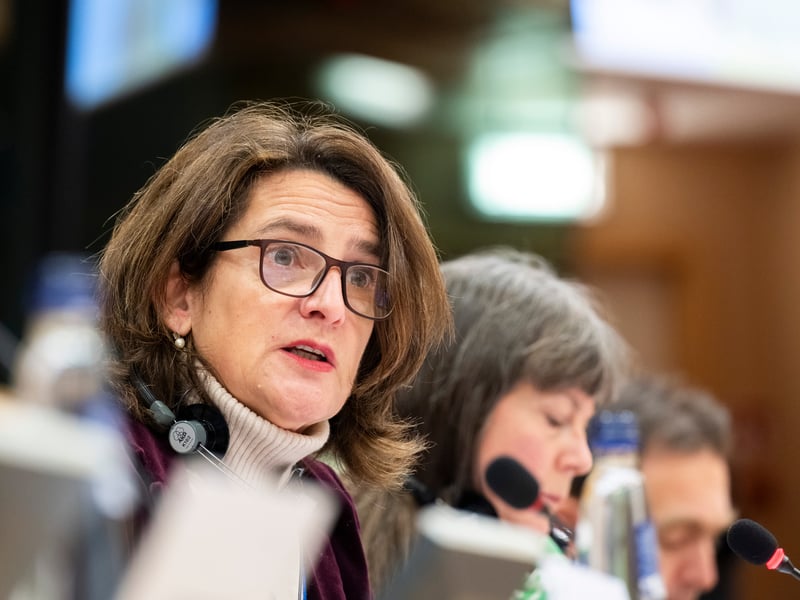
“We must ensure European citizens and businesses can benefit fully from this technological revolution and act to prevent dominant digital incumbents from abusing their power to crowd out innovative competitors,” Teresa Ribera, Brussels’ top competition official, said in a statement.
Ribera said investigators need to figure out whether Meta’s restrictions violate competition law and whether regulators should move fast to stop any long-term damage to AI markets, which she said are exploding across Europe and beyond.
The investigation comes as Meta has grown increasingly vocal about what it sees as regulatory overreach in Europe. In August, the company published a lengthy critique arguing that EU data rules are handicapping European businesses and stifling innovation in business messaging, claiming companies outside the bloc have access to far more sophisticated tools for reaching customers.
Speaking to European Parliament lawmakers Thursday, Ribera struck a defiant tone on enforcement. “We cannot accept anyone telling us how we need to rule or how we need to enforce,” she said, adding that enforcement decisions aren’t tied to trade discussions.
Ribera’s comments came just minutes after the investigation leaked to media outlets. She expressed surprise during the Parliament hearing that U.S. news organizations knew about the decision before the commission had formally signed off on it.
Her comments come amid mounting pressure from Washington over EU enforcement actions against U.S. tech giants. The commission is separately reviewing Google’s proposal to fix antitrust violations in its advertising technology business through behavioral changes rather than a breakup, after hitting the company with a 2.95-billion-euro fine in early September. Ribera has indicated she’s willing to impose structural remedies if companies’ proposed solutions fall short.
Broader enforcement push
The WhatsApp investigation adds to mounting regulatory pressure on Meta in Europe. The company faces potential fines of up to $9.9 billion under the EU’s Digital Services Act after Brussels claimed in October that Meta blocked researchers from studying content children see on Facebook and Instagram. Meta is also under investigation over its “pay or consent” advertising model, which offers users a paid ad-free version of its platforms.
Consumer advocacy groups have also raised concerns about the WhatsApp AI integration. “The EU’s decision to probe whether Meta is foreclosing competition by preventing rival chatbots from being used in WhatsApp is a positive step forward,” said Sébastien Pant, senior officer at the European Consumer Organization. The group has flagged concerns about Meta bundling its AI with WhatsApp, the lack of consumer choice and Meta using data to train AI models without proper consent, Pant told Courthouse News in an email exchange.
The probe covers all European Economic Area countries — the 27 EU member states plus Iceland, Liechtenstein and Norway — except Italy, where competition authorities are already pursuing their own case against Meta. Italian regulators opened their investigation back in July after Meta started embedding its AI assistant directly into WhatsApp in March. They expanded the case in November to include the business API restrictions.
Between the launch of Italy’s initial investigation in July and its expansion in November, Meta ramped up its AI integration into WhatsApp. The company added an “Ask” button to WhatsApp’s search bar and inserted an “Ask Meta AI” option when users forward messages, making its assistant more prominent across the app’s features.
Italy’s competition watchdog is now pushing for emergency measures to freeze Meta’s new terms and stop the company from promoting Meta AI even more aggressively across WhatsApp. Their worry: If rival AI services get locked out while the technology is still taking off, users will become so hooked on Meta AI that they won’t bother switching later — even if better options come along.
Italian authorities estimate the EU’s generative AI market at about $4.4 billion last year, jumping to $7.3 billion this year and projected to hit $11.7 billion by 2026. With WhatsApp reaching some 37 million users in Italy alone, regulators argue that shutting out competitors now could permanently warp how AI competition develops across Europe.
These kinds of antitrust investigations don’t have set deadlines — they can drag on depending on how complicated the case gets and how much companies cooperate. Just opening an investigation doesn’t mean officials have already made up their minds about what happened.
Facebook acquired WhatsApp for $19 billion in 2014, making it one of the largest tech acquisitions in history at the time. The messaging app had about 450 million users when Facebook bought it, promising to keep it operating independently. Today WhatsApp has grown to more than 3 billion users.
Courthouse News correspondent Yuval Molina is based in Brussels, Belgium.
Subscribe to our free newsletters
Our weekly newsletter Closing Arguments offers the latest about ongoing trials, major litigation and rulings in courthouses around the U.S. and the world, while the monthly Under the Lights dishes the legal dirt from Hollywood, sports, Big Tech and the arts.