Search Articles


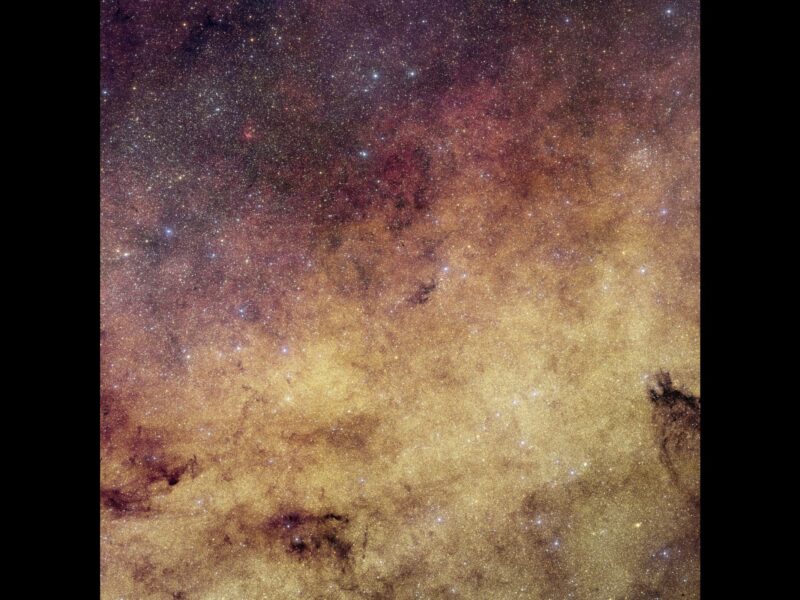
(CN) — The European Space Agency released the biggest and most detailed photo ever taken of the center of our galaxy on Wednesday.
The photo, which includes more than 60 million stars, nebulae and star clusters, was shot by the European Space Agency’s Euclid space telescope on March 23, 2025, over the course of 26 hours.
The telescope, which became operational in 2023, is designed to observe billions of galaxies through its visible light camera, which allows it to tell apart individual stars in extremely bright and crowded areas, such as the center of the galaxy, also known as the galactic bulge.
This ability to identify individual stars in extremely bright environments makes the telescope perfect for taking a photo of the galaxy’s center so astronomers can study the stars and the planets that inhabit their orbits, the European Space Agency said in a press release.
This crowded region of the galaxy is the perfect place for astronomers to search for new planets through the technique of microlensing, a technique used by astronomers to gather data about different planets and their potential habitability. But the technique requires an observation point and more than one star.
“To catch microlensing, you need to observe parts of the sky that are crowded with stars, such as close to the center of our galaxy,” said Jean-Philippe Beaulieu of the Institut d’Astrophysique de Paris and the University of Tasmania in Australia, said in the release. “During the last 20 years, almost 300 exoplanets have been discovered using this technique, all with ground-based telescopes and all towards the center of our galaxy. This image from Euclid includes 51 known planetary systems — and it will assist in studying many more that will be found.”
Essentially, the telescope observes two stars as a nearer star passes in front of a more distant star. But because space-time bends around these massive objects, the light from the farther star curves as it travels through the warped space-time around the nearer star. The reaction produces a natural magnification effect from the more distant star. But even planets can produce the effect on a much smaller scale.
Although Euclid’s 26-hour observation is not long enough to detect a microlensing event, its latest photo allows scientists to instead measure the mass of planets that are already known, as well as the planets that are yet to be discovered.
The photo is described as a mosaic of nine “pointings” aimed at different sections of the galactic center. This mosaic encompasses the entire region that NASA’s upcoming Roman space telescope will monitor for microlensing events when it goes online in August.
“This means that anyone who detects a microlensing event in the same region, for example with Roman, will be able from now on to use Euclid data as a time reference in the past and see how the stars looked before they overlapped,” said Natalia Rektsini, also of the Institut d’Astrophysique de Paris, who led the release of Euclid’s galactic center survey data for the scientific community. “Since Euclid can clearly separate individual stars, one can then measure how fast they move over time and use that information to confirm the existence of a planet and determine its mass. This would not be possible with data from one point in time.”
Although most planet-hunting techniques rely on detecting hot planets orbiting massive stars, microlensing allows astronomers to detect whatever is out there.
“This technique is unbiased, we discover whatever is out there,” Rektsini said. “It is uniquely suited to discover cold exoplanets. And we expect every star in the Milky Way to host at least one such planet.”
Among Euclid’s data so far are two stars with cold exoplanets. Beaulieu led the discovery of one of the planets 20 years ago, he said.
“It’s an icy planet, a bit like Hoth from Star Wars,” he said. “After all this time, I’m excited that Euclid might finally allow us to measure its precise mass.”
The other planet belongs to a fascinating system, Rektsini said.
“It consists of two stars and one planet,” she added. “By combining earlier observations from Keck and Hubble with new Euclid data, we can finally separate the stars and confirm the planet’s mass.”
The results show what a small, dedicated team can achieve in a large international mission, Euclid Project Scientist Valeria Pettorino said.
“In just 24 hours, Euclid has delivered unique data on the Milky Way’s center, with a large and sharp view of this region,” she said. “With time, the separation between sources and lenses increases. That’s why this Euclid data will be a time reference for past and future missions and enable studies of exoplanets and their masses. This data can also be used for other scientific applications, from brown dwarfs and binary stars to stellar motions and dust across our galaxy.”
Subscribe to our free newsletters
Our weekly newsletter Closing Arguments offers the latest about ongoing trials, major litigation and rulings in courthouses around the U.S. and the world, while the monthly Under the Lights dishes the legal dirt from Hollywood, sports, Big Tech and the arts.
Additional Reads
 Whale calls reveal cultural evolution June 23, 2026