
 Search Articles


BRUSSELS (CN) — EU foreign ministers agreed Monday to strengthen the bloc’s naval mission in the Red Sea but stopped short of extending it to the Strait of Hormuz, rebuffing pressure from Washington to take a more active role in securing the chokepoint at the center of the Iran war’s economic fallout.
President Donald Trump had ratcheted up the pressure over the weekend, telling reporters on Air Force One that his administration has asked seven countries to pitch in — naming France, the U.K., China, Japan and South Korea among those he hoped would contribute.
Failure to respond would be “very bad for the future of NATO,” he said Sunday. On Truth Social, he was more blunt: “Whether we get support or not, I can say this, and I said it to them: we will remember.”
The answer from Brussels was a qualified no. The talks laid bare a bloc at odds with itself: France has already sailed a carrier strike group into the Mediterranean with an escort mission in mind, while Germany and Spain want nothing to do with it. And no one has yet told Washington yes.
“There was a clear wish to strengthen this operation, but for the time being there was no appetite in changing the mandate,” EU foreign policy chief Kaja Kallas told reporters after the meeting, referring to Operation Aspides, the bloc’s existing naval mission. “Nobody wants to go actively into this war.”
Europe is not alone in its hesitation. Japanese Prime Minister Sanae Takaichi said Monday there were no plans to dispatch naval vessels to the region, and Australia’s transport minister said Canberra would not be sending ships either.
“Iran is now waging war on global economy,” Kallas said, noting that 20% of the world’s oil and gas passes through the strait, along with critical fertilizer shipments. “If we don’t have fertilizers now, this year, we will have a famine next year.”
The vehicle everyone is arguing about is Operation Aspides. The EU launched it in early 2024 after Houthi drone and missile attacks on Red Sea shipping caused container traffic to collapse by roughly 90%, forcing vessels onto longer routes around Africa.
It’s defensive-only — it can shoot down incoming threats but can’t strike targets. And it operates nowhere near the Strait of Hormuz. Moving it there would mean a new mandate, more ships and a unanimous vote from all 27 member states.
Kallas arrived at the meeting with two tracks in mind. On the diplomatic side, she said she’d spent the weekend on the phone with U.N. Secretary General António Guterres, floating the idea of a Black Sea Grain Initiative-style deal — the arrangement that briefly got Ukrainian grain moving during the war with Russia — to unblock the strait.
The urgency, she said, is real. “The closure of the Strait of Hormuz is really dangerous for the oil supplies, energy supplies to Asia,” Kallas told reporters on arrival, noting that 85% of the oil and gas transiting the strait is bound for Asian markets. And it’s not just energy: block the fertilizers long enough, she warned, and Africa is looking at food shortages next year.
On the military track, Kallas indicated Aspides remained the most practical instrument. “It would be easiest to already use the operation that we have in the region, and maybe change a bit,” she said. She also referenced the French-led coalition of the willing as a complementary option, saying the two tracks “could go hand in hand.”
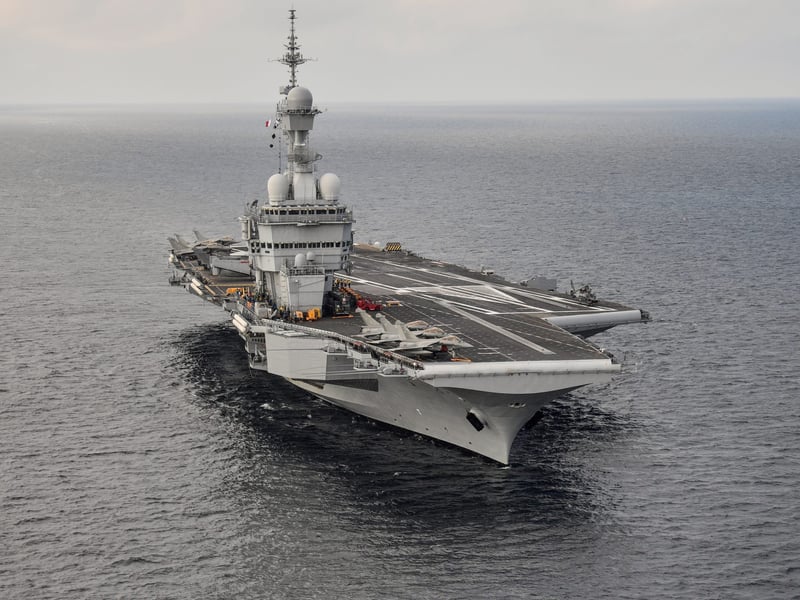
France isn’t waiting around. The Charles de Gaulle carrier strike group is already in the eastern Mediterranean, flanked by Spanish and Dutch frigates, with eight more French warships and two amphibious helicopter carriers spread across the region. Paris has form here — it’s led Operation Agenor, a nine-country European maritime monitoring mission in the strait, since 2020.
Speaking in Cyprus on March 9, Macron called it a “purely defensive, purely escort mission.” But France wants the worst of the fighting to stop first.
Germany’s response was a firm pump of the brakes. Foreign Minister Johann Wadephul flew into Brussels fresh off a tour of Mediterranean and Gulf countries, and said nothing had changed since Sunday, when he called expanding Aspides to the Hormuz “ineffective” and questioned whether it would improve security at all.
Berlin wants answers before it commits to anything. “We want to know from Israel and the U.S. when they want to achieve their military goals in Iran,” he said — a question he’d put directly to Israeli Foreign Minister Gideon Saar and U.S. Secretary of State Marco Rubio.
Spain’s Foreign Minister José Manuel Albares was more categorical, ruling out any mandate change and any new mission, full stop. “Spain is in the de-escalation,” he said. “The purely military solution never brings democracy, nor stability, nor economic prosperity.”
Madrid has been one of the most vocal European critics of the U.S.-Israeli campaign. Spain refused to let Washington use the jointly operated Rota and Morón bases in southern Spain for the operation — drawing a furious response from Trump, who threatened to cut off all trade with Madrid.
“Spain has been terrible,” Trump told reporters at the White House.
The economic stakes are acute. Brent crude was trading around $102 a barrel Monday morning, up roughly $30 over the past year.
U.S. Energy Secretary Chris Wright said Sunday the war would likely last “a few more weeks” but argued the short-term disruption was worth it, adding that U.S. consumers would not feel the oil price spike as acutely as those in other countries.
Adding to the unease in European capitals, the White House posted March 12 that “when oil prices go up, we make a lot of money.”
His administration also temporarily lifted sanctions on Russian oil the same day — a move European officials see as a gift to Moscow at exactly the wrong moment. “If we want this war to end, Moscow must have less money for the war, not more,” Kallas said Monday.
On the margins, the EU added 16 people and three entities to itsIran human rights blacklist— IRGC commanders, judges who prosecuted protesters, and a firm that built a surveillance app for law enforcement — over the January crackdown that left thousands dead. The bloc’s Iran sanctions list now covers 263 individuals and 53 entities.
Ministers were not expected to reach a formal decision on Aspides’ mandate at Monday’s meeting. EU heads of state and government are set to meet Thursday at the European Council, where the Iran crisis and its security implications are expected to dominate.
Courthouse News correspondent Yuval Molina is based in Brussels, Belgium.
Subscribe to our free newsletters
Our weekly newsletter Closing Arguments offers the latest about ongoing trials, major litigation and rulings in courthouses around the U.S. and the world, while the monthly Under the Lights dishes the legal dirt from Hollywood, sports, Big Tech and the arts.