
 Search Articles


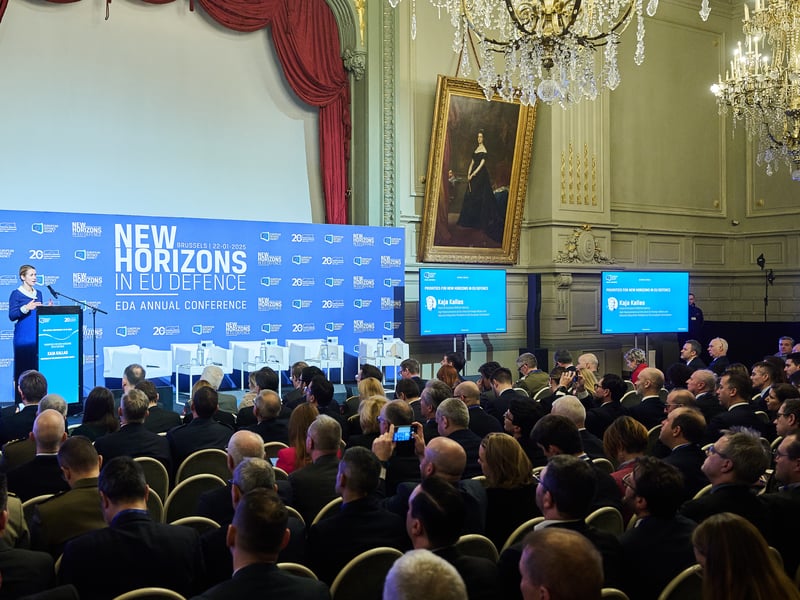
BRUSSELS (CN) — As Donald Trump returned to the White House, European leaders and top military brass look to step up their defense game.
European defense officials over the past weeks have increasingly said that there is a clear sense among European countries and institutions about what needs to be done to step up their defense preparedness.
They, however, also admit that a lack of clear leadership from key European member states on financing options and mapping out what capabilities are needed has so far stalled efforts.
The United States must remain Europe’s “strongest ally,” EU’s top diplomat Kaja Kallas told an annual European defense conference on Wednesday.
“[US] President Trump is right to say that we don’t spend enough — it’s time to invest,” she said, speaking to Europe’s defense top brass.
Europe should “shoulder a fair share of responsibility” for its security, she told a room full of top military brass and defense industry leaders.
Her comments came after Trump earlier this month said NATO members should increase their defense spending to 5% GDP up from the alliance’s 2% GDP target.
NATO Secretary-General Mark Rutte said he expected Trump’s return to “turbo-charge defense spending and production.”
But European defense officials repeatedly pointed out it would be an amount not even the United States spends, and national budgets would not be able to handle the increase.
The closest country to reach such a target, Poland, aims to reach 4.7% GDP on defense this year, an increase from 4.12% GDP in 2024. Others remain far behind, though twenty-three out of thirty-two NATO allies reached the 2% target last year.
‘Big Bang’ for European defense
All options on Europe’s future defense policy are supposed to be on the table when EU leaders meet for an informal retreat at the Château de Limont, in the Belgian countryside an hour out from Brussels, on February 3 to discuss how to organize the bloc’s new defense push.
“Europe needs to assume greater responsibility for its own defense,” European Council President António Costa wrote in an invitation letter to EU heads of state and government earlier this month.
EU27 member states will be joined by NATO Secretary-General Mark Rutte and Britain’s Prime Minister Keir Starmer to discuss cooperation with partner countries.
“I believe we share a similar assessment of the threats Europe is facing,” Costa said, namely that Russia’s war on Ukraine spelt the return of a “high-intensity war” to the continent, mixed with a surge in hybrid attacks against European countries.
However, divisions remain on how to finance the future EU defense spending bonanza.
A white paper on the future of European defense, which had been expected to be unveiled within 100 days of the European Commission taking office, is being delayed and unlikely to be presented before the German elections in late February.
The draft plan is expected to outline what European armies need to be prepared for the eventuality of war.
This would also include plans for how countries can jointly procure more equipment to ensure longer-term certainty for the bloc’s industry, as well as explore long-term funding options.
An EU leaders’ summit later in June would then discuss the proposals, which will have to be ultimately approved by all EU member states.
Buying American vs. Buying European
NATO’s Deputy Secretary-General Radmila Šekerinska on Wednesday called for strengthening the partnership between NATO and the EU to avoid duplication of efforts between the two organizations.
“At this dangerous time for our security, stepping up our cooperation is essential,” she told the same defense conference, adding that EU defense is of “great importance to NATO, because it is inextricably linked to transatlantic security.”
The EU and NATO in recent years, despite the latter fears that efforts to bolster the EU’s role in defense could undermine the US-led military alliance, have been seeking to ramp up cooperation, especially in the wake of Russia’s invasion of Ukraine.
Šekerinska also stressed the need to remove hurdles for non-EU allies’ defense industries to participate in future capability development.
“Non-EU Allied industry contributes essential technological know-how and industrial capacity for urgently needed defense capabilities, their fullest possible involvement is essential for our security in Europe and across the Euro-Atlantic,” Šekerinska said.
The topic for long had been a point of contention, as primarily French-led efforts had pushed for a ‘buy European’-clause in many of the continent’s capability development projects.
French President Emmanual Macron on Monday told his country’s top military brass that European taxpayer money should be invested in homegrown weapons to boost the bloc’s own industry, not only “buy more American material.”
Divisions remain between European countries that differ between the preference to buy from European weapons manufacturers over American ones,
But some capitals say there is a growing understanding that it could be part of an offer to Trump, namely to increase deals to acquire strategic US military equipment and maintain openness in the European Defence Industry Programme (EDIP) eligibility criteria for American companies.
Kallas said to counter any potential threats the EU does not require a single European army but rather 27 capable militaries.
“We need to consolidate our defense industry and develop common weapons systems,” Kallas said.
“Our European defense industry could then utilize the same military systems and help member states’ militaries become more interoperable (…) the EU should also work towards establishing a single market for defense.”
At the same time, European Defence and Space Commissioner Andrius Kubilius said European countries should increase their weapons stockpiles faster, with the EU ready to incentivize the joint procurement of larger military equipment orders.
“We can no longer afford the fragmented approach. We need a real ‘big bang’ approach to increase defense production and acquisition,” Kubilius told the same defense conference in Brussels.
Subscribe to our free newsletters
Our weekly newsletter Closing Arguments offers the latest about ongoing trials, major litigation and rulings in courthouses around the U.S. and the world, while the monthly Under the Lights dishes the legal dirt from Hollywood, sports, Big Tech and the arts.