
 Search Articles


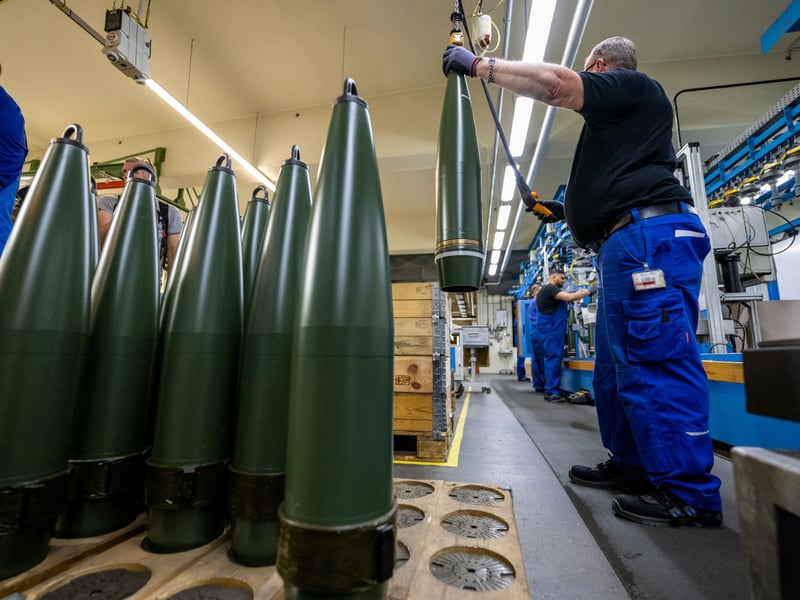
BRUSSELS (CN) — Europe has given itself five years to prepare for war with Russia, and the details reveal a twist: After years of Donald Trump demanding Europe spend more on weapons, they’re finally doing it — but they’re not buying American.
The European Union unveiled its implementation roadmap Thursday for an 800 billion-euro ($860 billion) defense plan announced earlier this year.
The plan pushes for 55% of all military purchases to come from European factories by 2030, with joint procurement targets reaching 40% by 2027. American defense contractors, who’ve dominated European military sales for decades, will largely be shut out of the biggest spending surge since the Cold War.
“Those that develop their own technologies will be the strongest and least dependent,” European Commission Executive Vice President Henna Virkkunen said Thursday, announcing the roadmap.
The scale of Europe’s pivot is unprecedented: Defense budgets have nearly doubled in four years, from 218 billion euros in 2021 to a projected 392 billion euros in 2025. The next budget cycle will multiply defense and space funding by five, military mobility funding by 10.
“A militarized Russia poses a persistent threat to European security for the foreseeable future,” officials wrote in the roadmap. Russia’s declared defense budget will surpass 7% of GDP in 2025, with 40% of its total budget dedicated to security and defense.
Target 2030
“Russia has no capacity to launch an attack on the European Union today, but it could prepare itself in the years to come,” EU foreign policy chief Kaja Kallas said Thursday. “Danger will not disappear, even if the war in Ukraine will end.”
Recent incidents underscore the tension. Russian drones have violated Belgian, German, Danish and Norwegian airspace in recent weeks. Russian fighter jets loitered in Estonian airspace, forcing NATO to scramble interceptors.
At the plan’s center are four priority programs. A European Drone Defense Initiative will create a system to counter unmanned aerial vehicles, with initial capacity by the end of 2026 and full functionality by the end of 2027. “Having drone defenses is no longer optional for anyone,” Kallas said.
An Eastern Flank Watch will fortify Europe’s borders with Russia through ground defense, air defense and border management systems, functional by the end of 2028. The ground defenses range from anti-tank trenches and concrete “dragon’s teeth” obstacles to plans to recreate swamps and marshlands along the border to bog down enemy tanks, according to EU Defense Commissioner Andrius Kubilius.
A European air and space shield will launch by mid-2026, connecting fragmented national air defenses and protecting satellites from potential Russian attacks.
The spending surge deliberately excludes American defense contractors from most opportunities. The plan’s SAFE loans of 150 billion euros have been fully subscribed by 19 member states, with requirements favoring European manufacturers. American firms are largely locked out unless Washington negotiates agreements with Brussels, which hasn’t happened.
The U.S. lock-out
By 2030, the plan requires that 55% of all weapons purchases come from European or Ukrainian manufacturers. Germany’s new military procurement plan shows 154 major defense purchases planned through 2026, with only 8% going to U.S. suppliers — a dramatic shift from recent years when Berlin was one of Washington’s biggest defense buyers.
The irony is hard to miss. Trump spent years pressuring NATO allies to spend more on defense, and they’re finally moving toward his target — NATO leaders agreed in June to raise spending to 5% of GDP by 2035. But instead of enriching U.S. contractors, the money will build European industrial capacity.
European officials frame this as operational necessity. European weapons come without restrictions on use, Kallas said, pointing to Ukraine’s experience. “Your military needs to really have free hands.”
The concern reflects genuine European anxiety about depending on America. Some European governments have discussed worries that the Pentagon could remotely disable American F-35 fighters or impose restrictions on how U.S. weapons can be used — claims U.S. officials deny.
Trump’s threats to abandon NATO allies reinforced fears that U.S. military protection comes with conditions that can change with each presidential administration.
The numbers are already accelerating. European defense budgets hit 343 billion euros in 2024, up 19% in a single year and 37% since 2021. Defense investments surged 42% to 106 billion euros, with procurement alone topping 88 billion euros.
Between 2020 and 2024, European NATO members more than doubled their weapons imports, with the United States supplying 64% of the total. Now Europe wants to redirect that money to its own factories.
The capability gap
But Europe faces significant obstacles to achieving defense independence by 2030.
“It is still too difficult to move troops and military equipment across Europe,” officials acknowledge in the roadmap. The EU has identified over 500 “hotspot” bottlenecks in military mobility that need 100 billion euros to fix. Only half of member states can move military equipment across borders within five working days.
The technology gap remains substantial. Europe still depends heavily on American weapons systems, particularly advanced fighters. There’s no European equivalent to the F-35 stealth fighter until the late 2030s at earliest, and European countries have already ordered hundreds of them. European defense systems like the French-Italian SAMP/T air defense and various tank models exist but haven’t replaced the need for American equipment.
European manufacturers must also prove they can scale production to wartime levels while finding 600,000 skilled workers for the defense industry by 2030 — with 200,000 needed by 2026.
More fundamentally, Europe faces a critical vulnerability: China controls the raw materials modern weapons require. China recently imposed export restrictions on rare-earth materials essential for drone motors, missile guidance systems and other military equipment. China produces 90% of the world’s rare-earth magnets and supplies 98% of what Europe imports.
Beijing now requires foreign manufacturers to obtain Chinese government approval before using these materials — even in trace amounts.
The restrictions expose the central contradiction in Europe’s strategy. Europe is attempting to escape American dependency by building weapons that require Chinese materials, while China helps arm the Russian military those European weapons are meant to deter: 80% of imported components Russia uses to build weapons flow through China, according to EU estimates.
Currently, Europe has reached only 50% of NATO capability targets, the EU executive said Thursday.
Partnering with Ukraine on drones may be Europe’s best bet. Kyiv produced 1.6 million small attack drones last year, creating a battlefield laboratory where European manufacturers can test systems against Russian electronic warfare.
Fighter jets require 20 years to develop. Drones take months.
U.S. Defense Secretary Pete Hegseth arrived in Brussels Wednesday, pressing allies to funnel roughly $1 billion per month through a NATO initiative that buys American weapons for Ukraine.
Several countries, including France, have declined to participate.
“We need to deter aggression, prevent war, preserve peace,” Kubilius said Thursday. By his calculation, joint procurement alone could save European taxpayers 200 billion euros through 2035. “We are spending only around 40% in Europe and we want to increase this up to 55%.”
The stakes are clear. If Europe succeeds, it will have built a defense industry independent of both superpowers, capable of deterring Russian aggression without American support. If it fails, European taxpayers will have spent hundreds of billions on inferior weapons while still depending on American F-35s and Chinese rare earths — and Russia will have five years to watch Europe’s industrial mobilization and plan accordingly.
The timeline is compressed: EU leaders meet next week to review the roadmap. Member states must launch their capability coalitions by Dec. 1. The next five years will determine whether Europe can achieve “full defense readiness” or whether the continent’s security still depends on a U.S. whose commitment remains uncertain.
Courthouse News correspondent Yuval Molina is based in Brussels.
Subscribe to our free newsletters
Our weekly newsletter Closing Arguments offers the latest about ongoing trials, major litigation and rulings in courthouses around the U.S. and the world, while the monthly Under the Lights dishes the legal dirt from Hollywood, sports, Big Tech and the arts.