
 Search Articles


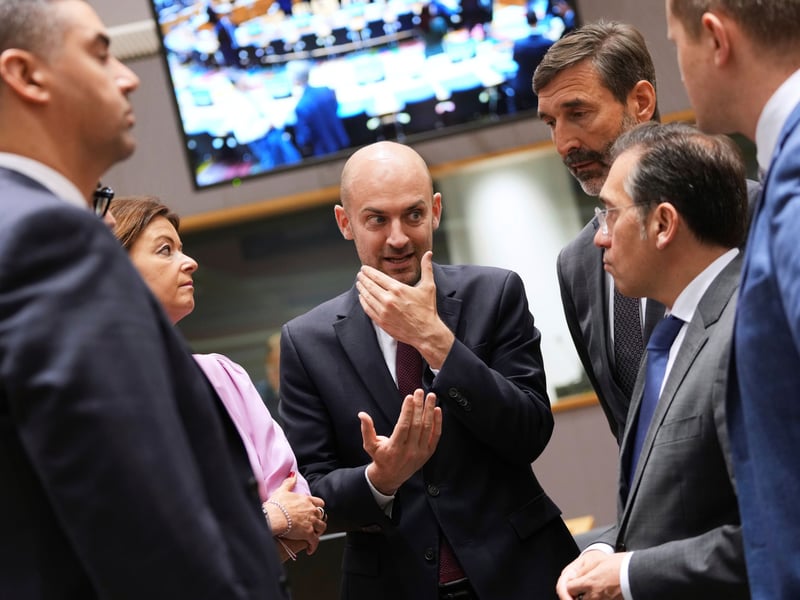
BRUSSELS (CN) — Foreign ministers from the European Union emerged from crisis talks Monday with their nuclear diplomacy with Iran in ruins after weekend U.S. airstrikes, while also acknowledging that Israel has breached human rights provisions of the EU-Israel Association Agreement.
After an EU Foreign Affairs ministers meeting on Monday, top EU diplomat Kaja Kallas called the escalating Iran conflict “a dangerous development” but offered little beyond familiar diplomatic language. Despite Iran’s rejection of European diplomacy, she insisted the bloc would persist with outreach efforts, detailing the scope of Friday’s Geneva discussions between EU leaders and Iran beyond nuclear issues.
“Iran was saying that they are willing to talk about these issues,” Kallas said, defending the EU’s diplomatic investment that also extended to “cyber and hybrid attacks that Iran is conducting against European countries, the detention of European citizens, and Iran’s support to Russia and their ballistic missile programs.”
“Today, there was a broad consensus among the European countries that we need to continue these discussions because diplomacy is the way to settle these things for long term,” she said, confirming communication channels remain open despite the weekend’s military escalation.
But Iran’s foreign minister declared European diplomacy dead in a scathing social media response.
“This week, we held talks with the E3/EU when the US decided to blow up that diplomacy,” Abbas Araghchi wrote Sunday on X, referring to the meeting, which included France, Germany and Britain as well as the EU’s chief of diplomacy. “What conclusion would you draw?”
He challenged EU leaders directly: “To Britain and the EU High Rep, it is Iran which must ‘return’ to the table. But how can Iran return to something it never left, let alone blew up?”
Earlier on Friday, a senior Iranian official reportedly called European proposals “unrealistic” but said Tehran was willing to review them.
The diplomatic collapse unfolded as Iran’s parliament approved closing the Strait of Hormuz — the vital oil shipping lane carrying a fifth of global crude supplies. Britain’s Foreign Secretary David Lammy warned on Monday this would be a “catastrophic mistake.”
U.S. President Donald Trump’s declaration that B-2 bombers had “totally obliterated” Iranian nuclear facilities at Fordo, Natanz and Isfahan left European officials scrambling to respond to military action they learned about only after the fact.
While Washington briefed Britain and France about its bombing plans, EU institutions were excluded because the bloc lacks military forces, said a spokesperson for the European Commission, the EU’s executive branch.
Prospects for renewed talks now appear remote with Araghchi’s meeting Monday with Russian President Vladimir Putin in Moscow while European leaders gather in Brussels.
Europe confirms Israel broke human rights rules
Legal experts also found Israel in breach of human rights provisions in its association agreement with the bloc, Kallas announced Monday. The European Commission last month launched a formal review of the EU-Israel Association Agreement, which entered into force in 2000 and includes 42.6 billion euros (about $49.2 billion) in annual trade, making the EU Israel’s largest trading partner.
The review, requested by 17 member states led by the Netherlands, assessed whether Israel still complies with the agreement’s Article 2, which requires ties be founded “on respect for human rights and democratic principles.”
The provision gives the EU one of its few concrete leverage points over Israeli policy, but so far the bloc has been reluctant to act on a unified front.
“The measures are there, but the concrete question is what then we are able to agree,” Kallas said in a news conference. Her emphasis on “humanitarian efforts” sidestepped questions about enforcement mechanisms, opening the window to further discussions on the topic in July.
Earlier on Monday, Spain escalated pressure, announcing it would push for immediate suspension of the association agreement despite likely opposition from Germany, the Czech Republic and Hungary.
Options being considered include imposing economic penalties such as removing trade preferences and cutting Israel’s participation in EU research programs. The full suspension of the partnership deal is unlikely, as all 27 EU members must agree and any single country can veto the decision.
Belgium and eight other EU countries separately asked the commission on Friday to assess at least halting trade with Israeli settlements in the occupied territories.
The twin crises exposed familiar European divisions over Middle East policy, as attention shifts dramatically from Gaza to Iran policy.
“Countries who criticized Israel three weeks ago over Gaza now back it over Iran,” one EU official said, pointing to Germany as an example.
German Chancellor Friedrich Merz defended the U.S. Iran strikes, telling the Federation of German Industries there was “no reason to criticize” American action. “Yes, it is not without risk. But leaving things as they were was not an option either,” he said.
Other Western European powers showed more caution on Iran while defending the strikes’ objectives. French Foreign Minister Jean-Noël Barrot told reporters in Brussels that “the Iranian nuclear program is an existential threat to Europe.” Earlier he said on X that France “didn’t participate either in the strikes or in their planning.”
French President Emmanuel Macron maintained direct diplomacy, holding another call with Iranian President Masoud Pezeshkian and demanding Iran renounce nuclear weapons, as per an X post.
Central and Eastern European allies offered more explicit backing for U.S. military intervention, with Czech Prime Minister Petr Fiala describing Trump’s Iran decision as an “understandable effort” to prevent nuclear weapons development.
A survey conducted by Brussels think tank European Council on Foreign Relations concluded on Monday that absolute majorities in France, Germany, Italy, Portugal and Spain now consider the U.S. political system broken.
Only 12% of British respondents believe Trump’s election benefits their country. In Denmark, which Trump has targeted over Greenland claims, 86% see the U.S. system as broken. While mainstream voters have turned sharply negative, the report found supporters of European far-right parties now hold predominantly positive views of the U.S. political system under Trump across 12 countries.
Crisis week ahead
Monday’s emergency Foreign Affairs Council — preceded by an informal breakfast with International Atomic Energy Agency Director General Rafael Mariano Grossi — kicks off a week testing European unity across multiple Middle East challenges.
The week continues with EU-Canada talks late Monday, followed by Trump’s delayed attendance at the NATO summit Tuesday and Wednesday. Trump postponed his departure to meet with national security advisers about the Iran crisis.
Thursday and Friday’s EU Council summit will also focus heavily on Iran and Israel policy, as well as looming trade tensions ahead of a July 9 deadline for potential U.S. tariffs and defense financing arrangements.
Oil markets reflected the uncertainty, with U.S. crude down 0.4% to $73.56 per barrel and Brent crude edging down 0.2% to $76.82 by Monday morning. Prices remain elevated from pre-conflict levels around $68 per barrel as markets weigh Iranian threats. Pentagon officials said strikes caused “severe damage” to Iranian facilities.
Despite tensions, EU officials say they must adapt.
“We’re not burying our heads in the sand, it is working with the reality that we have,” an EU Council official said.
The crisis underscores Europe’s struggle for strategic autonomy in a world where military power increasingly trumps diplomatic preferences. Many mainstream European leaders are repositioning themselves as defenders of European sovereignty against American influence — a reversal from traditional Atlanticist positions reflecting their frustration with being sidelined in major security decisions.
Subscribe to our free newsletters
Our weekly newsletter Closing Arguments offers the latest about ongoing trials, major litigation and rulings in courthouses around the U.S. and the world, while the monthly Under the Lights dishes the legal dirt from Hollywood, sports, Big Tech and the arts.