
 Search Articles


PHILADELPHIA (CN) — A Pennsylvania man told a Third Circuit Court of Appeals panel on Wednesday that his Second Amendment rights had been trampled when he was statutorily banned from having a gun following felony convictions for drug trafficking.
Stephen Becker, an attorney for Joshua Reichenbach, 42, said his client had repaid his debt to society by serving his prison sentence.
“At the time Reichenbach possessed the firearm at issue, he was not serving any sentence, imprisonment, parole, supervised release or otherwise,” he said. He cited a separate case where the Third Circuit ruled it was unconstitutional to bar nonviolent felons from gun ownership.
In that case, Bryan Range — who had pleaded guilty to making a false statement to obtain food stamps in 1995 — had his Second Amendment right to bear arms restored since his crime was nonviolent. Notably, while the crime was punishable by up to five years in prison, Range didn’t serve any time.
But Assistant U.S. Department of Justice Attorney Patrick Bannon, arguing for the Department of Justice, said that, unlike Range, Reichenbach’s history includes an assault charge and disorderly conduct charge.
Reichenbach also holds five past felony drug convictions in Pennsylvania: four for planning to sell or deliver illegal drugs, and one for conspiracy to possess illegal drugs.
“We only had a year since he’s been released from prison before he went out and obtained a firearm illegally, and then, when he was confronted about it by police, tried to run away and throw the firearm off to the side before he was arrested,” Bannon pointed out.
According to court documents, federal and local investigators became aware in February 2022 via a photograph that Reichenbach was in possession of a firearm and had expressed threats to “stick someone up,” and said “I got the strap.”
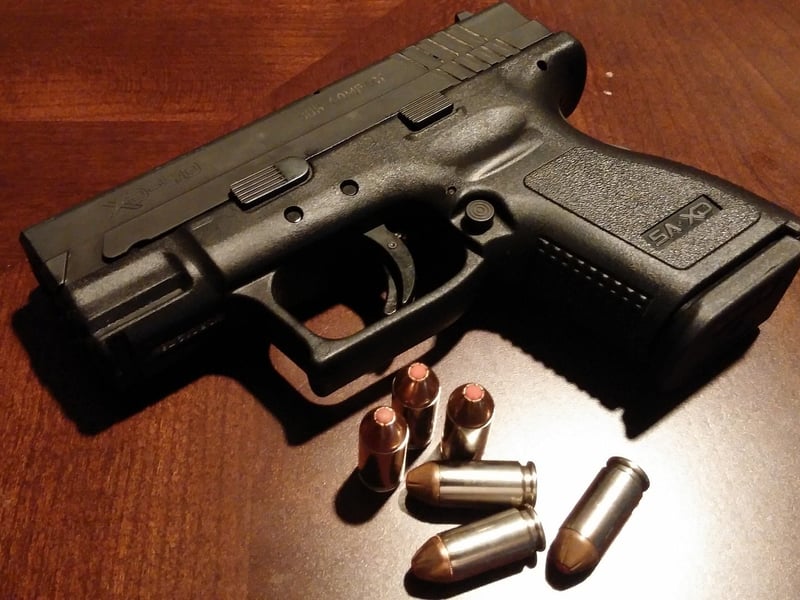
He was subsequently tracked down by authorities, who chased him. As he fled, a 9mm handgun flew from his possession, leading to his being charged with being a felon in possession of a firearm.
Bannon also noted Wednesday that hypodermic needles were found on Reichenbach after he was arrested.
“Drug trafficking, though potentially nonviolent, is dangerous because it leads to violence,” Bannon said, adding that there is a historic tradition of disarming dangerous individuals. Reichenbach is not a law-abiding, responsible citizen protected by the Second Amendment, the government argued.
But Reichenbach’s attorney maintained to the appeals court that drug dealing was not a violent offense.
“In Mr. Reichenbach’s case, all his drug cases were for relatively small amounts. He comes from a rural county, Northumberland County, in central Pennsylvania. There was no allegation ever of violence or threats or firearms and there was no suggestion that he was involved in anything other than dealing small amounts of illegal drugs,” Becker said.
U.S. Circuit Judge Peter Phipps noted that for Reichenbach had a much longer rap sheet than Range Wednesday.
“I don’t think it does get higher than his criminal history score,” the Donald Trump appointee said.
Nevertheless, the judge showed interest in the defendant’s argument.
“When a state incarcerates someone, they do so for many reasons, and some of those reasons include keeping the rest of society safe from that person. But then when they release that person, they’ve released them back into society,” the judge said. “It’s hard to say what the release of that person shows.”
He questioned whether the release of a person signaled they showed no violent threat to the public.
Becker then emphasized that the founding fathers would say that barring someone from the right to have a gun after releasing them from prison was clearly against the Second Amendment.
“They didn’t concern themselves with what would happen if somebody was released from prison. They didn’t have supervision,” he said.
U.S. Circuit Judge Cindy Chung, a Joe Biden appointee, meanwhile questioned if it would be safe to assume that the founders were “exercising their authority to the maximum constitutional boundaries” at the time.
Reichenbach has previously moved to dismiss the indictment against him for gun possession in Harrisburg Federal Court, arguing that the charge violated his Second Amendment right to bear arms. He was unsuccessful, and appealed his case to the Third Circuit in August 2024.
Possessing a firearm as a felon carries punishment of a maximum of 10 years in prison, a fine of $250,000 and a three-year term of supervised release.
U.S. Circuit Judge Jane Roth, a George H. W. Bush appointee, rounded out the panel Wednesday.
Subscribe to our free newsletters
Our weekly newsletter Closing Arguments offers the latest about ongoing trials, major litigation and rulings in courthouses around the U.S. and the world, while the monthly Under the Lights dishes the legal dirt from Hollywood, sports, Big Tech and the arts.