
 Search Articles


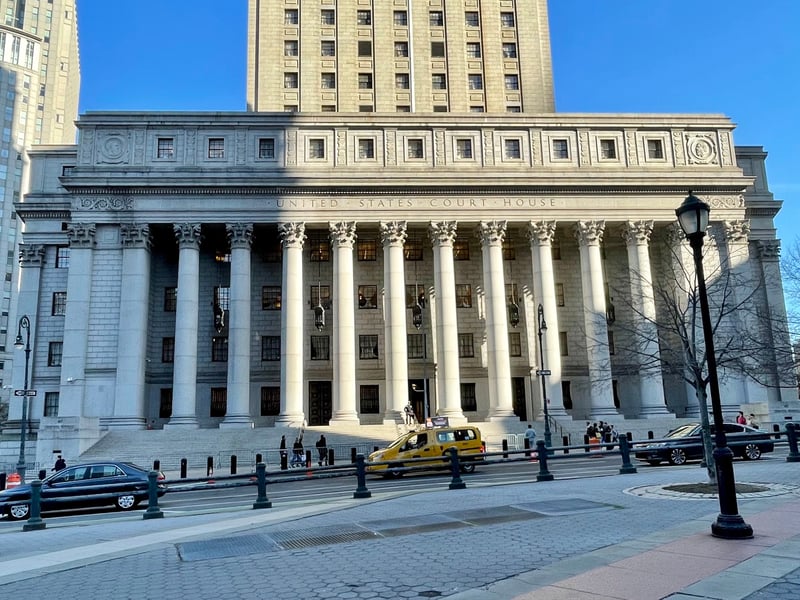
MANHATTAN (CN) — An embattled Obama White House education adviser challenged his federal wire fraud conviction on Tuesday, telling a panel of Second Circuit judges that the government’s case against him was based on “deeply flawed” legal theory.
Seth Andrew was arrested in 2021 on charges of wire fraud, money laundering and making false statements to a financial institution — all part of a scheme, prosecutors said, to steal froem Democracy Prep Public Schools, a series of public charter schools in New York City that Andrew founded in 2005.
Andrew worked in the White House as a senior adviser and in the U.S. Department of Education from 2014 to 2016. Three years after he left his federal position, he tried to rejoin Democracy Prep in his past leadership role, but the school system rejected him.
According to prosecutors, Andrew stole more than $218,000 in retaliation by moving funds from Democracy Prep Public Schools escrow accounts to which he still had access into other accounts. He pleaded guilty to a single count of wire fraud in 2022 and was sentenced to 366 days in prison.
Despite having served his time and been released, Andrew is appealing his conviction. He says he pleaded guilty to activities that weren’t crimes after all.
“My name is Seth Andrew. I served my yearlong sentence and remain on federal probation,” he began, representing himself pro se to the Second Circuit panel on Tuesday. “My actions cannot sustain a valid federal wire fraud conviction. I am here without counsel, but not without hope.”
Andrew claims federal prosecutors targeted him using the “right to control” theory of federal wire fraud. The theory allowed a defendant to be prosecuted for merely withholding funds from victims — until 2023, when the U.S. Supreme Court rejected it as unconstitutional.
On the heels of that ruling, Andrew says his case was “entirely built on an unconstitutional ‘right to control’ theory of wire fraud that fundamentally charged no offense.” He acknowledges that he admitted to what was alleged of him, but holds that such behavior was not criminal.
Almost immediately, he ran into skepticism on Tuesday from U.S. Circuit Judge Gerald Lynch, a Barack Obama appointee, who asserted, “That’s not what the control theory is about.”
“This seems to me more like you’re making an argument that if a pickpocket takes my wallet, he has deprived me of control of my assets,” Lynch said. “Well yeah, in a sense, but he deprived me of the assets themselves. I no longer have the wallet, and I no longer have the contents of the wallet. So why isn’t this just a straight-up theft of property?”
Andrew replied that there were no victims in his case, unlike in Lynch’s hypothetical.
“This is not a pickpocket,” he said. “This is a fiduciary obligation I had and I carried out under the guidance of the authorizer, the state of New York, the lawyers and the accountants. There was no intent.”
Assistant U.S. Attorney Prosecutor Ryan Finkel scoffed that the victim clearly was the charter school group.
“He didn’t just take money from one school,” Finkel said. “He took money from three different schools that were part of the Democracy Prep network. He made two different trips to a bank, multiple deposits, multiple transactions … so there was a victim.”
Andrew disagreed: “The lies continue.” He argued that Democracy Prep wasn’t an entity that could be considered a victim under the statute, and that he’d acted in good faith as an escrow agent.
If his appeal is successful, the government will likely be able to try Andrew again, since he pleaded guilty to the conduct in its complaint. Andrew said he’d likely take that risk, even after completing his time behind bars.
“I think a great injustice was done here,” Andrew said.
Joining Lynch on the panel were Joe Biden-appointed U.S. Circuit Judges Beth Robinson and Sarah Merriam. The trio of judges didn’t immediately issue a ruling.
 Follow @Uebey
 Follow @uebey.bsky.social
Subscribe to our free newsletters
Our weekly newsletter Closing Arguments offers the latest about ongoing trials, major litigation and rulings in courthouses around the U.S. and the world, while the monthly Under the Lights dishes the legal dirt from Hollywood, sports, Big Tech and the arts.