
 Search Articles


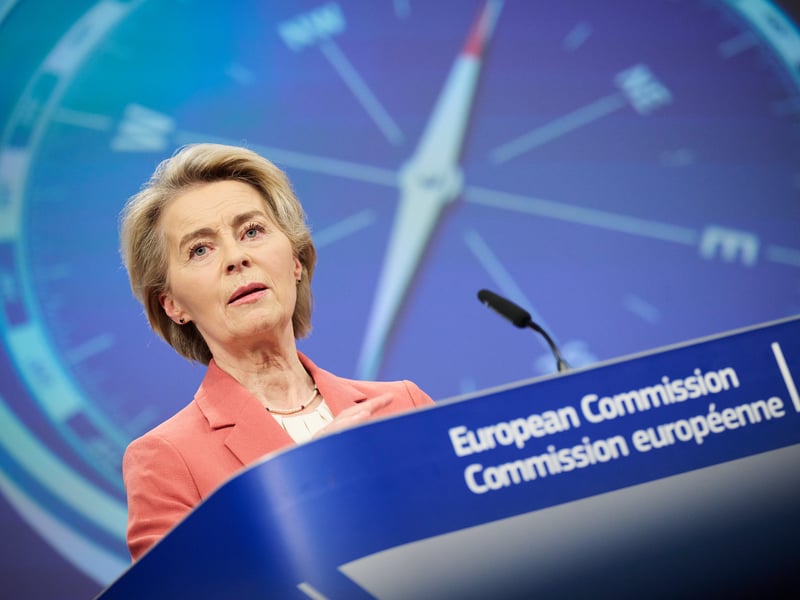
BRUSSELS (CN) — As Europe’s economy lags behind economic heavyweights like the United States and China, the European Commission on Wednesday presented a blueprint on how the bloc can “reignite” its economy.
“We need to reignite Europe’s innovation engine,” European Commission President Ursula von der Leyen told reporters in Brussels, presenting the new plans that will include efforts to boost innovation, push on with decarbonization and secure energy supplies and trade flows.
The bloc’s new “Competitiveness Compass” is expected to be a change of tack away from overregulation toward a more business-friendly environment.
“Our business model has basically relied on cheap labor, from China presumably, cheap energy from Russia and partially outsourcing security and security investment,” von der Leyen said. “These days are gone.”
The blueprint builds on landmark reports by former Italian prime ministers Mario Draghiand Enrico Letta, who both warned Europe should create a new industrial strategy or risk falling behind global competitors. It comes amid U.S. President Donald Trump’s tariff threats and China’s uptick in key industrial and digital sectors.
But while it picks up on the prime ministers’ criticisms, the document cautions that none of them can be remedied overnight. One passage in the blueprint stresses that “boosting competitiveness is not a quick fix."
The general lack of funding available for new investment across the bloc is likely to present an obstacle for the plans.
‘Simplification shock’
A key part of the plan is to make life easier for European companies.
The European Commission’s previous emphasis on fighting climate change and ensuring business standards has left many firms complaining about excessive regulation mixed with rising energy costs and weak investments.
Commission Vice-President Stéphane Séjourné said a new “simplification shock without affecting environmental targets" was meant to level the playing field by cutting unnecessary red tape.
According to the plans, dozens of laws on environmental and human rights supply chain standards, reporting on corporate sustainability and chemical safety will be revised.
A new category of mid-sized companies will be introduced to cut back the regulatory burden for around 30,000 firms, according to the European Commission proposal.
The EU executive said it wants to introduce a European legal regime rather than 27 individual national ones that would allow innovative companies to benefit from a single, harmonized set of rules on insolvency, labor law and taxation.
At the same time, the bloc’s competition watchdog would also take into account the investment needs of technology companies when assessing future mergers. The idea is to reduce hurdles and leave room for European behemoths to emerge.
“Revised guidelines for assessing mergers” are expected to give more space for “innovation, resilience and the investment intensity of competition in certain strategic sectors.”
The commission is expected to publish further proposals late next month on cutting red tape.
Those are likely to include adjustments on three of the bloc’s policies: the EU’s sustainable finance reporting law, its due diligence rules, and its “taxonomy” defining which investments can be labelled climate-friendly. EU officials say the bloc’s carbon border tariff plans could also be included in the reform proposal.
Green Deal goals ‘remain’
Nevertheless, EU officials stress that the new push for deregulation would not mean the bloc would abandon meeting its ambitious carbon-reduction goals.
“I want to be very clear: the European Union stays on course for the Green Deal objectives without any question,” von der Leyen said.
While Brussels would need to adapt legislation for the clean energy transition of the bloc’s industries, it would not mean weakening targets to cut net greenhouse gas emissions by 55% by 2030 and zero them by 2050.
“We stay the course — those goals are cast in stone,” von der Leyen said.
A number of EU member states including Poland, Italy and the Czech Republic have called for a delay in the bloc’s green plans that include a 2035 phase-out of combustion engine cars and the EU’s carbon border tax.
“Targeted, simplified aid” will encourage industrial decarbonization across the bloc. In addition, unique labels would be created to help create demand for low-carbon products, such as “green” steel, or troubled sectors, such as the chemicals and automotive industries.
Séjourné said Brussels would aim to give preference towards greening the “top 100 CO2-emitting sites,” which account for more than half of Europe’s industrial emissions.
To reduce dependency on China and other third countries for rare earths and raw materials, Séjourné said the plans would envisage the exploitation of more mining sites inside the bloc.
The European Commission to date has received 170 mining exploitation or research projects, some of them domestically controversial because of environmental concerns.
The blueprint also calls for a new platform for the “joint purchase” of critical raw materials needed for European industries, as well as plans to develop international partnerships to secure supply chains in key sectors such as for green technologies like solar and wind tech, microchips and pharmaceutical components.
Environmental groups have warned that the push could go too far.
“Under the guise of ‘simplification,’ this initiative will dismantle essential safeguards for European citizens, the environment and the climate,” Friends of the Earth Europe’s Kim Claes said.
Positive reactions
The commission’s first major initiative to kickstart the bloc’s economy has widely met with approval from policymakers and industry groups.
Reacting to the blueprint, EU lawmaker Aurore Lalucq, chair of the European Parliament’s Economic and Monetary Affairs Committee, welcomed “the commission’s acknowledgement of the necessity to scale up both public and private financing to meet Europe’s investment needs.”
“Parliament will work carefully to make sure simplification does not mean rolling back some of the significant progress achieved during last term,” Lalucq added.
The new plans were “a clear signal that the EU is committed to strengthening Europe’s economy,” Markus Beyrer, director-general of the EU-wide lobby group BusinessEurope said.
More critical voices cautioned the investment push would still fall short of what is needed.
“The EU Competitiveness Compass, which emphasizes needed simplification measures, still falls short of clearly addressing the need for substantial investment in clean tech and cheaper energy solutions," Marcin Korolec, president at the Green Economy Institute, said.
“We cannot overlook the pivotal role of targeted investments in achieving energy affordability and longterm competitiveness against China and the U.S.,” Korolec said, adding a European competitiveness fund should benefit all of Europe, not just its largest economies, Germany and France.
At the same time, some pointed to the distinct European approach to the new plans.
“By making decarbonization a pillar of Europe’s competitive edge, the commission has chosen a smarter path than following the Trump administration’s retreat from net-zero policies,” Neil Makaroff, director of the Strategic Perspectives think tank, said.
“Consistency is key to capturing new markets and competing with China — ‘stop and go’ policies have never created jobs, attracted investment or driven innovation,” Makaroff said.
“With well-crafted policies — such as a ‘European preference’ for net-zero technologies, strategic funding and a strong focus on electrifying the economy — the EU can establish itself as a net-zero powerhouse, seizing the opportunity to attract disillusioned U.S. cleantech companies to Europe,” he added.
Subscribe to our free newsletters
Our weekly newsletter Closing Arguments offers the latest about ongoing trials, major litigation and rulings in courthouses around the U.S. and the world, while the monthly Under the Lights dishes the legal dirt from Hollywood, sports, Big Tech and the arts.