
 Search Articles


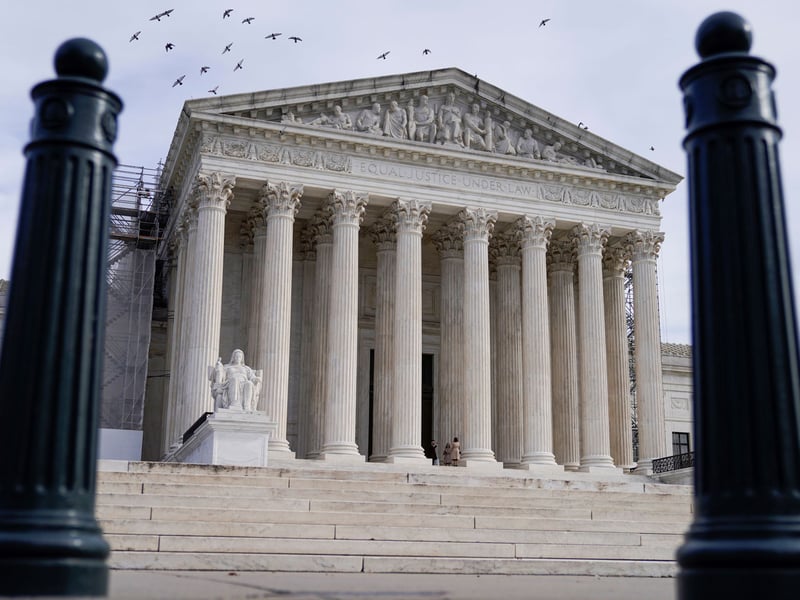
WASHINGTON (CN) — A Pennsylvania man from Trinidad and Tobago who faces deportation that would separate him from his American-born son can proceed with his federal court challenge, the Supreme Court ruled on Tuesday.
In a 6-3 decision, the justices ruled that Supreme Court precedent has established that a “primarily factual mixed question” is still a question of law and therefore reviewable by an appellate court.
The three liberal justices were joined by Justices Neil Gorsuch, Elena Kagan and Amy Coney Barrett in the majority, while Chief Justice John Roberts and Justices Samuel Alito and Clarence Thomas dissented.
Justice Sonia Sotomayor, a Barack Obama appointee, wrote the majority’s opinion. She said the immigration judge’s determination that deporting Situ Wilkinson would not cause his son excess hardship posed a “quintessential mixed question of law and fact.”
Wilkinson’s son has serious asthma, which requires frequent trips to the hospital. He lived with his mother in New Jersey while Wilkinson worked to support him.
Wilkinson claims an immigration judge erred in denying his deportation cancellation request. He fled to the U.S. in 2003 after police robbed, beat and threatened to kill him in his home in Trinidad and Tobago. Wilkinson entered the country using a tourist visa, but he never left.
As he established a life in Pennsylvania, Wilkinson’s son was born in 2013.
Wilkinson was arrested in 2019 while working on a house. Although he didn’t live on or own the property, he was charged for drugs officers found in the house. The charges eventually would be dropped.
Immigration officials took advantage of the defunct charges and detained Wilkinson when he appeared at the state courthouse. The Department of Homeland Security moved to deport him based on his overstayed visa. Wilkinson attempted to cancel the order, claiming it would cause his then-7-year-old son exceptional and extremely unusual hardship.
Since Wilkinson had lived in the U.S. for over 10 years, was found to have good moral character and had no criminal record, an immigration judge determined Wilkinson met three out of the four cancellation requirements. The judge, however, did not think the emotional and personal support Wilkinson provided met the standard so that removing the support would cause his son extreme hardship.
Wilkinson’s application was denied, and the Board of Immigration Appeals affirmed. Wilkinson attempted to move the case to federal court, but an appeals court determined it did not have jurisdiction to review his case.
Jamie Santos, an attorney with Goodwin Procter representing Wilkinson, argued that courts have the authority to review this type of agency decision.
The justices granted review of the case to settle a split on the issue between several U.S. circuit courts. Previously, three circuits held that hardship determinations are mixed questions of law and fact and therefore reviewable by an appeals court, while six circuits held otherwise.
Justice Samuel Alito, a George W. Bush appointee, noted his prior dissent in the similar Guerrero-Lasprilla v. Barr, which created the “question of law” standard, where he worried the court had permitted judicial review over all “criminal aliens’ challenges to their removal proceedings except the precious few that raise only pure questions of fact.”
“Whether ‘removal would result in exceptional and extremely unusual hardship’ to the ‘spouse, parent or child’ of the alien subject to removal is overwhelmingly a question of fact,” Alito wrote.
In a concurring opinion, Justice Ketanji Brown Jackson, a Joe Biden appointee, agreed in part with Alito. She expressed doubt that the “questions of law” standard set by Congress in the Immigration and National Act was intended to “sweep so broadly” as the majority’s opinion would do.
“When reviewing denials of discretionary relief, courts should respect the choice of Congress, reflecting the will of the people, to limit judicial interference,” Jackson wrote.
The high court’s decision will remand the case to the Third Circuit Court of Appeals to review Wilkinson’s request.
 Follow @Ryan_Knappy
Subscribe to our free newsletters
Our weekly newsletter Closing Arguments offers the latest about ongoing trials, major litigation and rulings in courthouses around the U.S. and the world, while the monthly Under the Lights dishes the legal dirt from Hollywood, sports, Big Tech and the arts.