
 Search Articles


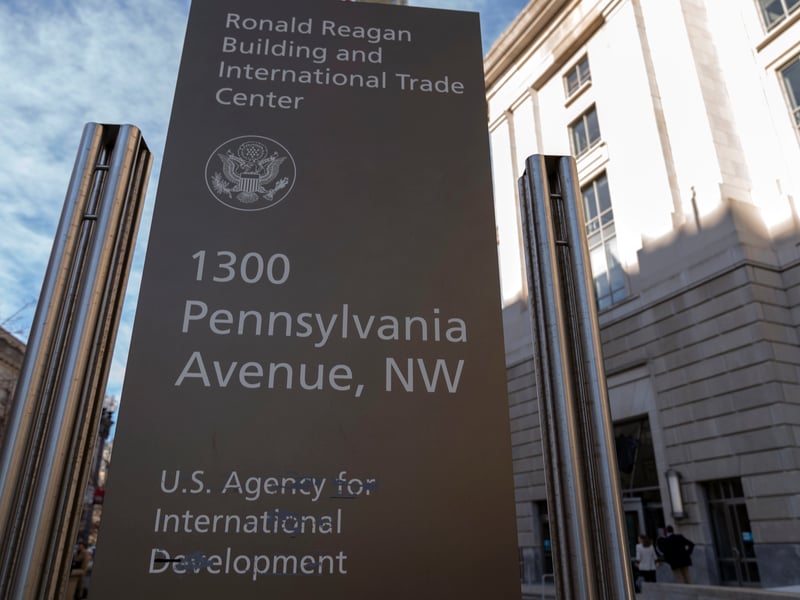
WASHINGTON (CN) — A federal judge on Friday denied a request by a union coalition of U.S. Agency for International Development employees to block the Trump administration’s effort to dismantle the humanitarian aid agency.
U.S. District Judge Carl Nichols, a Donald Trump appointee, wrote in the 26-page opinion that he could only rule on the union’s employment claims because USAID was “still standing.” Thus, any harm they would suffer from mass terminations could be address via monetary damages.
The unions claim the Trump administration’s 90-day foreign assistance pause and terminations at USAID would result in “catastrophic humanitarian consequences.” Further, the efforts would cause serious harm to the United States’ political and contractual relationships with allies and on-the-ground organizations, they say.
In its opposition, the government argued that a block of its handling of USAID would cause harms of their own, warning that the nation’s “foreign aid industry” was not aligned with America interests and antithetical to American values and to world peace.
“Weighing plaintiffs’ assertions on these questions against the government’s is like comparing apples to oranges,” Nichols wrote. “Where one side claims that USAID’s operations are essential to human flourishing and the other side claims they are presently at odds with it, it is simply not possible for the court to conclude, as a matter of law or equity, that the public interest favors or disfavors an injunction.”
However, Nichols said the unions’ constitutional and Administrative Procedure Act claims challenging USAID’s dismantling could find success in the long run, but for now he could only rule on the employment claims.
Nichols previously granted the union’s request to block a midnight deadline on Feb. 7 that would have resulted in 2,014 USAID employees being placed on administrative leave — joining 2,140 others already on leave. He granted another weeklong extension on Feb. 13.
Friday’s order opens the door for Deputy Administrator of USAID Peter Marocco to lay off those 2,014 USAID employees, leaving approximately 611 staff members the administration deemed essential.
Nichols was concerned that the sudden placements would result in serious risks for the over 1,400 USAID employees stationed overseas, losing access to vital security systems such as the SAFE Alert system, two-way radios and GPS-enabled panic buttons.
Since issuing the temporary restraining order, Marocco filed several declarations reassuring Nichols that any overseas employee placed on leave would retain access to security systems.
Marocco also addressed concerns that USAID employees overseas would be forced to leave their posts and return to the United States within 30 days from Feb. 4. Marocco clarified that USAID employees could choose whether to return and have their trips funded.
Those who decline could remain on paid leave and receive all their previous benefits, Marocco said. However, if they decided to return beyond the 30-day window, they would have to request an exception to receive agency-funded travel.
Nichols found the declarations satisfactory and noted that any resulting harms would be financial and could be redressed via damages, adding that the declarations had convinced him the unions’ “initial assertions of harm were overstated.”
The unions argued the Trump administration’s 90-day foreign assistance pause and “pencils down” stop-work orders would injure their members and damage their relationships with partner agencies.
Nichols was unconvinced, finding little proof that any agency would blame individual USAID employees to warrant any relief.
Friday’s decision comes as federal judges in Washington have grappled with requested emergency relief against the Trump administration’s broad efforts to reshape and realign the federal government with the president’s agenda and ideology.
A federal judge also declined to bar Trump’s mass terminations of probationary employees at the Treasury Department, the Food and Drug Administration, the Environmental Protection Agency, the National Park Service and others on Thursday.
U.S. District Judge Christopher Cooper, a Barack Obama appointee, ruled that the employment claims should be brought before the Federal Labor Relations Authority, rather than federal court.
In another lawsuit challenging billionaire Elon Musk and his so-called Department of Government Efficiency — the White House has asserted that Musk has no official role at DOGE but has not identified its administrator — U.S. District Judge Tanya Chutkan declined to enjoin DOGE because the harms alleged by 14 states were currently speculation.
 Follow @Ryan_Knappy
Subscribe to our free newsletters
Our weekly newsletter Closing Arguments offers the latest about ongoing trials, major litigation and rulings in courthouses around the U.S. and the world, while the monthly Under the Lights dishes the legal dirt from Hollywood, sports, Big Tech and the arts.