
 Search Articles


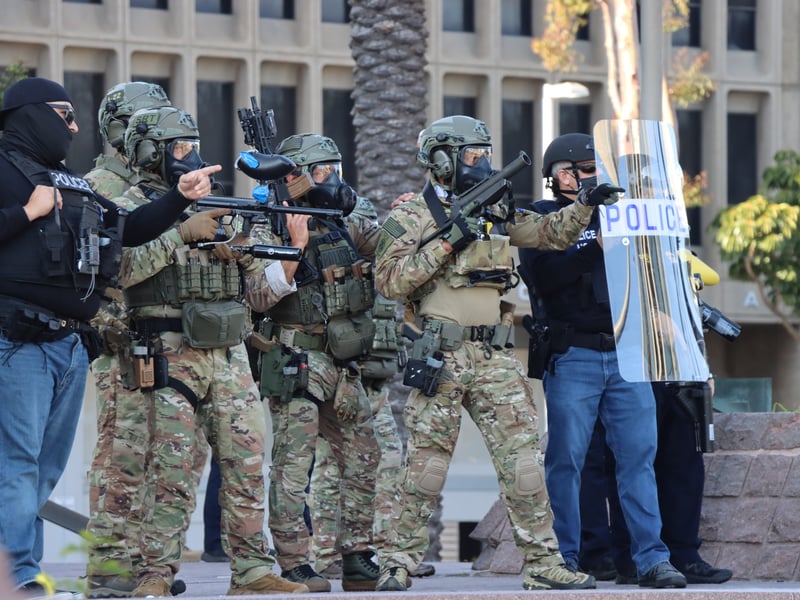
SAN FRANCISCO (CN) — The Department of Justice on Monday asked a Ninth Circuit panel to vacate a preliminary injunction barring federal law enforcement from using excessive and indiscriminate force against journalists covering protests in Southern California.
“This injunction is so overbroad and so unworkable in so many different ways that we submit that process is better left to the district court in the first instance and this injunction ought to be vacated,” Department of Justice attorney Michael Shih said. “The Supreme Court has traditionally not looked favorably on efforts to impose programmatic injunctions on law enforcement operators on the basis of individualized assertions of misconduct.”
In December, the three-judge panel denied the Department of Homeland Security’s request to stay the lower court’s injunction — issued in September by U.S. District Judge Hernán Vera in Los Angeles — while the government’s appeal is resolved. However, they trimmed the injunction so far as it applied to protesters in general who aren’t part of the journalists’ lawsuit.
At the Monday hearing, the judges echoed similar concerns, worried that the Joe Biden appointee’s preliminary injunction is at odds with the U.S. Supreme Court’s decision earlier this year in Trump v CASA Inc., which restricted any injunctive relief courts can provide only to the actual plaintiffs in a lawsuit.
“I think the district court’s factual findings are compelling, but as I’m sure you’ve gleaned from the argument on the stay motion, I think the panel may have serious concerns about the tailoring,” U.S. Circuit Judge Jacqueline Nguyen said.
Nguyen, a Barack Obama appointee, questioned the journalists on what the panel should consider given their overbreadth concerns, adding “sometimes it’s not possible to provide complete relief because the injunction goes too far.”
Matthew Borden, an attorney for the LA Press Club representing the plaintiffs, argued the injunction was, indeed, narrowly tailored to address the harm of the plaintiffs to attend protests “without fear that they’re going to suffer serious injuries.”
Borden also claimed that tailoring the relief to just the named plaintiffs would be difficult because law enforcement would not be able to distinguish between plaintiffs and non-plaintiffs.
“From the perspective of a protester, if you shoot the person next to me, that’s going to cause the same kind of chilling,” he said. “If our plaintiffs are not shot, it doesn’t mean that they’re safe if you have these sorts of indiscriminate acts of violence that the court found that [DHS] were engaging in over and over and over again.”
Attorney Adrienna Wong of the ACLU Foundation of Southern California emphasized that, unlike CASA, where the plaintiffs could be easily identified, there is no way for the government to identify the individual plaintiffs in a crowd of protesters.
“The district court specifically found that extending the injunction to cover other protesters, journalists and plaintiffs would render their relief more complete and was necessary to render their relief complete,” she said.
In response, Shih said questions of how to apply injunctive relief, given the difficulty of identifying plaintiffs, are not grounds for upholding the injunction. Instead, he argued the government should determine how to comply with the injunction.
Additionally, he said the injunction imposes unworkable restrictions on federal law enforcement officers, including requiring officers to give two separate warnings before using crowd control devices. He also said the injunction applies to “all interactions between DHS officers at any kind of protest activity,” including violent protests.
“Even in these circumstances, the restrictions in this injunction would apply. That’s far beyond providing complete relief to the other side,” he said. “Similarly, you don’t effectively ban the use of crowd control devices or the use of crowd dispersal orders in every single context.”
The appeals panel was rounded out by U.S. Circuit Judge Ronald Gould, a Bill Clinton appointee and U.S. Circuit Judge Mark Bennett, a Donald Trump appointee.
The DOJ did not immediately respond to a request for comment.
In a statement to Courthouse News, Borden said, “We think the argument went well and are hopeful that the district court’s critical protections for peaceful people exercising their First Amendment rights will remain in place.”
Protests erupted across LA County after U.S. Immigration and Customs Enforcement initiated unprecedented immigration enforcement raids in June, prompting President Donald Trump to deploy the National Guard in Los Angeles, supposedly to protect federal buildings.
The LA Press Club, the NewsGuild-Communications Workers of America and individual journalists, legal observers and protesters filed a trio of lawsuits against Homeland Security, the LA Police Department and the LA County Sheriff’s Department over the purported violence law enforcement directed against them during the protests.
“With tensions escalating, officers from the Federal Protective Services, Immigration and Customs Enforcement and U.S. Customs and Border Protection unleashed crowd control weapons indiscriminately and with surprising savagery,” Vera wrote in his decision to issue a preliminary injunction.
In downtown LA, the judge noted, journalists were repeatedly hit with pepper balls — plastic projectiles filled with a chemical irritant — while taking cover behind media trucks.
 Follow @mhattridge_
Subscribe to our free newsletters
Our weekly newsletter Closing Arguments offers the latest about ongoing trials, major litigation and rulings in courthouses around the U.S. and the world, while the monthly Under the Lights dishes the legal dirt from Hollywood, sports, Big Tech and the arts.