
 Search Articles


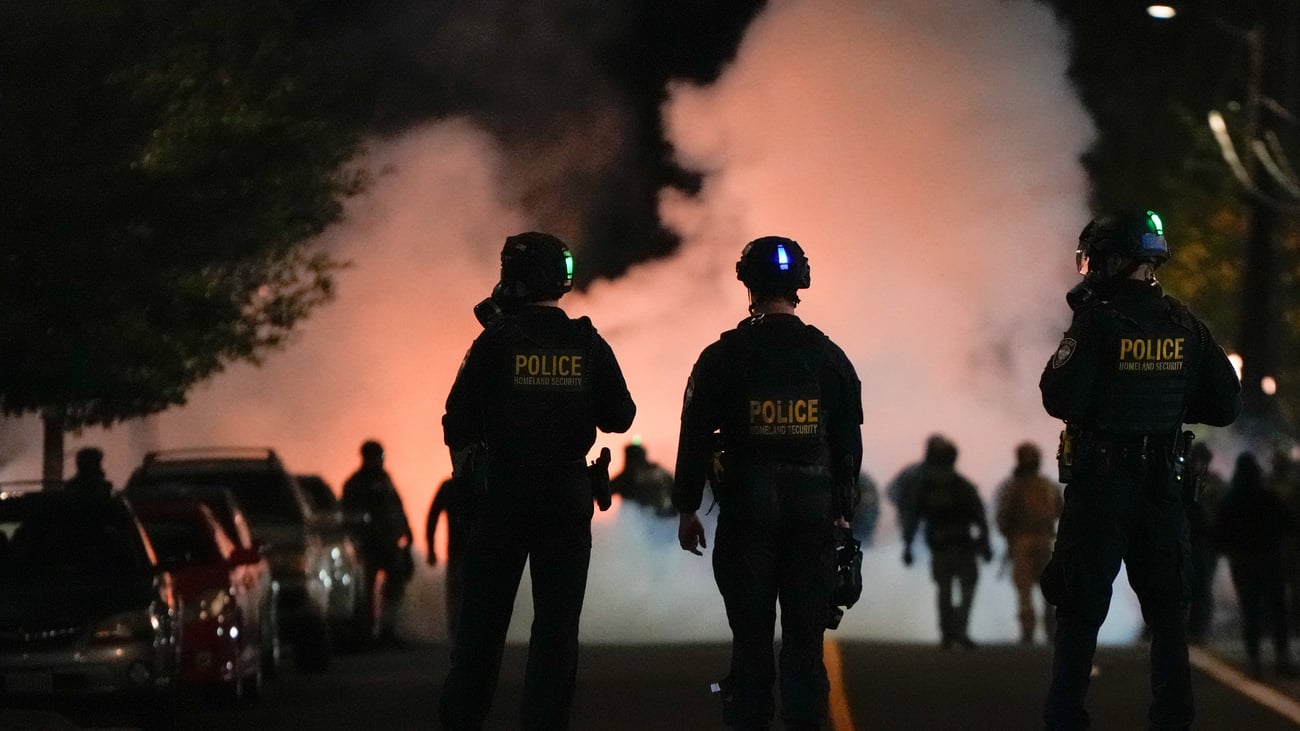
(CN) — The Trump administration to a Ninth Circuit panel Friday that federal agents should keep being free to use chemical munitions and tear gas outside a Portland U.S. Immigration and Customs Enforcement facility as they see fit.
“Plaintiffs are not likely to succeed on the merits of their Fifth Amendment substantive due process claim because their proposed fundamental right to be free from the incidental effects of airborne contaminants is not deeply rooted in this nation’s history and tradition,” Justice Department attorney Brenna Scully said in the government’s ask to continue a block on two court orders.
The two cases before the Trump-majority panel of Ninth Circuit judges both concern the use of tear gas.
A group of protesters and journalists sued Trump, the Department of Homeland Security and its former Secretary Kristi Noem late 2025, arguing federal officers deployed tear gas, pepper balls and other munitions outside of the ICE facility in retaliation for the exercise of First Amendment rights.
U.S. District Judge Michael Simon, a Barack Obama appointee, issued a temporary restraining order in early February blocking federal immigration officers from deploying chemical munitions or projectiles.
The residents of a low-income housing complex across the street from the ICE building also sued the federal government in 2025, accusing federal agents of intentionally and repeatedly deploying chemical munitions near the apartment complex, violating their right to bodily integrity by exposing them to toxic airborne substances.
Following an evidentiary hearing, U.S. District Judge Amy Baggio, a Joe Biden appointee, sided with the residents in early March and issued a preliminary injunction blocking federal agents from deploying crowd control devices in a way that would send the chemicals into the housing complex.
Three days later, Simon issued a preliminary injunction blocking agents from using chemical or projectile munitions unless they were legally justified in using deadly force against the target.
At the end of April, the Ninth Circuit issued twin rulings blocking the preliminary injunctions in both cases.
The federal government on Friday implored the court to continue those blocks.
In the apartment complex residents’ case, the federal government argued the lower court relied on a “new fundamental right” that had not previously been recognized and issued an injunction that was too broad.
The government argued the officers are tasked with balancing competing public safety interests and deploying tear gas as a crowd control measure doesn’t shock the conscience nor show they are acting with deliberate indifference to bystander safety.
“The district court made no findings that officers here, the government, acted with purpose to harm, and neither have plaintiffs really made that allegation,” Scully said.
U.S. Circuit Judge Ana de Alba, a Joe Biden appointee, questioned the government about why, if crowd conditions surrounding the ICE facility were so dangerous, did the federal agents escort conservative influencers to the scene.
“If the ICE agents were so concerned for their safety, why would they allow people to be on their side?” de Alba asked.
U.S. Circuit Judge Kenneth Lee, a Donald Trump appointee, questioned the government about the protesters’ contention that certain deployments of tear gas was used solely for social media purposes to portray a more dangerous situation.
Scully countered that the lower court had not made a finding on the social media accusation.
The residents argued the appeals court must consider whether the officers’ actions shock the conscience, and contended it does.
“The government has knowingly and repeatedly caused toxic chemicals to enter the bodies and homes of innocent people, causing them irreparable and life-altering harms,” attorney Stephen Wirth argued.
Lee pushed back on that, questioning if an abortion proponent could use the same reasoning to get around the Supreme Court’s holding of a lack of fundamental right to an abortion by arguing that it shocks the conscience for the government to force a woman to carry a child to term.
But the residents didn’t agree.
“They’re different approaches because the nature of the government conduct is so different,” Wirth argued. “Executive action, especially executive action by law enforcement, is simply a different type of governmental act from legislation.”
The residents argued the government agents had other crowd control tools available but deliberately chose to deploy “massive, massive quantities of tear gas right outside of a residential area.”
“They knew that these gases in particular were really harmful,” Wirth said.
“Should we be second-guessing what law enforcement does in that type of situation?” Lee asked.
The residents directed the panel to the evidence in the record showing multiple instances in which officers deployed tear gas in response to “zero threat whatsoever.”
As for the case brought by the protesters and journalists, the government argued the lower court’s injunction was far too broad.
“The district court applied the wrong legal framework to conclude that protected activity was a substantial or motivating factor for law enforcement’s response to chaotic protests outside the Portland ICE facility,” Justice Department attorney Douglas Dreier said.
De Alba again needled the government about the presence of escorted influencers.
“My big question is I’m having a hard time understanding this as a chaotic scene and you know, clear and present danger if you’re having people come take a look at it and videotape,” de Alba.
But the government argued it came down to a difference in opinion about how law enforcement should respond to trespassing, but that such a discussion is not relevant to decide the case.
“At the end of the day, this is a First Amendment retaliation case,” Dreier said. “We cannot live in a society where people are allowed to act unlawfully, where people are allowed to trespass on federal property.”
The protesters and journalists argued the lower court got it right, but Lee pushed back and noted the appeals court precedent showed law enforcement have more latitude when deciding when to use nonlethal force.
“If you want to clear the driveway, there is a way to do it without causing First Amendment harms to all the rest of the people who are not blocking the driveway,” argued Matt Borden, attorney representing the journalists and protesters.
U.S. Circuit Judge Eric Tung, a Trump appointee, noted there was evidence in the record of protesters genuinely threatening federal agents. Some reportedly threw bottles or other objects, another grabbed an officer in the groin.
Those protesters were arrested and the behavior wasn’t protected activity, Borden responded.
“It’s not appropriate to shoot an 84-year-old person under their walker. It’s not appropriate to shoot an 83-year-old person, neither of whom were on federal property,” Borden said. “These protests were not substantially infected with violence.”
The Ninth Circuit panel did not indicate when it would rule.
Subscribe to our free newsletters
Our weekly newsletter Closing Arguments offers the latest about ongoing trials, major litigation and rulings in courthouses around the U.S. and the world, while the monthly Under the Lights dishes the legal dirt from Hollywood, sports, Big Tech and the arts.
Additional Reads



 Keystone Pipeline operator will pay $26.8M+ July 10, 2026