
 Search Articles


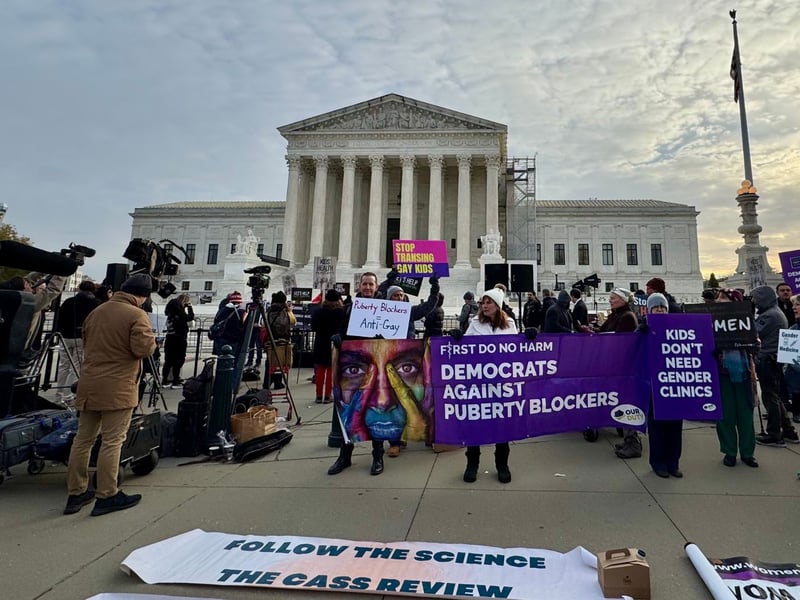
WASHINGTON (CN) — The push to put transgender rights before the Supreme Court was not subdued by the justices’ major ruling on gender-affirming health care for minors on Wednesday. Instead, the decision served as a preview of what cases might come to the high court steps next.
Alabama saw the ruling as an endorsement of other restrictions on transgender individuals, expressing optimism that prohibitions on transgender athletes in women’s sports, bathroom bills and other laws regulating transgender individuals will also survive legal challenges.
“Within the state of Alabama, there started to be a conversation about whether there is civil liability for providers who may have misled patients,” Katherine Green Robertson, chief counsel for the office of the Alabama Attorney General, told Courthouse News.
While disquieted by the loss and its profound impacts for transgender kids in over two dozen states that ban gender-affirming care, transgender advocates weren’t cowed by the decision, resolute on continuing their fight within the pathways left open by a potential divide among the conservative justices.
“We certainly decry that decision as just absolutely not in line with the court’s prior decisions, and obviously, it is that reasoning that is causing great harm to our clients and transgender young people across the country,” Chase Strangio, co-director of the ACLU’s LGBTQ & HIV Project, said in a briefing. “By the same token, I think it’s important to point out some of the ways that this opinion is much narrower than it could have been.”
Transgender minors, their families, and a doctor argued that Tennessee’s ban discriminated based on sex and transgender status. They relied on the equal protection clause of the Constitution and a 2020 ruling from the Supreme Court known as Bostock v. Clayton County , which held that an employer unlawfully discriminated against an employee for their transgender status.
The majority opinion avoided ruling on most of those key arguments, however. Chief Justice John Roberts, a George H.W. Bush appointee, rejected the notion that bans on transgender health care are based on sex, instead viewing the statute as a regulation based on age and a specific medical procedure.
This framing lets the court off the hook on Bostock as well.
“The Sixth Circuit had gone out of its way to limit Bostock’s reasoning to Title VII, which was inconsistent with the text of that opinion,” Strangio, who was the first openly transgender attorney to argue at the Supreme Court on behalf of those plaintiffs, said. “The court here does not opine on whether it is a decision that applies outside the context of Title VII.”
Title VII of the Civil Rights Act of 1964 prohibits employment discrimination based on race, color, religion, sex and national origin. The Sixth Circuit’s ruling would have limited Bostock’s protections against transgender discrimination to workplaces, but all six justices in the majority reversed that holding.
Court watchers saw some tension on the conservative wing over Bostock ’s holding. Justice Neil Gorsuch, a Donald Trump appointee, authored the surprise win for transgender rights, breaking from the ranks of his other conservative colleagues.
“We’re talking about a case that most of the members of today’s majority did not agree with Justice Gorsuch’s result in Bostock ,” Carrie Severino, president of the Judicial Crisis Network, said. “I think in order to maintain a united opinion, it was necessary not to get into details about whether Bostock was rightly decided or not.”
In a series of concurring opinions from Justices Amy Coney Barrett, Clarence Thomas and Samuel Alito, divisions within the conservative majority were laid bare. Thomas, a George H.W. Bush appointee, noted that he still thinks Bostock was incorrectly decided.
“While the majority concludes that SB1 does not discriminate based on sex even under Bostock ’s incorrect reasoning, I would make clear that, in constitutional challenges, courts need not engage Bostock at all,” Thomas wrote.
Alito, a George W. Bush appointee, broke from the majority on this point, suggesting that Bostock should never be employed when determining whether a law classifies based on sex under the equal protection clause.
“Since both joined the majority opinion finding that Tennessee’s law did not discriminate against transgender people, their concurrences were not necessary and seemed designed as proactive attempts to cabin Bostock in advance,” Shannon Minter, the legal director at the National Center for LGBTQ Rights, said in an email.
Gorsuch was notably silent on questions surrounding Bostock during oral arguments and within the ruling.
“Justice Gorsuch’s decision not to join either concurrence is encouraging and hopefully indicates that he and the chief justice remain open to the view that Bostock’ s reasoning that anti-transgender discrimination is sex discrimination applies to the equal protection clause as well as to Title VII,” Minter said.
The three-justice coalition also said transgender status should be excluded from the types of sex-based discrimination that require heightened scrutiny. This reasoning would make it harder for transgender advocates to challenge seemingly discriminatory laws.
Barrett, another Trump appointee, concluded that advocates did not sufficiently prove that transgender individuals have faced a history of documented discrimination.
“Because the group of transgender individuals is an insufficiently discrete and insular minority, the question is largely academic,” Barrett wrote in a concurrence joined by Thomas. “In future cases, however, I would not recognize a new suspect class absent a demonstrated history of de jure discrimination.”
Thomas Jipping, a legal fellow at The Heritage Foundation, didn’t read anything into the three other justices in the majority — Roberts, Gorsuch and Brett Kavanaugh — not weighing in on transgender status as a suspect class.
“In general, the court shouldn’t address issues that are unnecessary to decide the case before it,” Jipping said. “So that’s all that Roberts was doing. When you write a concurring opinion … you have the luxury of opining on a bunch of other things because you’re not speaking for anyone but yourself.”
Severino saw a consistent approach across the six-justice majority, even among the different concurrences. She noted that some justices prefer not to opine on issues that aren’t before the court, while others prefer to offer some additional guidance for the lower courts.
“I think that’s to some degree stylistic,” Severino said. “I don’t think it means that the other justices had a different underlying opinion. I think some of them are just like, ‘Let’s leave this issue for another day.’”
Whether or not there is consensus on these issues among the conservative wing will likely be answered sooner rather than later. Transgender advocates viewed the splintered opinions as tools to use in future cases.
“The court’s decision doesn’t tell us how to apply equal protection law in the context of a ban on care for adults, for example, which would be supported by a different rationale,” said Shayna Medley, a senior litigation attorney at Advocates for Trans Equality. “It also didn’t analyze this ban under animus.”
Animus refers to actions taken in hostility toward a particular group. Medley said some of President Donald Trump’s anti-trans executive orders are being challenged on these grounds. In those cases, executive overreach is another path for challenging discrimination, Medley said.
“We’re using our tools in court,” Medley said. “We’re also using tools in our communities, in legislatures, in the streets; there are so many ways that we’re fighting for our trans communities, and like have always, historically done so, even without explicit protections from the Supreme Court.”
 Follow @KelseyReichmann
 Follow @kelseyreichmann.bsky.social
Subscribe to our free newsletters
Our weekly newsletter Closing Arguments offers the latest about ongoing trials, major litigation and rulings in courthouses around the U.S. and the world, while the monthly Under the Lights dishes the legal dirt from Hollywood, sports, Big Tech and the arts.