
 Search Articles


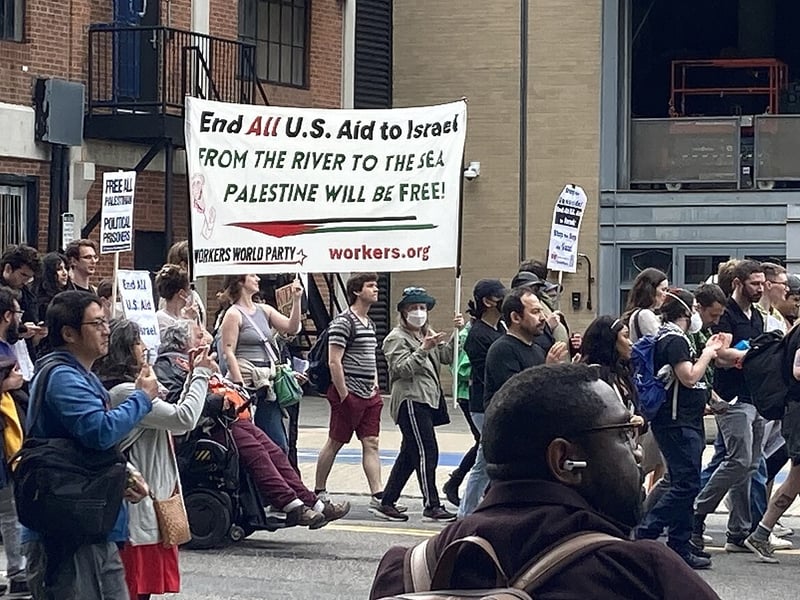
(CN) — The Massachusetts Institute of Technology has beaten a discrimination lawsuit from a pro-Israel group and two Jewish students, who claimed that the prestigious college didn’t do enough to quell pro-Palestine protests that made them feel unsafe on campus.
The First Circuit ruled Tuesday that the students’ accusations “do not plausibly rise to the level of actionable harassment” required for federal law, affirming a lower court’s ruling that dismissed the lawsuit for failure to state a claim.
“Even if the protestors’ conduct as a whole was actionable harassment … MIT is not liable because it was not deliberately indifferent to the effects of the protests on Jewish and Israeli students,” the three-judge panel ruled.
The trio of judges behind the ruling were U.S. Circuit Judge William Kayatta, a Barack Obama appointee, U.S. Circuit Judge Gustavo Gelpí, a Joe Biden appointee and U.S. District Judge William Smith, a George W. Bush appointee who joined the panel via designation.
They noted that they did not find Title VI, the federal law preventing racial discrimination on school grounds, to require “a university to quash protected speech.”
And the campus protesters’ actions, which started after Israel initiated its bombing campaign in the Gaza strip in 2023 and stretched into the spring of 2024, were indeed protected speech, the court found.
“By gathering together in groups on campus, disrupting campus tranquility, and impeding travel for many students, the protestors did not render their speech antisemitic, much less unprotected,” the judges ruled.
According to the plaintiffs, Jewish students at MIT were prevented for months from accessing portions of campus, blocked from attending classes, physically intimidated, assaulted, ridiculed, doxed, subjected to anti-Jewish chants, and shunned and excluded from study groups. Activists disrupted classes, sent mass e-mails to students justifying the Hamas attack on Israel, vandalized a vigil for the attack victims and organized protests outside Jewish professors’ offices.
The plaintiffs also claim that MIT allowed speakers on campus who fomented hostility toward Jewish students and allowed a hostile encampment for weeks outside the Hillel building.
But in their ruling, the judges wrote that actionable, discriminatory speech is a high bar to clear and “cannot be restricted simply because it is upsetting or arouses contempt.” They cited a 2011 case that protected the speech of Westboro Baptist Church protesters who chanted “God hates you,” “thank God for dead soldiers” and “priests rape boys” at a funeral for a deceased soldier.
They also acknowledged that, as a private university, MIT has even more leeway with how it chooses — or declines — to police speech that takes place on its campus.
“Requiring MIT to restrict students’ expression merely because those students opposed Israel and favored the Palestinian cause would infringe upon MIT’s freedom to encourage, rather than suppress, a vigorous exchange of ideas,” the judges ruled.
They added that using Title VI to “compel adherence to a preferred political viewpoint” would implicate students’ personal First Amendment freedoms as well.
The judges also found that MIT did take adequate steps to stamp out legitimate discriminatory behavior and harassment from some of the student protestors, such as suspending some students from nonacademic activities and suspending one pro-Palestine student group.
The judges’ Tuesday ruling echoed the skepticism they expressed at oral arguments in April, when Kayatta told the plaintiffs’ lawyer that “90% of your complaint says that speech made them feel uncomfortable.”
“Speech often makes people feel uncomfortable,” the judge said at the time.
Kayatta invoked the widespread college protests of the Vietnam War in the 1960s to make his point, calling student uprisings on campus “hardly unique.”
“They’re often designed to break campus rules to get attention,” the judge said.
In a statement, StandWithUs Center for Legal Justice, the pro-Israel group that sued alongside the students, called the decision “disappointing” and “troubling” and said it is considering its options in light of the decision.
“Plaintiffs maintain the allegations in the complaint were not focused on the punishment of speech but instead on holding MIT accountable for its failure to properly address the pervasively hostile environment on its campus for Jewish and Israeli students,” said Carly F. Gammill, the group’s executive director. “Plaintiffs sufficiently alleged what they experienced was actionable antisemitism. It is troubling — and out of step with the very purpose of Title VI — that the meagre steps taken by the MIT administration could be considered sufficient to address the vitriol experienced by its Jewish and Israeli students.”
MIT didn’t immediately respond to requests for comment.
 Follow @Uebey
 Follow @uebey.bsky.social
Subscribe to our free newsletters
Our weekly newsletter Closing Arguments offers the latest about ongoing trials, major litigation and rulings in courthouses around the U.S. and the world, while the monthly Under the Lights dishes the legal dirt from Hollywood, sports, Big Tech and the arts.