
 Search Articles


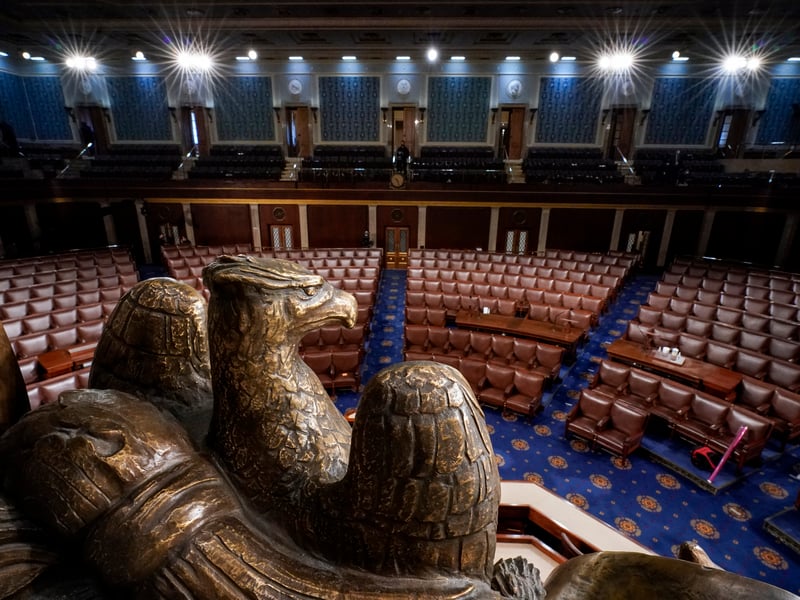
(CN) — With the election less than two months away, control of the presidency and both national legislative bodies rests on a veritable knife’s edge. Though Democrats currently control the Senate by a single seat, the Republicans are the favorites to take it back. In the House of Representatives, the opposite is true: Republicans hold a slim nine-seat advantage, but Democrats are slightly favored to gain control in November.
Just like the presidential race, the margins could hardly be more tight. According to the CookPolitical Report, Democrats are favored to win 203 seats, Republicans 208, leaving 24 seats as “toss-ups.” Democrats need to win 15 of those toss-ups to win a 218-seat majority; Republicans need just 10. But Democrats can be a little hopeful: recent polls show that voters would prefer Democrats to control the House, by margins of between five and one point.
Here are five key House races to watch in November, all rated as “toss-ups.”
**Arizona’s 1st Congressional District Incumbent David Schweikert (R) v. Amish Shah (D)
Republican David Schweikert has been in Congress for more than a decade, since 2011. But his seat is far from secure. He was forced to run for a newly drawn district in 2022, and eked out a victory by just 3,000 votes. Because of that, Democrats have targeted his seat as a vulnerable one. His challenger is Amish Shah, a Chicago-born former doctor and state lawmaker, the son of Indian immigrants.
The district was designed — gerrymandered, one might say — to be a Republican district, and the party enjoys a significant advantage in voter registration. But independent voters make up roughly a third of voters in Arizona, and they have the power to swing most races.
Although Schweikert has outraised Shah by more than a million dollars, two forces are against him. One is Proposition 139, a constitutional amendment that would establish the fundamental right to abortion access which will also be on the ballot in November. The referendum enjoys broad support — recent polls have it winning by between 27 and 49 points — and is opposed by Schweikert.
Another key factor is the Senate race, which pits Democrat Ruben Gallego against Republican Kari Lake, a former TV news anchor, in a race to replace Krysten Sinema, who decided not to run for reelection. Lake is a Trumpian and divisive figure, and is well behind Gallego the polls. The fact that the House race appears on the ballot after Donald Trump and Kari Lake means that some voters will associate Schweikert with them, which may hurt him, particularly among independents.
“The old conventional wisdom was that most politics is local,” said former Tucson Mayor Thomas Volgy, now a political science professor at the University of Arizona. “I think most of that has now changed.” Now, thanks to Trump, Lake and the abortion issue, “there’s an enormous amount of momentum toward the Democrats in Arizona.”
A poll taken in August showed this race a dead heat.
**California’s 13th Congressional District Incumbent John Duarte (R) v. Adam Gray (D)
California — the most populous and perhaps the bluest state in the country — could be crucial to Democratic hopes of taking back the House.
“The House is so evenly divided, a lot of races are pivotal,” said University of California, Irvine political science professor Louis DeSipio. “California is unique though, because it has a couple of districts that have been leaning Democratic for a while. They’ve said that before. But it will happen at some point. Democrats have money and energy, and both of those are important commodities.”
The party has targeted a number of Republican-held congressional seats, including the 13th, currently held by John Duarte. His race against Adam Gray, a former state Assembly member and, prior to that, a longtime political staffer, is a rematch of 2022, which Duarte won by 3,500 votes. Duarte also won the open primary in March by about 8,500 votes, but much has changed since then and turnout will be much higher in November.
The Central Valley district is among the more rural parts of the state. Democrats enjoy a registration advantage, but getting those voters to the polls requires money, energy and organization.
“It’s an area where Democrats, if they want to control the House, they need to make investments,” DeSipio said.
And indeed they have. As of June 30, Gray has raised $2.5 million, an impressive sum, though one bested by Duarte, who’s raised more than $3 million.
**California’s 27th Congressional District Incumbent Mike Garcia (R) vs. George Whitesides (D)
This sprawling northeast Los Angeles County district was held by Democrats for much of the 2000s, by Brad Sherman and Judy Chu, before Mike Garcia captured it in 2023. He’s running against George Whitesides, the longtime CEO of Virgin Galactic and a businessman who’s never held public office. As of June, Whitesides had spent more than $1.3 million of his own money on his campaign, adding to the the $4.3 million or so that he’s raised; Garcia has himself raised just over $4.3 million.
Although Garcia finished more than 20 points ahead of Whitesides in the March open primary, a poll taken in April showed Whitesides ahead by three points.
“It is a Democratic-leaning district,” DeSipio said. “It has elected a Democrat recently. They’ve put a big effort into wining the seat before, and they have a registration advantage. But it’s the rural part of LA County. It’s a hard district to do the ground game in.”
**California’s 41st Congressional District Incumbent Ken Calvert (R) vs. Will Rollins (D)
The race is another rematch of the 2022 matchup, which saw Ken Calvert, a 30-year veteran of Congress, defeat 39-year-old Will Rollins, a former prosecutor, by about 15 points — not a small margin, per se, but small enough to make people think the 71-year-old Calvert might be vulnerable.
“People that run a second time typically don’t do much better, but the thinking is that he can,” DeSipio said.
Rollins, impressively enough, had raised nearly $7 million, compared to Calvert’s $5.7 million, as of June. And a poll taken in May had Rollins ahead by a single point — effectively a dead heat, but an encouraging sign for the challenger.
**Colorado’s 8th Congressional District Incumbent Yadira Caraveo (D) vs. Gabe Evans (R)
Colorado’s 8th Congressional District was designed, by an independent redistricting commission, to be competitive, and the commission did a good job. According to the Cook partisan voting index, it is one of seven districts in the country to vote almost identically to the national electorate. So goes the country, so may very well go the 8th.
Yadira Caraveo became Colorado’s first Latina member of Congress in 2022, when she narrowly defeated the Republican by just 1,500 votes. This year, she’s up against Gabe Evans, a 38-year-old military veteran and former police lieutenant.
“Given that control of the next House will probably be down to just a handful of seats, a seat like this, where there’s a freshman — the parties are going to invest a lot of money in that sort of thing,” said Seth Masket, a political science professor at the University of Denver.
A pair of opinion polls taken in April had Evans ahead by one and five points, respectively. Caraveo has, as of June, significantly outraised Evans, $4.5 million to $1 million.
“If Democrats want to take the House back, they can’t lose a district like this,” Masket said.
 Follow @hillelaron
Subscribe to our free newsletters
Our weekly newsletter Closing Arguments offers the latest about ongoing trials, major litigation and rulings in courthouses around the U.S. and the world, while the monthly Under the Lights dishes the legal dirt from Hollywood, sports, Big Tech and the arts.