
 Search Articles


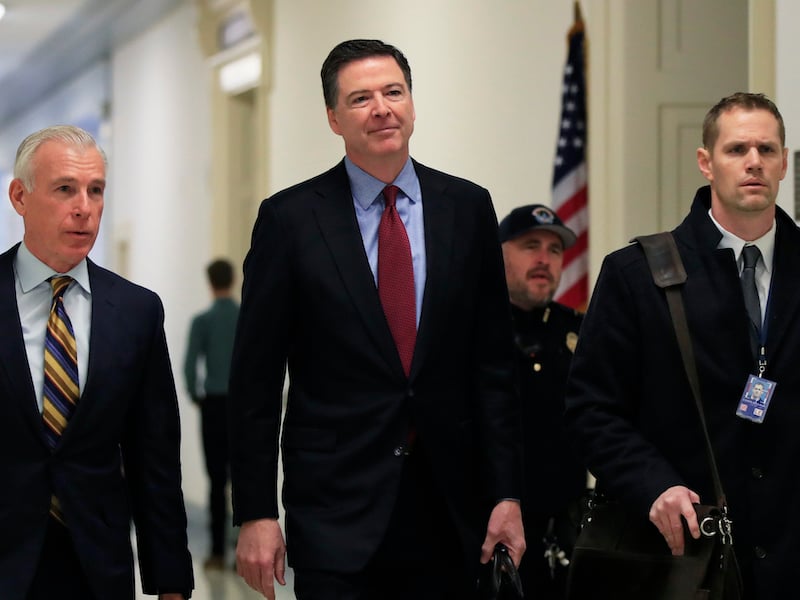
ALEXANDRIA, Va. (CN) — James Comey is a lawyer, a onetime deputy attorney general and a former FBI director. But now, he contends he is the target of a vindictive and unlawful prosecution spearheaded by President Donald Trump.
In a court document filed Monday at his behest, Comey argues that the government has singled him out for prosecution “because of his protected speech and because of President Trump’s personal animus.”
Charged with lying during a U.S. Senate committee meeting, Comey is asking U.S. District Judge Michael Nachmanoff, a Joe Biden appointee, to dismiss the case on grounds that it is selective prosecution in violation of his constitutional rights.
Lawyers for Comey also filed a second motion calling for dismissal, saying that Lindsey Halligan, interim U.S. attorney for the Eastern District of Virginia, was unlawfully appointed and lacks valid governmental authority. Department of Justice attorneys counter that Comey previously used his lead attorney, Patrick Fitzgerald, to improperly disclose classified information, a claim that Comey’s legal team described as provably false.
Taken together, the court filings sketch out a defense strategy that Trump pursued Comey out of spite — a claim bolstered by interviews, public statements and posts on the social media platform X, formerly known as Twitter.
For his part, Comey once described Trump as “untethered to truth” and “morally unfit to be president” during a 2018 ABC News interview. And after Trump affirmed Vladimir Putin’s denials of Russian election interference, Comey posted on X: “This was the day an American president stood on foreign soil next to a murderous lying thug and refused to back his own country.”
During his first term in office, Trump began exploring the possibility of using his official powers to retaliate against Comey. General John F. Kelly, Trump’s chief of staff in 2017-2018, said Trump expressed a desire to deploy the FBI, DOJ, and Internal Revenue Service against his critics, including Comey, according to court filings.
The Constitution prohibits the government from prosecuting a defendant for arbitrary reasons, including exercising First Amendment rights. But in his second term, Trump didn’t let the matter drop. When no career prosecutor would carry out orders to pursue a case against Comey, the president forced an interim U.S. Attorney to resign and installed Halligan — a White House aide with no prosecutorial experience — as interim U.S. Attorney. Halligan indicted Comey on her fourth day in office, just before the statute of limitations was set to expire.
The indictment accuses Comey of making false statements within the jurisdiction of the U.S. legislative branch and obstruction of a congressional proceeding on Sept. 30, 2020. That day, Comey was called as a witness for the U.S. Senate Committee on the Judiciary for oversight of the Crossfire Hurricane Investigation, a probe focused on the Russian government’s efforts to interfere in the 2016 U.S. presidential election.
During the hearing, Senator Ted Cruz, a Republican from Texas recounted that during 2017 testimony before the Senate Judiciary Committee, Comey denied “ever authorizing someone else at the FBI to be an anonymous source in news reports about the Trump investigation or the Clinton Administration.”
In his court filing, Comey argues that the indictment muddles events, misstating the exchange that is at the heart of the case and attributing statements to Comey that he did not make.
The Justice Department must respond to Comey’s filing by Nov. 3. The trial is set for Jan. 5, 2026. Comey faces up to five years in prison if convicted.
The case against Comey is one of three high profile prosecutions of public figures disparaged by Trump. The others are: Letitia James, charged with bank fraud and making false statements to a financial Institution, and former National Security AdviserJohn Bolton, charged with unlawfully transferring classified information during his time in the Trump administration between 2018-2019.
Subscribe to our free newsletters
Our weekly newsletter Closing Arguments offers the latest about ongoing trials, major litigation and rulings in courthouses around the U.S. and the world, while the monthly Under the Lights dishes the legal dirt from Hollywood, sports, Big Tech and the arts.