
 Search Articles


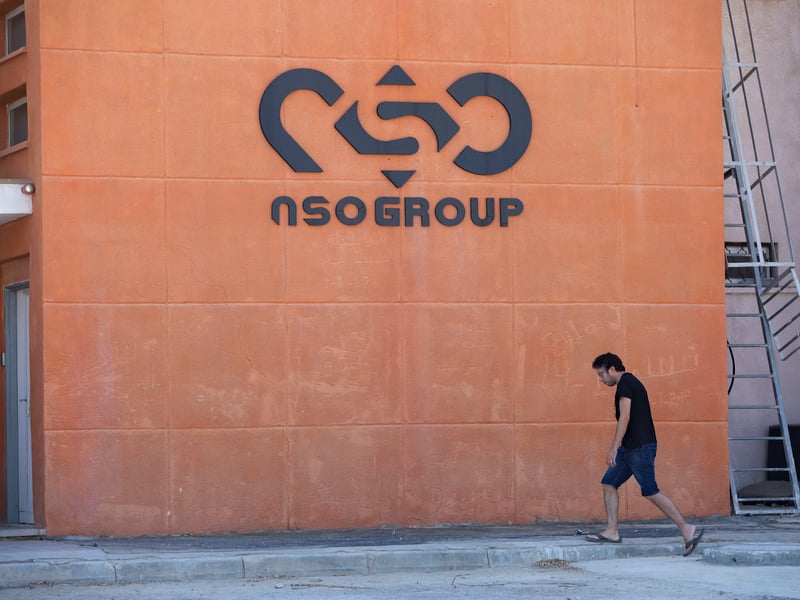
SAN FRANCISCO (CN) — A federal judge remained skeptical Thursday that a case brought by a group of Salvadoran investigative journalists who claim they were the targets of Israeli spyware attacks should be heard in California.
The journalists, from an investigative news outlet called El Faro, sued Israeli cyberintelligence agency NSO Group and its parent company in 2022 after they said they were victims of spyware attacks in 2020 and 2021.
The journalists claim that between June 2020 and November 2021, hackers used the Pegasus spyware to access their iPhones. Pegasus, according to the plaintiffs, allows hackers to take control of a user’s smartphone and get access to calls, texts, contacts and other personal data.
They argue that the companies and their unidentified clients surreptitiously installed Pegasus on the iPhones of at least 22 of El Faro’s 35 employees, calling the attacks “part of a coordinated and sustained effort to undermine independent journalism in El Salvador.”
The journalists sued the Pegasus makers in the Northern District of California because that is where Apple is based, and the Israeli companies purportedly used Apple’s servers to target their phones.
NSO Group — blacklisted by the U.S. government in 2021 — argued the case should be dismissed under the doctrine of forum non conveniens, under which a court can decline jurisdiction if it believes another court is a more convenient or just venue for the case.
U.S. District Judge James Donato agreed and dismissed the lawsuit, but a Ninth Circuit Court of Appeals panel revived the case in July, finding that the Barack Obama appointee had failed to consider that one of the plaintiffs is a U.S. citizen and two others are U.S. residents, which entitled them to a higher degree of deference to bring a lawsuit in a federal judicial district where they don’t reside.
“When the plaintiff is a U.S. citizen or resident, the defendant must satisfy a heavy burden of proof, such that unless the balance is strongly in favor of the defendant, the plaintiff’s choice of forum should rarely be disturbed,” the panel said. “Here, however, it appears the district court gave little to no deference to plaintiffs’ choice of forum, overlooked the allegations of the operative complaint and shifted the burden of proof from defendants to plaintiffs.”
In a hearing Thursday, Donato asked the journalists why California has a stronger interest in the case than El Salvador, where they resided at the time of filing the lawsuit, or Israel, where NSO Group Technologies and parent company Q Cyber Technologies are based.
The journalists’ attorney, Caroline DeCell of the Knight First Amendment Institute at Columbia University, responded that California has a strong and compelling interest in ensuring that U.S. technology companies are not being used as venues for spyware around the world.
DeCell emphasized that there is significant evidence held by Apple in the U.S. and in California, and the location of the evidence weighs in favor of hearing the case in the Northern District of California. However, Donato seemed unconvinced that evidence from Apple could not be included in a case litigated outside the country.
“Send a subpoena, and you’re done. It’s not basis for being in the district,” the judge said, adding later, “We are in an age today where everything is technology, I’m not sure you carry that burden.”
Joseph N. Akrotirianakis of King & Spalding, an attorney for NSO Group, argued that the case should not be heard in California, but either in El Salvador or Israel.
“What they are complaining about has nothing to do with Apple’s servers," he said. “Nothing that they would have to prove has anything to do with anything in California — it has to do with things in Israel and El Salvador.”
Akrotirianakis added that critical evidence is not allowed to be brought into the U.S., explaining that certain code is export-controlled in Israel, and asking his Israeli clients to export the code would force them to commit a crime.
“This case cannot be litigated here — only in Israel,” he said.
In rebuttal, DeCell highlighted the recent acquisition of NSO Group by a group of American investors, emphasizing the “convenience of litigating” in California.
“The laws of Israel have not changed,” Donato responded.
Representatives for either party did not immediately respond to a request for comment.
Surveillance software has reportedly been used by governments to track and spy on dissidents and journalists, at times leading to their arrest, imprisonment and even murder. In 2021, the United Nations human rights chief pushed for better regulation of the industry, saying the apparent use of spy software to illegally undermine the rights of those under surveillance, including journalists and politicians, was “extremely alarming” and confirmed “some of the worst fears” surrounding the potential misuse of such technology.
In July, Microsoft and Google filed an amicus brief with the Ninth Circuit in support of the El Salvador-based journalists’ bid to hold the Israeli companies liable in U.S. court.
Apple itself sued NSO Group and Q Cyber Technologies in 2021 for hacking its devices, but voluntarily dropped the lawsuit last year over concerns that discovery in litigation would reveal the measures Apple has implemented to protect users.
WhatsApp — an encrypted communication app owned by Facebook’s parent company Meta Platforms that boasts over 2 billion users around the world — sued in 2019 after Pegasus reportedly compromised the privacy of 1,400 activists, journalists and diplomats via WhatsApp servers.
Last month, a federal judge blocked NSO from Meta’s WhatsApp messaging platform, ruling that there was evidence Pegasus could still infiltrate WhatsApp users’ devices.
Around the same time, a group of American investors led by Hollywood producer Robert Simonds purchased NSO Group. Soon after, the intelligence firm appointed former U.S Ambassador to Israel David Friedman, who served in the first Trump administration, as executive chairman.
 Follow @mhattridge_
Subscribe to our free newsletters
Our weekly newsletter Closing Arguments offers the latest about ongoing trials, major litigation and rulings in courthouses around the U.S. and the world, while the monthly Under the Lights dishes the legal dirt from Hollywood, sports, Big Tech and the arts.