
 Search Articles


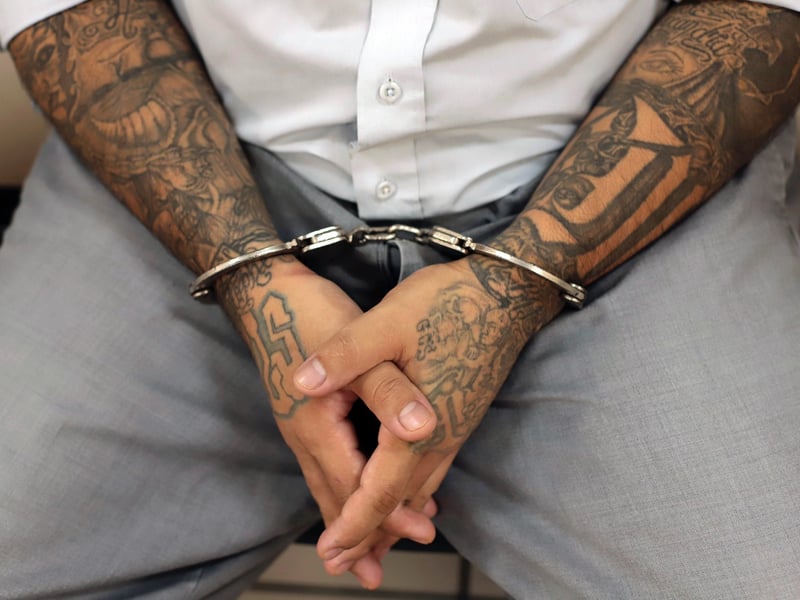
(CN) — A Fourth Circuit panel on Thursday upheld the convictions of five members of an MS-13-affiliated street gang who savagely killed two teenage boys at a northern Virginia park.
The three-judge panel dismissed arguments that the defendants — Ronald Herrera-Contreras, Pablo Velasco-Barrera, Henry Zelaya-Martinez, Duglas Ramirez-Ferrara and Elmer Zelaya-Martinez — deserved a new trial after they were convicted in 2022 of murdering the boys on behalf of the View Locos Salvatrucha clique, an affiliate of the international street gang MS-13.
The appellate judges agreed one defendant, Henry Zelaya-Martinez, should be resentenced, however.
A jury determined the defendants lured 17-year-old Edvin Eduard Escobar Mendez to a gang meeting on Aug. 28, 2016, at a northern Virginia park, where they butchered him with knives, a machete and a pick axe.
Sergio Arita Anthony Triminio, 14, was stabbed to death a few weeks later in the same park after he began to ask questions about Mendez’s death.
The defendants recorded part of Triminio’s assault and the cellphone video was later recovered by law enforcement officials in California. Herrera-Contreras agreed to help authorities find the teenagers’ bodies, which were buried in the park, after he was arrested in an unrelated case.
Eleven defendants were indicted in the murders and five stood trial. They were found guilty on eight counts, including murder in aid of racketeering activity and kidnapping resulting in death, and sentenced to life in prison.
At an appeal hearing in December, defense attorneys argued gruesome videos of the killings, which were shown to the jury during trial, unfairly prejudiced the defendants. They also claimed the judge erred by rejecting a duress instruction to mitigate the men’s culpability.
U.S. Circuit Judge Nicole G. Berner rejected the arguments in a 39-page opinion published Thursday. The Joe Biden appointee found that the probative value of the violent videos outweighed the danger of unfair prejudice.
“The videos placed several of the appellants at the scene of the crime; corroborated witness testimony; helped establish the victims’ identities; and depicted parts of the events that were the subject of the charges,” she wrote.
Regarding the duress instruction, Berner said the men failed to show they faced a “real and specific threat” that drove them to commit the murders.
“To be sure, within the MS-13 hierarchy, obedience is required,” Berner wrote. “Refusing to comply with an MS-13 order would almost certainly bring consequences, potentially fatal ones.”
The duress defense is narrowly defined, however, the judge noted.
“A generalized fear of reprisal, even one that is likely, is no defense to criminal conduct,” Berner wrote.
Paul Beers of Glenn, Feldmann, Darby & Goodlatte in Roanoke, Virginia, argued at the appeal hearing that his client, Henry Zelaya-Martinez, should be resentenced because of two issues that arose in the judge’s orders.
The judge first failed to cite all the discretionary conditions of Henry Zelaya-Martinez’s supervised release during his hearing. The court then included a requirement for the defendant to pay for rehabilitation if he were released on probation — a condition that was not mentioned during the hearing.
Henry Zelaya-Martinez was unlikely to earn supervised release since he faced a life sentence, but Beers noted that his client could challenge the constitutionality of his sentence at the new hearing.
The appellate court agreed the inconsistencies in the judge’s order justified reversal on that issue.
U.S. Circuit Judge Marvin Quattlebaum Jr., a Donald Trump appointee, concurred with the decision in a separate opinion, but questioned whether the court had jurisprudence in the case.
U.S. Circuit Judge J. Harvie Wilkinson III, a Ronald Reagan appointee, also served on the panel.
 Follow @SteveGarrisonPC
Subscribe to our free newsletters
Our weekly newsletter Closing Arguments offers the latest about ongoing trials, major litigation and rulings in courthouses around the U.S. and the world, while the monthly Under the Lights dishes the legal dirt from Hollywood, sports, Big Tech and the arts.