
 Search Articles


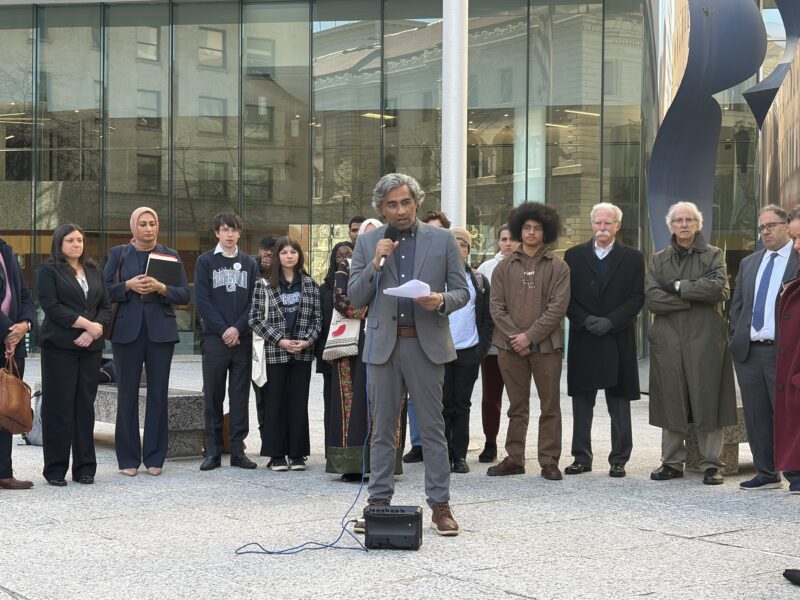
RICHMOND, Va. (CN) — The Fourth Circuit ruled against the Trump administration Thursday, holding that those believed to be unconstitutionally detained by immigration officials can seek relief in District Courts.
The ruling creates a circuit split with the Third Circuit, which recently ruled in favor of the government in Khalil v. President, United States. In *Khalil,*a case concerning a former Columbia University graduate student who criticized Israel, the majority found the Immigration and Nationality Act strips District Courts of subject matter jurisdiction to hear challenges to their confinement, which the majority held should be heard in immigration courts during removal proceedings.
Khalil and Georgetown postdoctoral fellow Badar Khan Suri sought review of their habeas petitions in District Courts to avoid the sometimes yearslong removal process that plays out in immigration courts.
“The government insists that judicial review of the allegedly unconstitutional detention can come only after removal proceedings that can last for months or years. Until then, according to the government, a detained noncitizen has no judicial recourse,” U.S. Circuit Judge DeAndrea Gist Benjamin, a Joe Biden appointee, wrote on behalf of herself and U.S. Circuit Judge Pamela Harris, a Barack Obama appointee. “We disagree.”
Immigration officials arrested Suri, who held a J-1 exchange visa, in March 2025 for what his legal team describes as retaliation for his pro-Palestinian political views and his marriage to the daughter of a former Palestinian political adviser.
The majority held the U.S. District Court for the Eastern District of Virginia properly granted injunctive relief enjoining the government from removing Suri and ordering his release from custody.
“The federal government cannot do an end run around the First Amendment by locking people up for their speech and denying them their day in court,” American Civil Liberties Union attorney Noor Zafar, representing Suri, said in a press release. “Immigration laws cannot be abused to silence dissent, and we are grateful that today, justice prevailed.”
The government first argued the court lacked the requisite subject matter jurisdiction. The government claimed the controversy over the detainment is intertwined with the merits of the removal, an issue reserved for immigration courts. The majority disagreed.
“If a noncitizen is challenging their detention pending removal, then waiting for their removal proceedings does them no good,” Benjamin said. “They have already been detained, allegedly in violation of the Constitution. This ‘absurd’ reading of the INA would make such detention claims ’effectively unreviewable,’ and the Supreme Court has repeatedly refused to embrace it.”
The government next challenged whether Virginia is the appropriate venue for the proceedings. After his arrest, immigration officers swiftly moved the professor first to a facility in Farmville, Virginia, then to Richmond, then to Louisiana and finally to Texas. Habeas petitions seeking to challenge present physical custody are typically filed in the district of confinement. There are exceptions, however, that Benjamin ruled warranted Suri’s attorneys’ filing of the petition in Virginia.
The first exception, labeled the unknown custodian exception, applies when the government holds detainees in a secret location. The majority also cited an exception laid out by Associate Justice Anthony Kennedy, a Ronald Reagan appointee, in the 2004 case Rumsfeld v. Padilla. In concurrence, Kennedy acknowledged an exception for situations where the government has purposely made it difficult for a lawyer to know where to file.
“His reasoning and provided examples proved strikingly predictive — prescient even — as it almost perfectly parallels the circumstances of Suri’s arrest and detention,” Benjamin said. “Because Suri was repeatedly denied the chance to update his wife or lawyer, and ICE’s online detainee tracker offered no updates, we think that this would make it highly difficult, or impossible, for any diligent lawyer to ‘catch up’ on their client’s location.”
The lower court determined, and Benjamin agreed, that the government strategized to forum shop for the removal proceedings.
“These undisputed factual findings demonstrate the government’s lack of candor regarding Suri’s place of detention and its deliberate attempt to manipulate venue,” Benjamin said.
U.S. Circuit Judge Harvie Wilkinson dissented from the majority, instead holding that the Immigration and Nationality Act does strip district courts of subject matter jurisdiction.
“The majority rips an irreparable hole in the INA’s jurisdiction-channeling scheme,” the Reagan appointee said. “Every alien who is detained pending removal will now have a pathway into District Court for a thinly veiled habeas challenge to his removability. Each such suit will grind removal proceedings to a halt, invite a District Court to take control of them, and require the government to prove the alien’s removability a second time.”
The government has yet to dispute Suri’s contention that his removal proceedings hinge on his participation in protected speech, instead focusing on jurisdiction.
“Today reaffirms my faith that an independent judiciary remains the truest guardian of liberty, due process and the rule of law,” Suri said in a press release. “We should remember that a democracy without an accessible writ of habeas corpus is a democracy in name only; as the honorable court so aptly observed, the scope of habeas corpus ‘must not be subject to manipulation by those whose power it is designed to restrain.’”
Attorneys representing the federal government did not respond to a request for comment.
“We are gratified that the court recognized the basic and critical principle that executive officials cannot escape judicial review of their patently unconstitutional action — here, arresting, detaining and attempting to deport Dr. Khan Suri for nothing more than his associations and constitutionally protected advocacy for Palestinian rights,” Baher Azmy, legal director at the Center for Constitutional Rights, representing Suri, said in a statement. “We are eager now to address the substance of Dr. Khan’s claims, which is that this administration unconstitutionally targeted him in violation of his First Amendment and Due Process rights.”
Subscribe to our free newsletters
Our weekly newsletter Closing Arguments offers the latest about ongoing trials, major litigation and rulings in courthouses around the U.S. and the world, while the monthly Under the Lights dishes the legal dirt from Hollywood, sports, Big Tech and the arts.
Additional Reads


 AstraZeneca immune from Covid-19 vaccine injury lawsuit July 23, 2026