
 Search Articles


MARSEILLE, France (CN) — Pressure is mounting for governments to pursue a two-state solution to end the Israel-Palestine conflict amid gravely urgent humanitarian concerns over Israel’s conduct in Gaza.
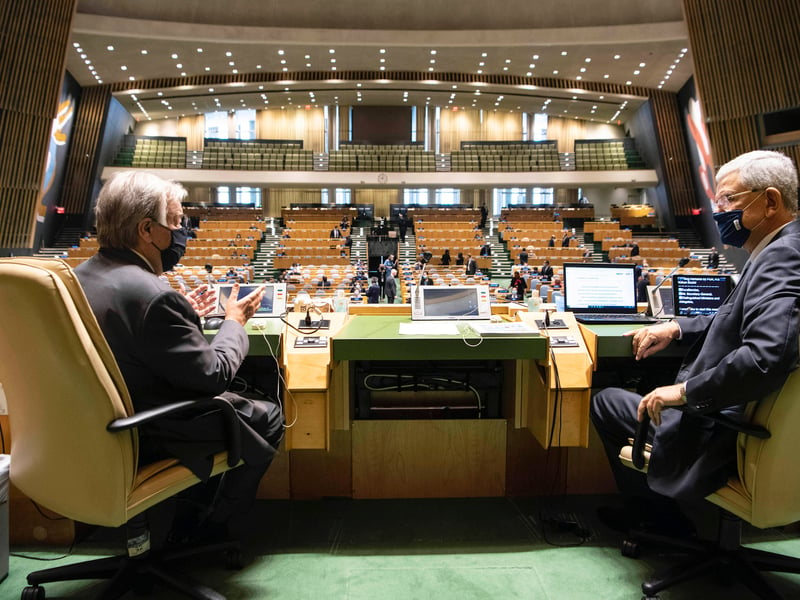
Representatives from 125 countries are attending a high-level U.N. conference, co-chaired by France and Saudi Arabia, from Monday through Wednesday. The event centers around the “New York Declaration,” which urges countries to recognize the state of Palestine in order to move forward with a plan to establish and support a viable two-state solution.
“Today’s conference is a rare and indispensable opportunity…. We must ensure that it does not become another exercise in well-meaning rhetoric,” António Guterres, the UN secretary general, said in his opening remarks. “It can and must serve as a decisive turning point — one that catalyzes irreversible progress towards ending the occupation, and realizing our shared aspiration for a viable two-state solution.”
The United States and Israel are notably absent from the conference.
On Friday, French President Emmanuel Macron announced that France would recognize the state of Palestine in September. Though the statement in and of itself will likely not have immediate, tangible impact on ground operations, it carried high significance, since it will make France the first G7 nation to recognize Palestinian statehood.
It has also increased pressure on other governments to follow suit; on Tuesday, prime minister Keir Starmer said the U.K. will follow Macron’s lead in September unless Israel agrees to a ceasefire and commits to a long-term peace in the framework of a two-state solution.
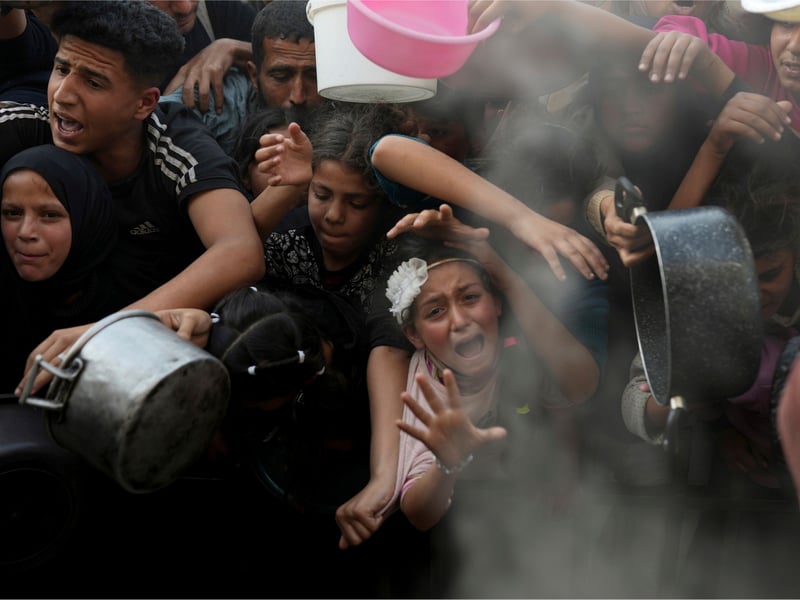
Symbolically, this signals a changing paradigm toward the conflict, fueled by mounting humanitarian concerns including widespread starvation. Israel is facing increasing accusations of genocide. Countless videos documenting the protruding ribcages of children in Gaza, alongside the Israeli military firing at people waiting for aid, have become almost impossible for governments to dismiss.
“I don’t know… those children look very hungry. … That’s real starvation stuff,” U.S. President Donald Trump said on Monday. “Nobody’s done anything great over there…. The whole place is a mess … I told Israel maybe they have to do it a different way.”
Israeli Prime Minister Benjamin Netanyahu denied that Israel is deliberately starving Gazan civilians, calling it a “bold-faced lie,” and adding that “there is no starvation in Gaza.”
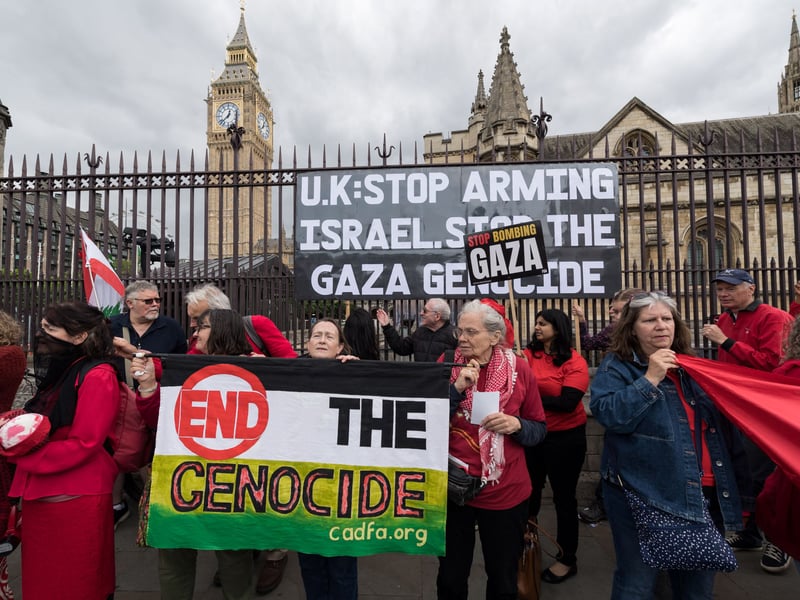
Gisèle Sapiro, a sociology professor in France’s School of Advanced Studies in the Social Sciences, known as EHESS, is also part of “A Land for All,” an Israeli-Palestinian political initiative advocating for a two-state solution. The group includes 600 political scientists, sociologists, legal scholars and experts in other intellectual disciplines.
“The idea behind A Land for All is that separation creates violence, whereas cooperation can foster peaceful coexistence, which would therefore imply a confederation,” she told Courthouse News. “This movement is based on the idea that these two people share an attachment to this land, and that this must be recognized and taken into consideration, and that it’s necessary to create conditions for freedom of movement.”
Sapiro is Franco-Israeli and has been part of the recent demonstrations in Tel Aviv against the war. In her view, although the symbolic recognition of Palestinian statehood is a good thing, it needs to go hand-in-hand with other measures, including sanctions to enforce international law “by halting the ongoing ethnic cleansing in Gaza and use of starvation as a weapon of war,” and territorial commitments for the future of Palestine.
Hall Gardner, a professor of politics at The American University of Paris, agrees that concrete action and planning needs to accompany the recognition of Palestinian statehood in order to have a significant impact.
“Merely declaring French recognition of a Palestinian state will prove nothing if the US, Israel, Hamas and the Palestinians in general cannot come to terms over who will be the leadership of such a new Palestinian state and how that state will survive, protect itself and be protected by international peacekeepers,” Gardner told Courthouse News.
Omar Dajani, a Palestinian-American professor at the University of the Pacific, previously served as a legal advisor to the Palestinian negotiating team in peace talks with Israel. He is also one of the leaders of “A Land for All.”
He told Courthouse News that France’s recognition of a Palestinian state is important given its global influence, and advocates for making this recognition into something concretely transformative. There should be a territorial dimension on the table, Dajani argues.
“That [it is not] a state in name only, but instead is a place where Palestinians can actually achieve liberty and security for themselves, the very basic basis for self determination,” he explained. “So I think that’s an important piece…. I think a second important piece is really facilitating Palestinian access to international organizations.”
This would mean adhering to the frameworks of theInternational Criminal Court and International Court of Justice, and extending the full benefits of statehood within the context of international organizations, he added.
“Finally, I think it means taking steps to extend to Palestinians the kind of rights and protections that having a sovereign government should entitle them to,” Dajani said. “I think in those ways, it can make this recognition something serious.”
Though the conference is a step in the right direction, Dajani said, a real impact will require action.
“I think that it’s great that the French and Saudi governments are framing this conference around what it would take to implement a two-state solution and that they are getting a lot of states, including states that are supportive of policy and self determination, but also other states that have been more silent about these questions,” he told Courthouse News. “I think what will determine whether this conference makes a difference is whether the governments that are involved are prepared to go one step further and to actually attach consequences to Israel’s failure to move forward.”
 Follow @lilyradz
Subscribe to our free newsletters
Our weekly newsletter Closing Arguments offers the latest about ongoing trials, major litigation and rulings in courthouses around the U.S. and the world, while the monthly Under the Lights dishes the legal dirt from Hollywood, sports, Big Tech and the arts.