
 Search Articles


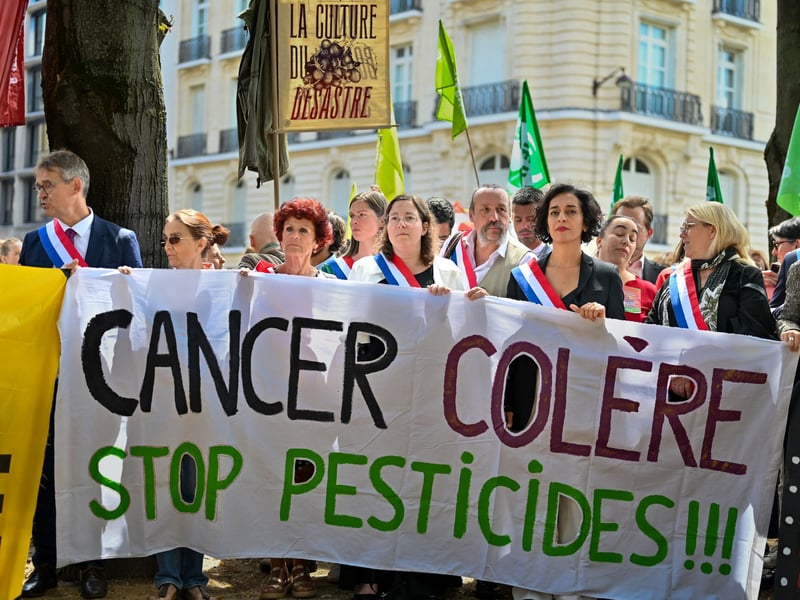
MARSEILLE, France (CN) — French lawmakers are being forced to confront the record 1.8 million people and counting fighting the new Duplomb law, which will legalize a banned pesticide and loosen environmental restrictions in a bid to ease constraints on farmers.
In a tense era for the agriculture industry — farmers have been leading nationwide demonstrations regularly for over two years, demanding better pay and working conditions — right-wing and centrist lawmakers say they presented the bill to level the playing field between French and European farmers.
Acetamiprid, a neonicotinoid pesticide banned in France since 2020, is allowed in the rest of Europe. It penetrates crops, and when pests eat them, it attacks their neural systems. Scientists have said it also poses health risks to humans who consume the crops. But right-wing senator Laurent Duplomb, the namesake of the law, says France should accept “the European rules of the game.”
Parliament adopted the text, by Duplomb and centrist Franck Menonville, on July 8. Two days later, Eléonore Pattery — a 23-year-old master’s student — launched a petition that became the first to secure the 500,000 signatures needed to request a fresh hearing for the law in Parliament.
“The Duplomb Law is a scientific, ethical, environmental and health aberration. It represents a frontal attack on public health, biodiversity, the coherence of climate policies, food security and common sense,” Pattery wrote.
She said in a social media post that she will not respond to media requests.

The Duplomb law has infuriated parliamentarians, environmentalists, agricultural associations and farmers, who argue it not only reintroduces a potentially harmful pesticide into the food chain — it also ignores what farmers really need.
“I absolutely don’t see how this law will improve my profession — my first demand is pay,” Angélique Thiallier, the vice president of the Movement for the Defense of Family Farmers, known as MODEF, told Courthouse News. For the past 20 years, she and her husband have made a living with their 70 dairy cows.
“In the 20 years I’ve been living here, I’ve never been able to put any money aside … . It’s catastrophic,” she said. “Compared to the hours we work, especially with dairy cows, I don’t think I’ve earned a good living.”
Thiallier argues that rather than succumbing to the European standard, which permits the potentially harmful pesticide, France should “pull Europe up” and set an example. When pesticides have been banned in the past, she said, farmers have adapted and made things better.
Others are worried. On Wednesday morning at a farmers’ market in Marseille’s Cours Julien — a central hilltop square framed by graffiti-splashed streets — Alain Seamat, who has been a farmer since 1987, was selling a rainbow array of fresh produce.
Although he agrees that farmers should be careful with their products and work cleanly, Seamat is skeptical about completely eliminating pesticides.
“When you’re sick, if you’re not treated with medication, you’ll have problems, so I think that if we eliminate everything we’ll have big problems in the long run,” he told Courthouse News. “Vegetables are like human beings, like animals — they need to be looked after. What’s needed is reasonable products and clean farmers.”
The National Federation of Agricultural Workers’ Unions, known as the FNSEA, also supports the law. The organization did not respond to multiple requests for comment.
Thiallier believes that the FNSEA has a vision that is “no longer agriculture, it’s agribusiness.”
The law would loosen regulations on larger-scale operations. For example, the current cap of 40,000 poultry per farm would rise to 85,000. Restrictions will be lifted on water storage projects, known as mega-basins.

Jérome Martinez, a coordination officer for Solidarité Paysans, an organization that supports and defends French farmers in difficulty, told Courthouse News that farmers supporting the Duplomb law are a minority who believe agriculture needs to be competitive first and foremost, but the majority oppose this vision.
“We don’t think that it’s by removing environmental standards, societal standards, that we’re going to resolve the issue of farmers’ unhappiness,” he told Courthouse News. “Many farmers don’t live well from their jobs today because prices aren’t profitable, the price of land has increased sharply and setting up as a farmer is becoming more and more expensive — today, it’s also closing off the possibility of renewing generations of farmers.”
Jean-Claude Tissot, a French senator and farmer, has been fighting the law since December and is one of its loudest critics. He described how the bill stemmed from large-scale protests.
“And what were French farmers actually asking for at that time? They were asking for a supplementary income to live decently from their work,” he told Courthouse News. “And clearly, what’s being proposed is a lie being offered to them, because absolutely nothing in this proposed French law will guarantee them additional income — it’s simply an alibi used by the French government.”
Tissot argues that the law is an unacceptable step backward for both society and the environment — unacceptable to the point that it violates rights and freedoms guaranteed by the constitution.
“That’s why we, the Socialist group in the Senate, have filed an appeal with the French Constitutional Council,” he explained, saying the Duplomb law contradicts freedoms guaranteed by the Constitution and Environmental Charter. “It ignores the rules relating to the right to live in a balanced and healthy environment.”
He also asserts that French farmers who support the law are a minority.
“The majority of French farmers don’t want this law because it poisons them,” he said.
What happens next depends on the Constitutional Council, which has until Aug. 11 to confirm its findings about the constitutional claims over the law. After that, French President Emmanuel Macron could sign the bill into law within two weeks, or request Parliament to debate the law or some of its articles again and call for a new vote.
With public pressure mounting, members of Parliament have said they’re open to a new debate, expected to happen in the fall.
 Follow @lilyradz
Subscribe to our free newsletters
Our weekly newsletter Closing Arguments offers the latest about ongoing trials, major litigation and rulings in courthouses around the U.S. and the world, while the monthly Under the Lights dishes the legal dirt from Hollywood, sports, Big Tech and the arts.