
 Search Articles


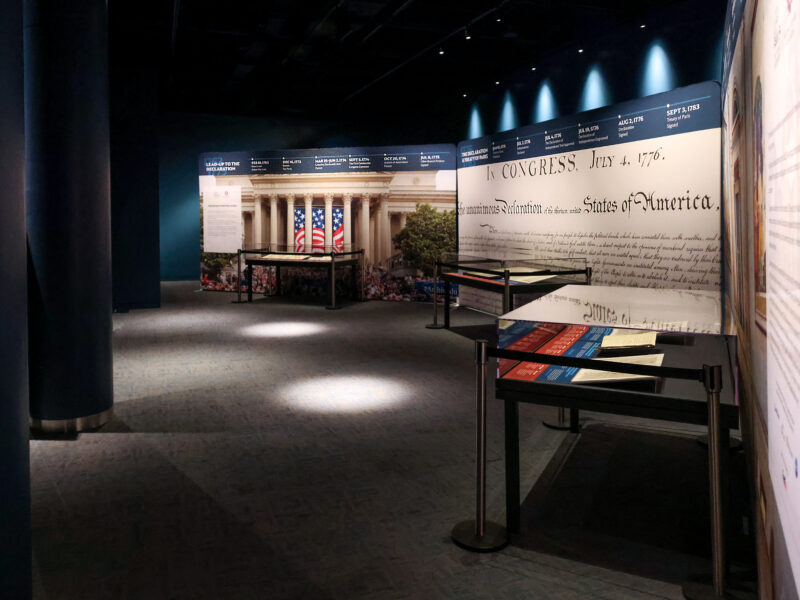
DENVER (CN) — The simplest version of events, the one we all learn in school, starts with tea and taxes.
“It was America against Great Britain,” explained 11-year-old Aaron M., standing in line with his family to view the Freedom Plane exhibit at History Colorado in Denver in June.
The young history buff was just as eager to recite the United States’ origin story as he was to see the actual documents that kicked off the American Revolution in the late 18th century, including the actual Articles of Association agreeing to boycott British goods. Signed in October 1774 in response to the Coercive and Intolerable Acts — including those tea taxes — the agreement marked the colony’s first steps toward political and economic independence.
“The American Revolution happened because they were putting high taxes on colonists, and American people didn’t really like that much,” Aaron said.
Aaron and his family were among 20,000 people who attended the National Archives’ Freedom Plane stop in Denver.
Inspired by the 1976 Bicentennial Train, which traversed the 48 contiguous states with 500 historical artifacts, the semiquincentennial Freedom Plane carries seven rare documents tracing the nation’s foundational period from George Washington’s 1778 oath of allegiance to the 1783 Treaty of Paris signed by John Adams, Benjamin Franklin and John Jay — the soon-to-be Supreme Court chief justice.
The centerpiece is an engraving created by William J. Stone in 1823, preserving the original Declaration of Independence down to the letter. Believed to be one of 50 in existence, this copy was loaned out by billionaire David M. Rubenstein, chairman of the Carlyle Group and owner of the Baltimore Orioles.

Starting in Kansas City, Missouri, in March, the custom Boeing 737 will deliver “documents that forged a nation” to eight different states through August. After the Centennial State stop, the plane is scheduled to land in Miami, Florida, on June 20.
Each museum is encouraged to emulate the National Archives Rotunda in Washington, D.C., and must adhere to strict lighting requirements, from the lumens of the showroom to limiting the hours during which the documents can be shown during the day. To offset the amount of light exposure during this tour, the documents will be submerged in dark storage for the next 20 years.
Even in the last 20 years, however, it was rare for the public to see these documents in person, although they are widely available in digital form.
“I like to see the real thing, I like to see the old thing,” said Gwendolyn Lockman, senior exhibition developer for History Colorado. “Seeing the real thing has a gravitas to it, to know that you’re standing within a foot of something that George Washington held and signed.”
On a June tour of the Denver display, Lockman pointed out details preserved in iron gall ink across parchment detailing the hands that wielded the pens, from the way George Washington sometimes shortened his first name to its initial to 18th century printers’ habit of using the letter “f” to denote “s” sounds, as in conftitution and succeffion.
“Seeing someone’s handwriting makes you feel like you know a little bit about them,” Lockman reflected.
Jill VanderMeer, from Lakewood, Colorado, attended the exhibit with her young children and several friends from their homeschool co-op. “This is a once-in-a-lifetime opportunity, and our kids need to know the history of our country,” she said.
For VanderMeer, learning about American history is learning about freedom and where the principles came from.
“Slowly but surely, we’re seeing people infringe upon those freedoms today,” VanderMeer said. “That’s why it’s so important for not only our generation but our kids’ generation to be fighting for the same freedoms that our Founding Fathers fought for and died for.”

Although many attendees spoke of seeing U.S. history as set in stone, Lockman pointed out that the very existence of the Bill of Rights — displayed in annotated draft form — encapsulates the debate and compromises that even the Founding Fathers found themselves making.
Take slavery.
“There were people who knew that the idea of freedom and liberty, as it was being defined in this early republic, the American experiment, were in contradiction. People in the past were not more naive than us in that regard, but the economy of the new nation was very much tied into slavery,” Lockman explained.
To get all 13 colonies to sign onto the U.S. Constitution, drafters carved up the controversial three-fifths clause, which counted a fraction of a state’s enslaved population toward their portion of seats in the House of Representatives. While many people supported abolition, this compromise gave Southern slave-owning states a political boost and enshrined the practice’s continuance in the new nation.
With the same pen, the Founding Fathers left a mechanism to change the Constitution and right the wrongs left behind. Dreamed in the progressive fervor of the Enlightenment Period, Lockman said the point wasn’t to be perfect but to make strides toward continual self-improvement.
“Our founding documents have mechanisms for amending the government,” she said. “They aspire to a more perfect, not a perfect union in this moment, but something that will continue to improve.”
Along with the nation’s evolving political system, History Colorado paid tribute to the U.S.’ ever-growing map. Across the hall from the Freedom Plane, museum curators held Expedition 1776, an exhibit detailing the southwest journey made by two Spanish priests the same summer the eastern British colony declared Independence.
Although the priests never reached their intended destination, their six-month journey provided one of the earliest European maps of the Four Corners region of modern New Mexico, Utah, Arizona and Colorado, a full century before they were incorporated into the U.S. The journey marked various encounters with the Native American tribes inhabiting the region, those who accepted Spanish Catholicism and those who stood strongly against it.

If the Freedom Plane documents show the defining moments in early American government, Expedition 1776 offers a broader, more complicated map of the nation. Together, they capture a continent that is both grounded in values but also ever-changing.
“It’s nice to see this part of our history,” reflected Jim Borgstede, who lives in Denver and also visited the National Archives in D.C.
Seeing the annotated draft of the United States’ first amendments “reinforces how important our Bill of Rights is, how important our Constitution was, and how much debate occurred to develop policy,” Borgstede said. “It wasn’t just printed out. There was a lot of discussion.”
 Follow @bright_lamp
Subscribe to our free newsletters
Our weekly newsletter Closing Arguments offers the latest about ongoing trials, major litigation and rulings in courthouses around the U.S. and the world, while the monthly Under the Lights dishes the legal dirt from Hollywood, sports, Big Tech and the arts.
Additional Reads



 Ukrainian strikes hit oil sites in Russia and Crimea June 8, 2026