
 Search Articles


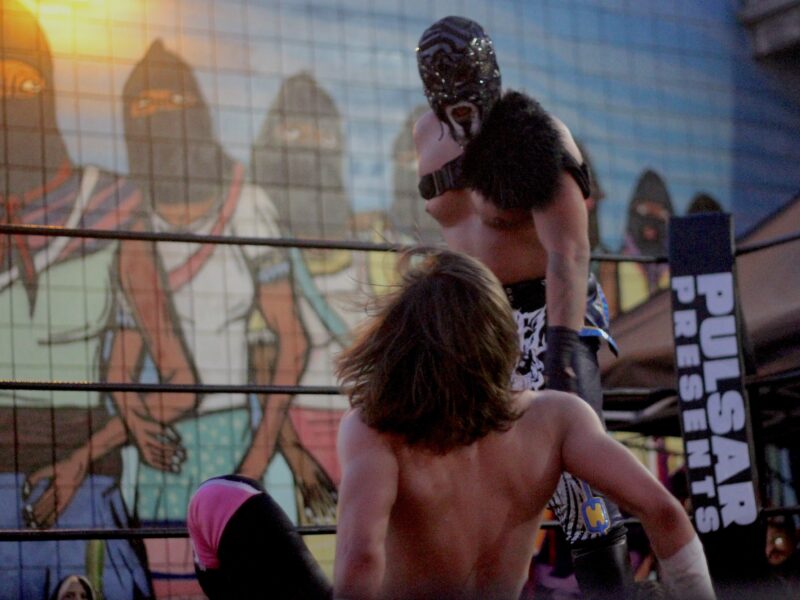
SAN DIEGO (CN) — It’s brother-versus-brother, mask-versus-mask. Sweaty, grimy lucha-on-lucha violence.
A mess of limbs, hair, tattoos and latex twist on the mat as luchador Skalibur, veins bulging, takes on his younger brother Kamik-C under the dim lights at Queen Bee’s Banquet Hall in San Diego’s North Park neighborhood.
The pair trade flying kicks and running clotheslines, clobbering each other onto the wrestling mat.
There’s a satisfying clap each time as flesh bounces off the padded wooden boards. The audience reaction, tepid at first, picks up as the mayhem escalates.
This is lucha libre, Spanish for “free fight,” a theatrical style of wrestling with roots on both sides of the border.
These men are the 420 Brothers from Mexicali, Baja California’s capital. They won’t share their real names — or for that matter, much of anything about their personal lives. Such details are often kept secret when it comes to lucha, a time-honored Mexican tradition that’s increasingly gaining prominence in the United States.
Both men are in their 30s. Skalibur is a few years older than Kamik-C, but the two are equally physically matched. They’re both slender, but with whipcord arms and sinewy, muscular torsos. But Skalibur has one big advantage: He has years more experience than his brother.
About 20 minutes in, the brothers’ exhaustion is apparent under their ornate lucha masks.
The more experienced Skalibur has the upper hand. He delivers a reverse piledriver on Kamik-C before pinning him for a final time.
The referee hammers his arm on the mat, giving the count in Spanish. Uno, dos, tres — and it’s a victory for Skalibur.
The crowd erupts in applause, spilling beer all over the wooden floor as they raise their cups in celebration. Skalibur is advancing, with another fight scheduled at Queen Bee’s on May 1.
The two brothers shake hands and embrace.
Defeated but not demoralized, Kamik-C grabs his brother’s wrist and hoists it into the air, prompting another round of applause.

Like his brother, Kamik-C has been in the lucha scene for much of his life.
His career started at just 7 years old, when he was a mascot for the luchador Hormiga Atómica, or “Atom Ant.” He made his wrestling debut at 18 in 2013. His name and persona — in wrestling, the technical term is a “gimmick” — is a nod to World War II-era kamikaze pilots.
Lucha is a cultural powerhouse in Mexico, where its vibrant masks and high-flying acrobatics have become a national symbol. And yet lucha has history and fans on both sides of the border.
In the United States, the style is a major undercurrent in wrestling. Luchadors regularly show up at small competitions across Southern California and anywhere with Mexican influence — which is to say, basically all of the United States. Americans might think of lucha as mainstream wrestling’s Mexican cousin. You won’t see TV advertisements for these events, but you might find flyers plastered at music venues and taco shops.
For fans and fighters like Kamik-C, it’s a lifestyle.
In a post-fight interview, Courthouse News managed to pry a couple details from the man behind the mask. He jogs and trains at the gym every day, going to wrestling practice a couple times each week. He works a normal 9-to-5 — but he won’t say much more than that. In this world, the lucha always comes first.
Even those who have never seen a lucha would likely recognize the flashy mask of a luchador.
El Santo or “The Saint” was the first major one, appearing at events in Mexico in the 1950s. Mil Máscaras or “Thousand Masks” helped break masked wrestling into the United States’ mainstream, appearing at a fight in Madison Square Garden in 1977. In 2018, Mexico City officially recognized lucha libre as part of its intangible cultural heritage.
In important ways, lucha libre is distinctly Mexican: The idea of masking for fights dates back to Aztec times, when elite warriors wore ornate masks into battle.
What’s less known is how the medium also found inspiration in the United States. The father of lucha libre, Salvador Lutteroth aka Don Chava, supposedly got the idea after attending a wrestling event in El Paso, Texas. Lucha libre has always been a cross-border dialogue, dating from an era when the U.S.-Mexico border was a lot less hardened than it is now.
Santos Escobar, a WWE performer from Mexico, has explored this history on his podcast “Lucha Libre: Behind the Mask.”
As Escobar tells it, Mexican wrestlers in the United States were often subject to discrimination from both fans and authorities. He recounts one apocryphal incident, where a lawman supposedly pulled a gun on a Mexican wrestler to prevent him from winning against an American.

Don Chava wanted a venue where Mexican wrestlers could compete fairly, without threats of violence. In 1933, he started the company Empresa Mexicana de Lucha Libre. It still exists today as Consejo Mundial de Lucha Libre. He started hosting events in Mexico City, giving working-class people a new form of entertainment that wasn’t boxing or the circus.
In a twist of historic irony, the first masked luchador was actually an American from Missouri: Corbin James Massey aka “Cyclone Mackey.”
Lutteroth put him in a red mask in 1934. Massey became La Maravilla Enmascarada or “The Masked Marvel,” a mysterious figure who baffled and fascinated audiences.
The trend stuck around. Masking, it turned out, has benefits.
“There’s value to keeping your name secret — and the mask makes that possible,” Escobar says on his podcast. “The mask is also your source of power. Because no one knows who you are, you can be whoever you want to be.”
“I have had the opportunity to wear a mask in my career,” Escobar goes on. “I can tell you, when you put it on and walk into that ring, you feel invincible.”
The history of lucha libre is still being written. Last year, WWE bought Mexico’s leading promotion, giving the sport a whole new level of visibility with audiences in the United States.
Even so, the purest form of lucha libre is arguably the version at scrappy underdog events.
Take Pridestyle Pro, an indie wrestling organization that primarily hosts events in San Diego and Las Vegas. It’s run on a slim budget by a group of volunteers.
One big difference from major, televised WWE events is the intimacy, owner Milhouse Malott said in an interview.
“If you go to a WWE event, you’re 25 feet from the ring, [and] you’re paying $5,000,” said Malott, a would-be wrestler turned wrestling organizer. In indie wrestling, for better or worse, audience members are part of the action. One must be quick on their feet, in case a chair or luchador comes flying out of the ring and into the crowd.
“What we really focus on is curating the environment and the experience,” Malott said. “It’s like going to a block party.” Summing up the vibe at Pridestyle Pro events, he said: “It’s Rocky Horror Picture-esque.”

Another big difference between major and indie wrestling is that performers in the indie circuit don’t sign contracts as they would in big leagues like WWE.
“On our level, they are independent contractors,” Malott said. “It’s tough for a lot of these wrestlers. It’s definitely a grind. After the show or in intermission, the wrestlers sell merchandise. This isn’t their full-time job. They feel like real people,” an effect heightened by the fact that many have ordinary 9-to-5s.
That said, don’t let these humble trappings undermine the talent. These guys are still pros, most of them with years of experience.
The differences between indie wrestling and lucha libre are harder to pin down. Perhaps there exists a spectrum, with lucha on one side and all-American wrestling on the other. Most fall somewhere in between. That’s particularly true in places like San Diego, where — with Tijuana just across the border — there’s a medley of styles, with many wrestlers coming from Mexico to perform.
“Tijuana is a hotbed for wrestling,” Malott noted. “There’s also an awesome talent pool. It infiltrates the California scene especially, because there are a lot of Latinos in California.”
Lucha libre is evolving to become more inclusive. With the motto a “safe place for violence,” Pridestyle Pro is one of a growing number of wrestling organizations that explicitly bills itself as being LGBTQ-friendly.
Although it was historically men behind the masks, women fighters or luchadoras have also taken a more prominent role in the sport. Once such luchadora is Lady Lee, who got her professional start in 2003. A proud Tijuana native, she’s earned a reputation as a “ruda” — the luchaverse version of villains, though the moral lines can get blurry. Rudos bring aggressive behavior and a willingness to break rules into the ring, in contrast to tecnicos, the stereotypical good guys.
These days, Lady Lee balances being a mom with her role as an instructor at La Escuela Lucha Libre de Lady Lee, a luchador training academy in her hometown of Tijuana. The school helps hopeful luchadors achieve their dreams in the ring.
“I love what I do, and I enjoy every moment that I spend in the lucha and with the public,” Lee said in a social media message in Spanish. “If I was born again, I would still be a luchadora.”

Becoming a luchador requires a range of skills, from strength training and safety techniques to just knowing how to put on a good show.
At his gym in San Diego, owner, coach and indie-circuit wrestler Juan Mattioli teaches aspiring fighters the basics. The school offers a 12-month program, where would-be wrestlers of all stripes can hone their skills before the first match.
Cardio is important, as running around a ring and throwing around rivals can quickly become exhausting. So is strength. But physical control is the main skill: If a performer has the strength to pull off a maneuver but lacks the control to execute it cleanly, both wrestlers could get injured.
“We’re big on cardio, but it’s more just being in control of the body,” Mattioli explained in a phone interview from his gym. “It’s almost like reteaching your body to do different things.”
Being safe means staying loose, tucking the chin and landing on the back during falls.
Injuries are an inevitable part of the sport — but they can derail a wrestler’s entire career. The goal is to minimize them as much as possible.
Learning throws, jabs and slams is just the technique. The real art comes next, with the storylines and characters that go into each match.
That part — the creativity — is harder to train for at a gym. For that, one must spend time in the luchaverse, developing a sense for the drama and learning what makes audiences tick.
Another day, another lucha in San Diego — this time at Mujeres Brewing in Barrio Logan near downtown.
This match has been organized by Pridestyle Pro. After nearly three hours of body slams, dropkicks, and open-palm punches, the sun has gone down. Just one fight remains, and it’s SoCal against NorCal. Los Angeles’s Chris Nastyy aka the Lucha Scumbag is taking on Oakland’s Alpha Zo aka the Blue Demon.
The two fighters are evenly matched throughout the night. They take turns wailing on each other, dropping each other onto the mat with a heavy smack or bouncing off the ropes to clobber the other with a perfectly timed clothesline.

This match is outside, under power lines and swaying palm trees. A cool breeze blows in from the San Diego Bay. It’s clear who this Southern California audience is rooting for. “Nastyy! Nastyy! Nastyy!” the crowd chants from makeshift bleachers around the ring.
Exhaustion is apparent in both fighters as the match draws to a close.
After repeated failures to pin Alpha Zo, Nastyy finally puts him into a cradle, pinning Zo’s head against his knee. Three, two, one — and with that, Nastyy is Pridestyle Pro’s world champion. He climbs the ropes and triumphantly hoists his belt over his head. Then the wrestlers head into Mujeres Brewing, where rivalries dissipate over cold beers.
There’s a familiar cadence after matches like these. Workers mop up spilled beer and sweat. Pieces of a chair, broken over a luchador’s back at some point, are thrown away or taken home by a fan as a souvenir.
The audience trickles into the street, heading for the nearest bar or taco truck. Luchadors peel off their masks and kick off their boots. Backstage, the storylines are put on pause. Bitter rivals go back to being friends and colleagues.
Some performers will head back home to Mexico. Others will perhaps get ready for another match. After that, a week of ordinary routines. Work. Family. School. Church. Chores. Then Friday hits, the show resumes, and these ordinary people are once again heroes and villains.
Subscribe to our free newsletters
Our weekly newsletter Closing Arguments offers the latest about ongoing trials, major litigation and rulings in courthouses around the U.S. and the world, while the monthly Under the Lights dishes the legal dirt from Hollywood, sports, Big Tech and the arts.
Additional Reads


 EU suspends funds for Serbia over law reforms May 1, 2026