
 Search Articles


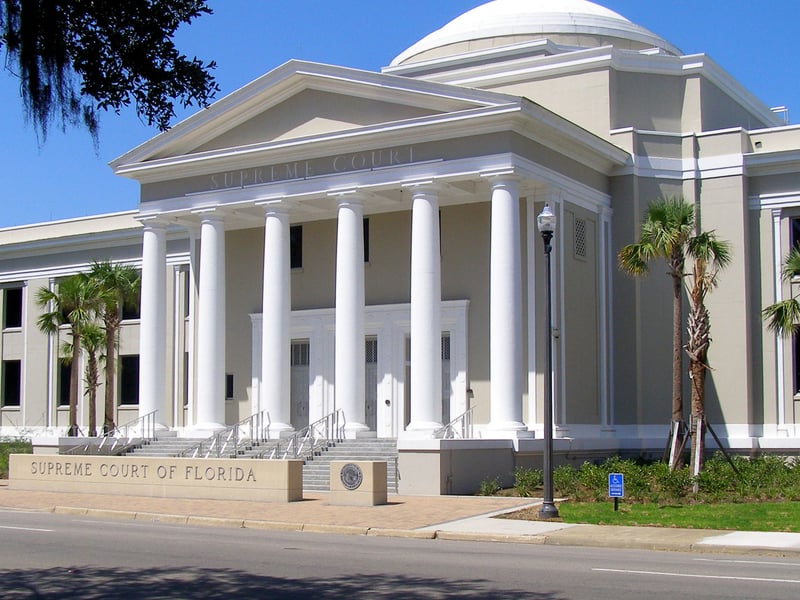
WASHINGTON (CN) — The Federal Trade Commission sent a letter Tuesday supporting the Supreme Court of Florida’s effort to reduce its reliance on the American Bar Association.
“We applaud the amendment,” the directors of the FTC’s Office of Policy Planning and Bureau of Competition wrote in the 14-page letter. “These important efforts surely make the ABA’s monopoly less secure.”
The letter comes after the Florida high court amended on Jan. 15 a policy requiring bar exam applicants to attend a law school accredited by the American Bar Association. The amendment allows applicants to attend law schools accredited by other accreditors.
“The court is persuaded that it is not in Floridians’ best interest for the ABA to be the sole gatekeeper deciding which law schools’ graduates are eligible to sit for the state’s General Bar Examination and become licensed attorneys in Florida,” the justices wrote in a per curiam opinion. “The court’s goal is to promote access to high-quality, affordable legal education in law schools that are committed to the free exchange of ideas and to the principle of nondiscrimination.”
The FTC directors expressed their displeasure with the use of professional boards and trade associations, which they claim undermine competition.
“The ABA, unfortunately, has a long history of using its law school accreditation monopoly to harm competition,” the directors wrote. “It forces every law school to follow its preferred costly, elitist model of legal education.”
The directors claim the American Bar Association’s accreditation system harms consumers and potential attorneys.
“By increasing the costs of legal education, the ABA’s excessive accreditation standards also limit the supply of new lawyers. With fewer lawyers available, consumers may struggle to access legal services and pay more dearly when they do,” the directors wrote. “Thus, ABA accreditation serves the interests of lawyers and law school faculty who dominate the ABA and council while injuring consumers of legal services and saddling law students with high costs.”
Florida’s high court created a workgroup in March 2025 to analyze potential alternatives, partially due to a diversity and inclusion standard that the all-Republican-appointed justices took issue with.
“Consistent with sound legal education policy and the standards, a law school shall demonstrate by concrete action a commitment to diversity and inclusion by providing full opportunities for the study of law and entry into the profession by members of underrepresented groups, particularly racial and ethnic minorities, and a commitment to having a student body that is diverse with respect to gender, race and ethnicity,” Standard 206 reads. “Consistent with sound educational policy and the Standards, a law school shall demonstrate by concrete action a commitment to diversity and inclusion by having a faculty and staff that are diverse with respect to gender, race and ethnicity.”
The American Bar Association suspended the enforcement of the standard until at least the end of August in February 2025 after facing pressure from the Trump administration.
The amendment extends accreditation authority to certain types of accrediting agencies recognized by the U.S. Department of Education and, where appropriate, approved by the court. Justice Jorge Labarga dissented from the majority on the amendment.
“Regrettably, under the guise of expanding the accrediting agencies for law schools in Florida, the majority has taken the extraordinary step of divesting the ABA of its three-decade-long status as the sole accreditor of Florida law schools,” Labarga wrote. “Crucial to Florida, as the sole law school accreditor for three decades, the ABA has cultivated unmatched proficiency in dealing with Florida law-school-specific issues that would require decades for any successor to develop. As is the case with any large entity engaged in providing service to the public, refinements can always be made. However, replacing an established entity with an unknown alternative is detrimental in the context of disputes.”
The American Bar Association has been the sole accreditor of Florida’s law schools since 1992, helping to foster the admission of over 115,000 applicants to the Florida Bar, making it the third-largest state bar association in the country.
Admission standards vary by state, with 35 requiring applicants to attend an American Bar Association-accredited school or graduate from non-ABA-accredited law schools and meet specific legal practice requirements. States including Alabama and Massachusetts permit graduates of some non-accredited state schools, while California, Virginia, Vermont and Washington permit applicants who haven’t attended law school, so long as they complete a structured apprenticeship or law office study program over a set number of years. Currently, 15 states only permit applicants who’ve attended American Bar Association-accredited schools.
The Texas Supreme Court recently proposed a similar amendment, placing the burden of selecting accredited schools on the court rather than the American Bar Association. The initiative from Florida aligns with efforts in states like Tennessee and Ohio to seek similar changes.
Tuesday was the deadline to submit comments to the court.
Subscribe to our free newsletters
Our weekly newsletter Closing Arguments offers the latest about ongoing trials, major litigation and rulings in courthouses around the U.S. and the world, while the monthly Under the Lights dishes the legal dirt from Hollywood, sports, Big Tech and the arts.