
 Search Articles


ATLANTA (CN) — As elections in Georgia, a key battleground state, draw national scrutiny in the wake of the upcoming presidential election, Republican activists asked a judge Thursday to force a county to remove people they believe are ineligible from its voting rolls.
Citizen AG, a non-profit election integrity organization representing Georgia Republican Party-connected activists Jason Frazier and Earl Ferguson, seeks to allow the removal of voters from Georgia’s voter registration rolls within 90 days of election day, a period protected by the National Voter Registration Act.
During the hearing, Citizen AG attorney Nicole Pearson argued that Fulton County, which encompasses Atlanta, should be required to remove ineligible voters within the 90-day period if they are identified in an individual voter challenge from a county resident. Pearson argued the law’s allocated time period applies only to the systemic, routine purging of voter rolls by the state.
In their lawsuit against the Fulton County Department of Registration and Elections, its board members and Georgia Secretary of State Brad Raffensperger, Frazier and Ferguson say they submitted voter challenges last month based on residency concerns, but the county declined to hold hearings.
U.S. District Judge Steve Jones proposed ordering the county to conduct hearings on Frazier and Ferguson’s submitted challenges, noting that they are the only two plaintiffs listed on the complaint. But Pearson argued that would not be a sufficient enough remedy for what they seek, prompting the judge’s decision to allow her to amend the complaint to reflect Fulton County voters as a whole.
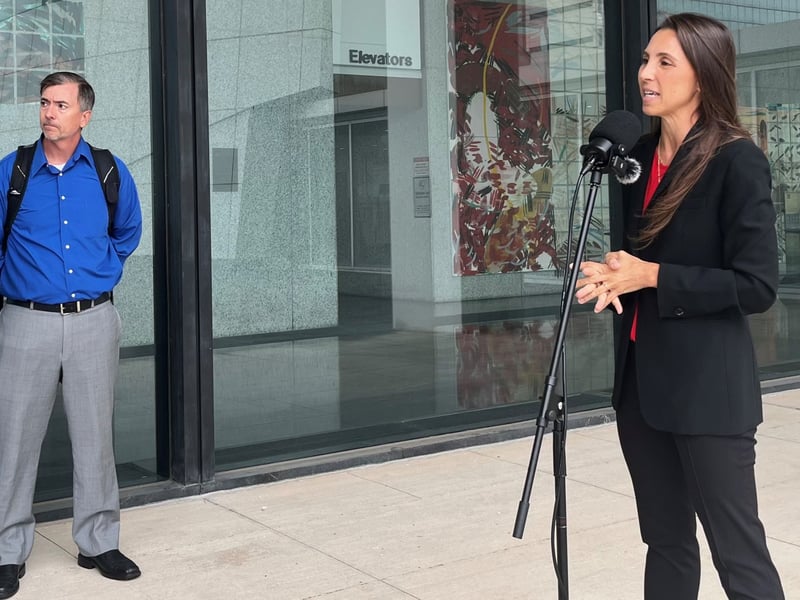
“We want to make it very clear that this is about everyone’s constitutional right to vote and have that vote count in the election,” Pearson told reporters after the hearing.
Jones said after the amended complaint is filed and the other parties respond, he will will hold another hearing, likely at the end of September.
The judge also approved a motion to intervene filed Wednesday night by the New Georgia Project Action Fund, which argues that the lawsuit seeks to weaponize the Voting Rights Act to purge voters from the rolls on the eve of an election and should be dismissed.
“Their complaint declares that thousands of ineligible voters remain on Fulton County’s voter rolls but offers no factual support for this conclusion. They fault Fulton County’s Department of Registration and Elections for refusing to consider their voter challenges during the NVRA’s 90-day quiet period, but never reveal the grounds for their challenges, or the evidence they presented,” the organization wrote.
Pearson told the judge that their interests align in upholding the integrity of Georgia’s elections.
Frazier, an urban farmer and chairman of the newly created Georgia Republican Assembly Election Integrity Action Group, has filed about 10,000 voter challenges in Fulton County. He is one of just a handful of conservative activists who, often assisted by right-wing organizations, have taken on a greater role in launching a flurry of voter challenges across Georgia over the past three years citing fear of widespread fraud.
After the 2020 election, from which former President Donald Trump’s charges in Fulton County stem for falsely claiming he won, Georgia’s Republican-controlled legislature passed a law in 2021 allowing anyone in the state to challenge an unlimited number of voters.
Last year, Georgia’s Republican Party sought twice to appoint Frazier to the Fulton County Board of Registration and Elections. But the Democratic-led County Commission rejected his appointment, saying his mass voter challenges undermined public confidence in elections.
In 2022, voter fraud hunters challenged 92,000 state voter registrations, most of which were rejected by county boards. County election boards upheld about 5,800 of the challenges, according to an accounting by Fair Fight, a Georgia nonprofit aimed at addressing voter suppression.
In January, a judge sided against Fair Fight’s claims that Texas-based conservative group True the Vote engaged in voter intimidation when it challenged more than 360,000 Georgia voters’ eligibility.
Fair Fight and other voting right advocates argue such mass voter challenges disproportionately affect Democratic voters, Black voters and those experiencing homelessness or escaping domestic abuse, as well as relocated workers, students or military members who may have mail forwarded to different addresses.
 Follow @Megwiththenews
Subscribe to our free newsletters
Our weekly newsletter Closing Arguments offers the latest about ongoing trials, major litigation and rulings in courthouses around the U.S. and the world, while the monthly Under the Lights dishes the legal dirt from Hollywood, sports, Big Tech and the arts.