Search Articles


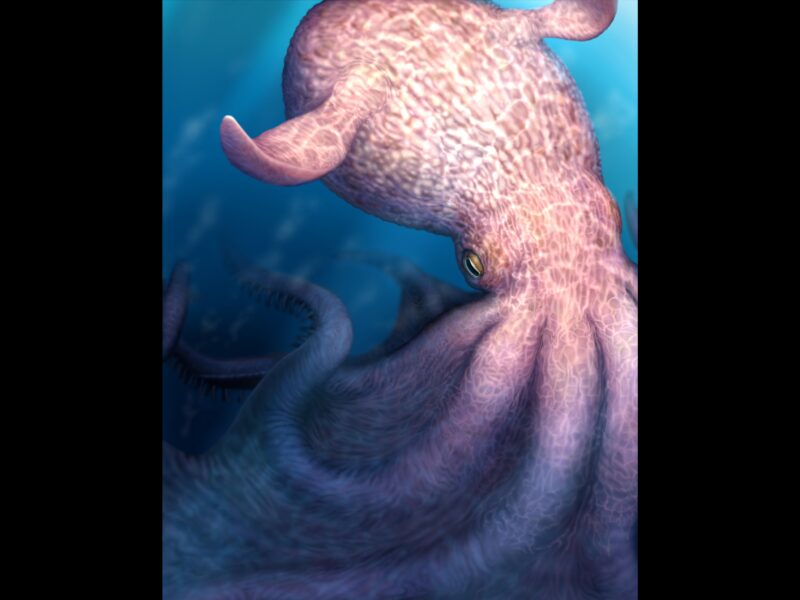
(CN) — Researchers say giant “kraken-like” octopus relatives, some stretching nearly 19 meters, likely competed with apex predators like marine reptiles and sharks.
Findings publishedThursday in the journal Science are based on an analysis of fossilized jaws, or beaks, from ancient octopus relatives. Those structures, one of the few parts of an octopus that can fossilize, preserve clues about both size and diet.
Researchers reexamined 15 known specimens and identified 12 additional jaws using digital imaging techniques, focusing on two species: Nanaimoteuthis jeletzkyi and Nanaimoteuthis haggarti. The latter appears to have reached especially large sizes, rivaling or exceeding the length of modern giant squid.
“There is a range in the estimates, but we are confident that these animals were extremely large,” said Yasuhiro Iba of Hokkaido University in an email. “The estimates are based on well-established relationships between jaw size and body size in modern finned octopuses. For Nanaimoteuthis haggarti, total length is estimated at about 6.6 to 18.6 meters.”
The jaws themselves showed clear signs of heavy use.
“The jaws show chips, scratches, polished surfaces, and rounded edges. These features indicate repeated crushing of hard structures such as shells and bones,” Iba said.
That kind of wear is similar to what scientists see in modern cephalopods that feed on hard-shelled prey, though the damage in these fossils appears more intense.
Researchers say that suggests these animals regularly consumed organisms with tough exteriors, including large bivalves, crustaceans, fish and other cephalopods.
“There are three main lines of evidence,” Iba said. “First, body size. Nanaimoteuthis haggarti reached a size comparable to large vertebrate predators of its time. Second, jaw structure. The jaws were very strong and well adapted for processing prey. Third, jaw wear. The adult jaws show intense wear, indicating repeated processing of hard materials such as shells and bones.”
“Taken together, these features suggest that these octopuses occupied the very top of the Cretaceous marine food web," Iba continued.
For decades, scientists have largely viewed vertebrates as the dominant predators in those environments. The new findings suggest that picture may be incomplete.
“Traditionally, the top of the marine food web in the Cretaceous has been thought to be dominated by vertebrates,” Iba said. “Our study shows that giant invertebrates — octopuses — also occupied that top tier.”
Understanding the role of animals like these has been difficult in part because of how rarely they fossilize.
“The main reason is preservation,” Iba said. “Octopuses have soft bodies and lack hard external shells, so most of their anatomy is lost after death.”
New techniques are helping change that. By using digital methods to identify fossils hidden inside rock, researchers are beginning to build a clearer picture of how these animals lived and what role they played.
“This means that Cretaceous marine ecosystems were more complex than previously thought, with a broader range of apex predators,” Iba said.
Subscribe to our free newsletters
Our weekly newsletter Closing Arguments offers the latest about ongoing trials, major litigation and rulings in courthouses around the U.S. and the world, while the monthly Under the Lights dishes the legal dirt from Hollywood, sports, Big Tech and the arts.