
 Search Articles


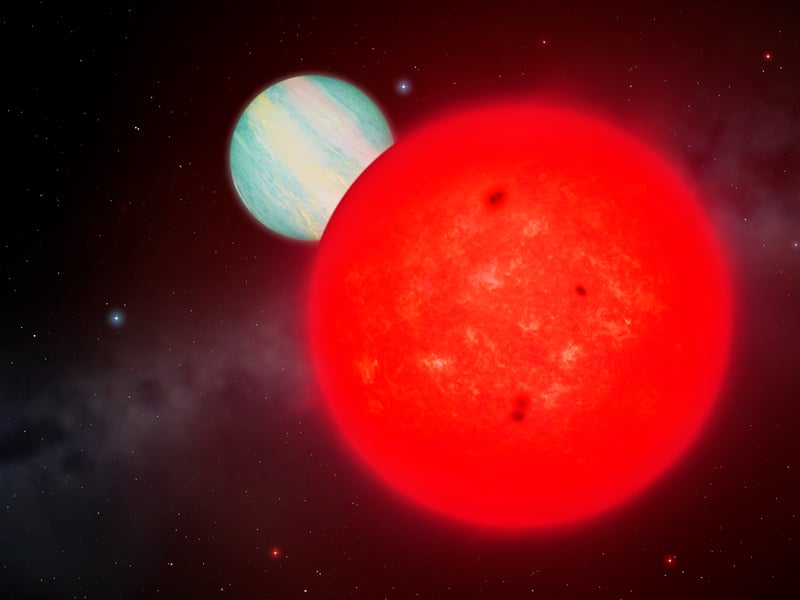
(CN) — Astronomers have discovered a giant planet orbiting a star that’s barely one-fifth the mass of our Sun — one of the smallest stars known to host a planet this big. The star, TOI-6894, is a tiny red dwarf previously thought unlikely to have big gas giants.
Published Wednesday in the journal Nature Astronomy, an international team of astronomers found clear evidence of a giant planet called TOI-6894b orbiting the star. They say it challenges existing ideas about how gas giants develop around smaller stars.
“I was very excited by this discovery,” said Edward Bryant, Warwick Astrophysics Prize Fellow and lead author of the study, in a press release. “I originally searched through TESS observations of more than 91,000 low-mass red-dwarf stars looking for giant planets. Then, using observations taken with one of the world’s largest telescopes, ESO’s VLT, I discovered TOI-6894b, a giant planet transiting the lowest mass star known to date to host such a planet. We did not expect planets like TOI-6894b to be able to form around stars this low-mass. This discovery will be a cornerstone for understanding the extremes of giant planet formation.”
TOI-6894b is a gas giant with a radius slightly larger than Saturn’s but only about half its mass, making it unusually low in density, researchers say. The host star is the smallest known to have a transiting giant planet and is about 60% the size of the next smallest star with such a planet.
“Most stars in our Galaxy are actually small stars exactly like this, with low masses and previously thought to not be able to host gas giant planets,” said Daniel Bayliss, associate professor at Warwick, in the press release. “So, the fact that this star hosts a giant planet has big implications for the total number of giant planets we estimate exist in our Galaxy.”
Researchers say this discovery shows that the usual explanation for how giant planets form might not work for stars this small. The theory, called core accretion, says dust and gas gather around a young star to build a solid core that then pulls in gas to become a giant planet. But with low-mass stars, there usually isn’t enough material to grow a big enough core.
“It’s an intriguing discovery,” said Vincent Van Eylen from UCL’s Mullard Space Science Laboratory, in the press release. “We don’t really understand how a star with so little mass can form such a massive planet! This is one of the goals of the search for more exoplanets. By finding planetary systems different from our solar system, we can test our models and better understand how our own solar system formed.”
Bryant said TOI-6894b might have formed through an intermediate core-accretion process, where a protoplanet steadily gathers gas without the core triggering runaway gas accretion. Alternatively, it could have formed from a gravitationally unstable disk, which breaks apart and collapses to form planets.
“Neither theory completely explains the formation of TOI-6894b based on current data,” he said.
According to researchers, studying the planet’s atmosphere could provide clues.
Unlike many gas giants known as “hot Jupiters” with temperatures around 1,000 to 2,000 Kelvin, TOI-6894b is cooler, at about 420 Kelvin. Its atmosphere is expected to be dominated by methane, which is rare in exoplanets, and may also contain ammonia, never before seen in an exoplanet atmosphere.
“Based on the stellar irradiation of TOI-6894b, we expect the atmosphere is dominated by methane chemistry, which is exceedingly rare to identify,” said Professor Amaury Triaud of the University of Birmingham, in the press release. “Temperatures are low enough that atmospheric observations could even show us ammonia, which would be the first time it is found in an exoplanet atmosphere. TOI-6894b likely presents a benchmark exoplanet for the study of methane-dominated atmospheres and the best ‘laboratory’ to study a planetary atmosphere containing carbon, nitrogen, and oxygen outside the Solar System.”
The James Webb Space Telescope is scheduled to observe TOI-6894b’s atmosphere within the next year. Those observations could help determine which formation theory fits.
“This system provides a new challenge for models of planet formation, and it offers a very interesting target for follow-up observations to characterize its atmosphere,” said Andrés Jordán, a co-author and professor at Adolfo Ibáñez University, in the press release. “This discovery is the result of a systematic program we have been carrying out for several years from Chile and the UK. Our efforts have allowed us to contribute significantly to a better understanding of how often small stars can form giant planets, and we are providing prime targets for follow-up with space-based platforms.”
Subscribe to our free newsletters
Our weekly newsletter Closing Arguments offers the latest about ongoing trials, major litigation and rulings in courthouses around the U.S. and the world, while the monthly Under the Lights dishes the legal dirt from Hollywood, sports, Big Tech and the arts.