
 Search Articles


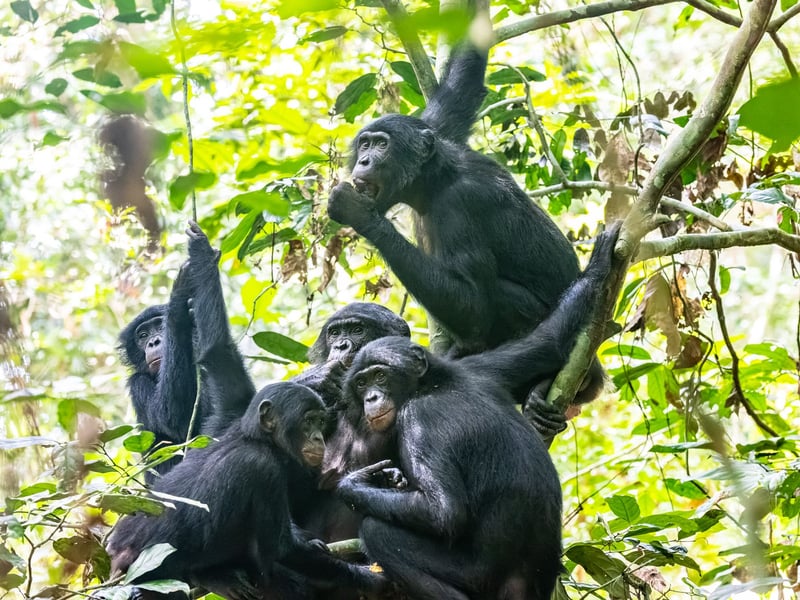
(CN) — Bonobos are humans’ closest living relatives, and researchers expected them to follow the roles of most social mammals where males dominate females, decide when to mate and who gets to eat first. But to the surprise of an international research team, female bonobos reverse the roles.
In their study published Thursday in Communications Biology, Barbara Fruth of the Max Planck Institute of Animal Behavior and Martin Surbeck of Harvard University, along with an international team of colleagues, compiled 30 years of data collected from six wild bonobo communities across three field sites in the Democratic Republic of the Congo, the only country where bonobos live in the wild.
Male bonobos are larger and stronger than the females, so theoretically they could physically overpower females in the over 1,700 male-female bonobo conflicts the researchers studied. Instead, the females won over 1,000 of those fights by forming gangs that the researchers called “coalitions.”
Currently, the researchers don’t know how female bonobos generally form these coalitions. After all, adult females immigrate from other communities, so none of the females formed a familiarity through a shared childhood. The team does know that coalitions can form in an instant, such as when females band together to protect a young bonobo from one of the males.
When a coalition does form, the researchers said the first signal is the ear-piercing screams of females, sometimes followed by the coalition delivering fatal injuries against the offending male.
“You can win a conflict by being stronger, by having friends to back you up, or by having something that someone wants and cannot take by force,” said Surbeck, who runs the Kokolopori bonobo research station. “It’s a ferocious way to assert power. You know why these males don’t try to overstep boundaries.”
Females won 61% of the observed conflicts and outranked 70% of the males on average, but that dominance varied depending on the population. Rather than rely solely on group numbers, the researchers think that the females combine that with reproductive strategies like hiding their ovulation cycles from the males.
That way, males are more likely to stay near the females in a friendly capacity and wait for a fertile female to choose him rather than attempt coercion, risking a failed attempt at impregnation and incurring the wrath of nearby females.
“It’s more accurate to say that in bonobo societies, females enjoy high status rather than unchallenged dominance,” said Fruth, leader of the LuiKotale bonobo research station for the last 30 years.
With these results in mind, the team has a collective desire to pursue more testing due to some unanswered questions, like how they don’t know why male bonobos don’t copy the female strategy of forming gender-based groups to obtain power, though Surbeck had one idea.
“The males’ closest allies are their mothers, as having a living mother in their communities increases their chances of siring offspring substantially,” said Surbeck via email. “Otherwise, they compete very individualistically. One theory is that given females have such a high rank, the males’ mothers are their most effective ally through their shared common genes, so they do not form coalitions with other males.”
“I’m still puzzled why, of all animals, bonobos were the ones to form female alliances,” said Fruth. “We might never know, but it gives me a glimmer of hope that females of our closest living relatives, in our evolutionary line, teamed up to take the reins of power alongside males.”
 Follow @kndrleon
Subscribe to our free newsletters
Our weekly newsletter Closing Arguments offers the latest about ongoing trials, major litigation and rulings in courthouses around the U.S. and the world, while the monthly Under the Lights dishes the legal dirt from Hollywood, sports, Big Tech and the arts.