
 Search Articles


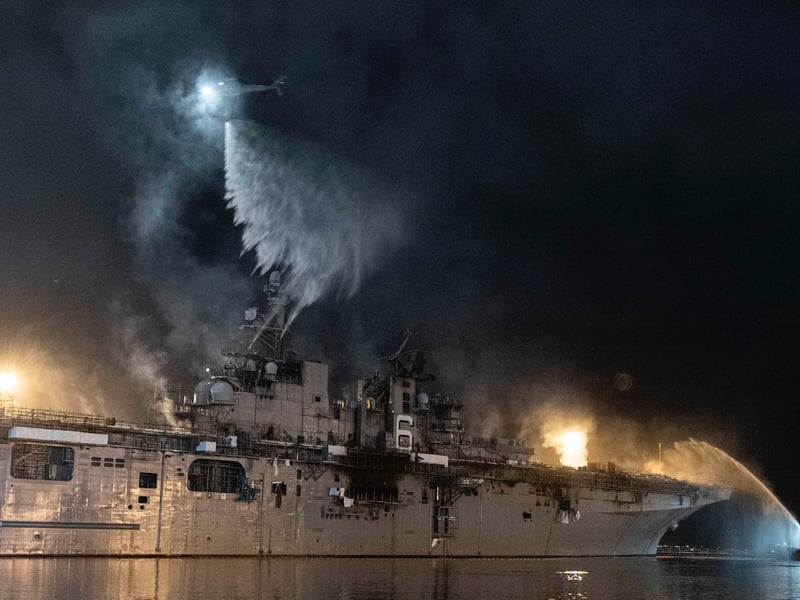
SAN DIEGO (CN) — A federal judge ruled that the U.S. and the Navy must face a lawsuit brought by a subcontractor seeking damages from a fire that destroyed their equipment when a billion dollar assault ship caught fire in 2020 because the subcontractors didn’t have a contract with the government or the Navy.
In July 2020, a fire erupted on board the USS Bonhomme Richard, a U.S. Navy amphibious assault ship docked in San Diego Bay. The fire lasted for four days, injuring dozens of sailors and civilians, and destroying the more than a billion dollar ship itself.
Two years before, National Steel and Shipbuilding Co. was awarded a contract to perform repair work on the USS Bonhomme Richard. The company then subcontracted part of its repair work out to California Marine Leaning Inc., leading to the destruction of some of California Marine Cleaning’s equipment on board when the fire broke out in 2020.
The company sued the federal government through the Department of the Navy in 2022 for ultrahazardous activity, for storing large amounts of flammable and combustible fuel on the USS Bonhomme Richard, and for negligence for not segregating and properly protecting that combustible material.
The government argued that the case should be dismissed for lack of subject matter jurisdiction since the dispute is related to a government contract, and the company should have gone through administrative remedies outlined in the Contract Disputes Act, but U.S. District Court Judge Larry Alan Burns, a George W. Bush nominee, didn’t buy it.
“Cal Marine hasn’t claimed any contractual right or obligation. In fact, it doesn’t have a contract with the Navy. Absent a contract between the United States and Cal Marine, officials who administer CDA claims don’t have jurisdiction over any claims brought by Cal Marine directly,” Burns wrote in his ruling on Wednesday. “Instead, the complaint refers to common law negligence principles as a source of rights. Negligence, strict liability based on ultrahazardous activity, and respondeat superior all lie outside of contract law, rendering the CDA inapplicable to Cal Marine’s tort claims.”
Burns also ruled that the company’s tort claims are sound in admiralty, or maritime, law because the fire happened when the ship was docked at Naval Base San Diego while it was undergoing repairs and maintenance, and the fire was potentially disruptive on maritime commerce because it could have spread to nearby ships, or made the marina inaccessible, and because “maintenance or repairs of a vessel at a marina on navigable waters is related to maritime activity.”
The company also filed for a request for judicial notice, which established a fact in the case that isn’t the subject of reasonable doubt, which Burns partially denied, other than four points: that the ship was owned by the U.S., that a fire occurred on the ship in July of 2020, and damages were caused by the fire, and that the ship was in navigable waters at the time of the fire.
In 2021, the Navy itself released a report that concluded that the fire was preventable and caused by the Navy’s failure to follow its own policies, including policies around properly handling and storing hazardous and combustible materials, fire safety standards, lapses in training, communications, and making sure unauthorized people didn’t enter the ship.
After the fire, multiple senior officers and sailors in the Navy were disciplined. The Navy also pursued an arson charge against seaman apprentice Ryan Sawyer Mays in a military court. Mays was acquitted of the charge last year.
Attorneys for both California Marine Cleaning and the U.S. government did not immediately return requests for comment.
Subscribe to our free newsletters
Our weekly newsletter Closing Arguments offers the latest about ongoing trials, major litigation and rulings in courthouses around the U.S. and the world, while the monthly Under the Lights dishes the legal dirt from Hollywood, sports, Big Tech and the arts.