
 Search Articles


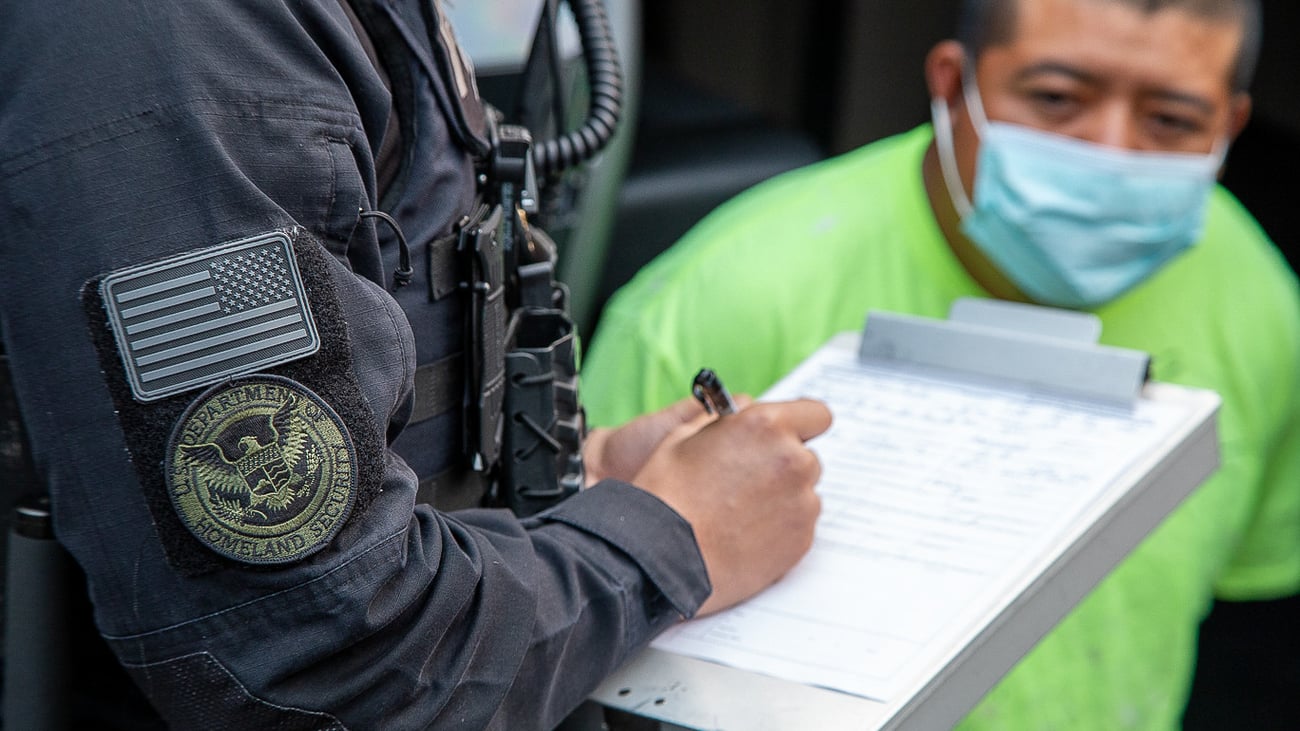
WASHINGTON (CN) — President Donald Trump heads to the Supreme Court next week in search of a shortcut to deport certain green card holders.
A key benefit for lawful permanent residents, as they are formally known, is being able to travel freely abroad without the fear of being denied admission back into the United States. The Trump administration wants to instead apply a “parole-and-see” approach, leaving some green card holders open to removal proceedings.
The complex statutory question before the Supreme Court only directly applies to green card holders who are convicted of certain crimes, but advocates worry it creates a dangerous legal limbo.
“Lawful permanent residency is meant to provide stability and the freedom to live a settled life in the United States,” immigrant advocacy groups told the court. “But when the government imperils that status based on the mere existence of an unproven criminal allegation, it converts permanent residency into a precarious and revocable privilege.”
Two-path track
The Immigration and Nationality Act includes a two-pronged approach for expelling immigrants with temporary or permanent legal status in the United States. Under the statute, those falling into the latter bucket — lawful permanent residents — are subject to deportation proceedings, whereas immigrants in the first bucket can be removed through inadmissibility proceedings.
While both deportation and inadmissibility removal have the same end point, their proceedings and requirements vary. Immigrants without legal status can be admitted into the United States on parole, granting them temporary permission to enter the country. While physically on U.S. soil, they are still legally considered to be at the border for purposes of immigration laws.
Lawful permanent residents aren’t considered to be seeking admission into the United States for the purposes of immigration laws when returning from travel abroad. Therefore, they are not typically paroled into the United States unless they meet a limited set of exceptions.
The Supreme Court will focus on the exception for individuals who commit a crime involving “moral turpitude.”
The government wants to remove Muk Choi Lau — who has been a lawful permanent resident since 2007 — under inadmissibility proceedings. While facing pending charges for trademark counterfeiting in 2012, Lau traveled to his home country of China for a short visit. Lau pleaded guilty and was sentenced to probation after returning to the U.S.
Even though he hadn’t yet been convicted at the time, the government says Lau’s reentry into the U.S. exempted him from the privileges of his legal status. According to the government, Lau was paroled into the country for deferred inspection after traveling to China, allowing officials to initiate removal proceedings following his conviction.
But Lau’s lawyers say the government can only use such an exception if it can meet its requirements at the time of reentry. They argue parole isn’t a tool for the government to use while trying to determine whether an immigrant’s circumstances trigger the very authority it already exercised.
“The government claims it could parole Mr. Lau to figure out if it had the authority to parole him,” Lau’s attorney wrote. “The argument refutes itself.”
Broader scope
Lau’s argument isn’t that there is no path for his removal, but rather that the government chose the wrong one. Since he is a green card holder, Lau says officials must use deportation proceedings to remove him.
Advocates say Trump’s broad immigration crackdown has already demonstrated the perils of the administration’s approach. Last year, reports surfaced of green card holders being detained in immigration facilities for months based on old charges.
After a European vacation, a Boston man with legal residency was detained for two months on a decade-old misdemeanor charge that had been dismissed. Another lawful permanent resident returning from scattering his mother’s ashes in Mexico was similarly held in ICE custody over a nonviolent felony charge that had also been dismissed more than a decade ago.
“By exploiting a gap between inadmissibility and deportability, DHS may detain a returning [lawful permanent resident] — who would otherwise not be subject to mandatory detention even if deemed deportable had they remained in the United States — by classifying that individual as ‘seeking admission’ at the border,” the advocates wrote.
In name only
Under the government’s argument, legal experts say any green card holder traveling outside the country could be stripped of their privileges indefinitely based on a mere accusation they committed a crime. Officials can confiscate an immigrant’s green card under these circumstances, leaving them without identification and proof of residency.
“Without reliable proof of identity and status, individuals may be unable to work, open bank accounts, secure housing, obtain health care or insurance, or enroll in school,” immigrant advocates wrote.
Parole status is wholly dependent on the government’s timeline, the advocates said, potentially leaving green card holders in an indefinite limbo.
“The resulting uncertainty undermines the ability of [lawful permanent residents] to work lawfully, plan for the future, or live settled lives, while simultaneously increasing their vulnerability to exclusion, error and prolonged detention during routine encounters with authorities,” the advocates wrote.
The Supreme Court will hear arguments on Wednesday.
 Follow @KelseyReichmann
 Follow @kelseyreichmann.bsky.social
Subscribe to our free newsletters
Our weekly newsletter Closing Arguments offers the latest about ongoing trials, major litigation and rulings in courthouses around the U.S. and the world, while the monthly Under the Lights dishes the legal dirt from Hollywood, sports, Big Tech and the arts.
Additional Reads
 EU spells out how Google must share data with rivals April 16, 2026
 Penis costume protester prevails in court April 15, 2026