
 Search Articles


WASHINGTON (CN) — Guns are back on the docket at the Supreme Court next week, highlighting the ongoing challenges to implement the conservative majority’s Second Amendment history test.
Firearm advocates asked the justices to strike down Hawaii’s so-called “Vampire Rule” that bans guns on private property unless expressly authorized by the owner. The Aloha State argued that its law is supported by early U.S. history and its previous existence as an independent kingdom.
“Hawaii has never had a custom of armed entry onto private property, reflecting Hawaii’s long prestatehood history as a kingdom that tightly regulated firearms,” the state wrote.
NYSRPA v. Bruen reframed gun regulations nationwide, requiring laws to be historically analogous. In the years since the Supreme Court’s landmark 2022 ruling, the lower courts have increasingly struggled to decide how to measure modern legislation against 18th-century regulations.
In 2024, the justices tried to clarify where to draw that line in Rahimi v. United States, which upheld prohibitions on domestic abusers’ possession of firearms.
Hawaii’s Vampire Rule
Prior to 2022, Hawaii tightly restricted carrying firearms in public, granting licenses only to applicants who feared injury to themselves or their property. The state was forced to relax its licensing requirements in the wake of Bruen, but Hawaii tried to strike a balance by implementing new rules for how license holders may carry their weapons.
Senate Bill 1230, or Act 52, prohibits individuals from intentionally carry a firearm on private property without permission. Authorization can be written or verbal, including signage or a verbal “OK” from the owner or their agents.
Three Maui gun owners claim that Hawaii — and four other states with similar laws — implemented its default rule in defiance of Bruen.
“Not by accident, these are the same outlier jurisdictions (minus the District of Columbia and Massachusetts) that had adopted ‘may issue,’ discretionary carry permit statutes of the type overturned in Bruen,” the gun owners wrote. “All five of these states have sought to defy Bruen by regulating carry permits in ways that nullify the ‘general right’ to be armed in public for self-defense articulated in Bruen.”
Hawaii countered that its law has more to do with property rights than gun rights, arguing that the rule doesn’t regulate conduct within the scope of the Second Amendment. During the 1700s, the state noted the right to bear arms did not include the right to bring weapons onto private property without consent.
Whose history?
Founding-era history and the Constitution itself, Hawaii said, support its argument that “the right to exclude” is fundamental to property rights.
The state argued that those ideals are embodied in the Third and Fourth Amendment — barring the government from quartering its soldiers or conducting an unwarranted search without the owner’s consent. And under the Fifth and 14th Amendment, Hawaii argued, the deprivation of any property right is prohibited without due process.
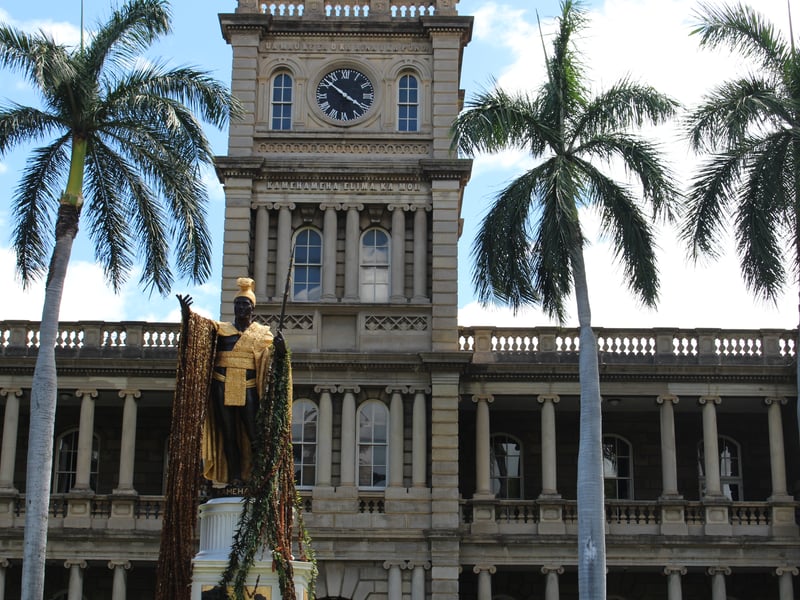
However, the Aloha State said its unique history should also be considered by the court. Before becoming a state, the Kingdom of Hawaii had a complete ban on the possession of weapons.
“Prestatehood, Hawaii was a kingdom, and in 1833, King Kamehameha III promulgated a law prohibiting ‘any person or persons’ from possessing deadly weapons, including any ‘knife, sword-cane or any other dangerous weapon,’” Hawaii wrote. “That law was in effect until 1870, when Kamehameha V created a narrow exception for hunting licenses in the southern part of Oahu.”
After the Kingdom of Hawaii was overthrown in 1893, the provisional government prohibited the importation of guns and ammunition. Hawaii said that even after statehood, its residents never developed a custom of armed carry.
“Thus, whatever the case in states with a custom and practice of armed entry into private property, there is no basis for claiming an implied license to enter private property with a gun in Hawaii,” the state wrote. “And in the absence of such an implied license, the ‘general rule’ is that a person may not enter private property without the owner’s express consent.”
The gun owners dismissed any consideration of prestatehood history, suggesting Hawaii’s citation reflected its disagreement with the Supreme Court’s precedent.
“Hawaii is thus claiming that the former Kingdom of Hawaii’s traditions trump both the founding and our national traditions,” the gun owners wrote. “That assertion cannot be accepted under the supremacy clause.”
A shifting standard
The Ninth Circuit upheld Hawaii’s law, finding six examples of states enforcing similar laws. Weighing in for the gun owners, the Trump administration argued that pulling scattered cases and regulations from seemingly random time periods did not meet Bruen’s standard.
“Just as historical laws excluding arms from sensitive places cannot justify modern laws banning arms everywhere, so too laws presumptively excluding firearms from certain types of private land to combat poaching cannot justify modern laws presumptively prohibiting the carrying of firearms for self-defense on all private property open to the public,” the federal government wrote.
The Trump administration urged the justices to use Hawaii’s case to further clarify Bruen’s standard. While Rahimi addressed who may possess firearms, the government said Hawaii’s case could clarify where arms may be carried.
Billy Clark, a litigation attorney at Giffords Law Center, said Rahimisoftened Bruen’s strict historical analog standard, focusing the test less on finding an exact historical match and more on past regulatory principles.
“The concern that we have is in some ways methodological,” Clark said. “If this case were to be a return to the most aggressive reading of Bruen, then it could pose a serious threat to gun laws across the country. If the court is able to focus on the narrow issues at hand and to focus on solely on the law that’s at issue, we think that the consequences would be less dire.”
No end in sight
The high court’s ruling on Hawaii’s Vampire Rule is unlikely to clear up the lower court’s confusion over the Bruen standard. Later this term, the justices will hear another Second Amendment case concerning federal prohibitions on gun possession by users of illegal drugs.
Gun advocates are also asking the justices to review age limits on firearm ownership, assault weapons bans and restrictions on ammunition feeding devices.
 Follow @KelseyReichmann
 Follow @kelseyreichmann.bsky.social
Subscribe to our free newsletters
Our weekly newsletter Closing Arguments offers the latest about ongoing trials, major litigation and rulings in courthouses around the U.S. and the world, while the monthly Under the Lights dishes the legal dirt from Hollywood, sports, Big Tech and the arts.