
 Search Articles


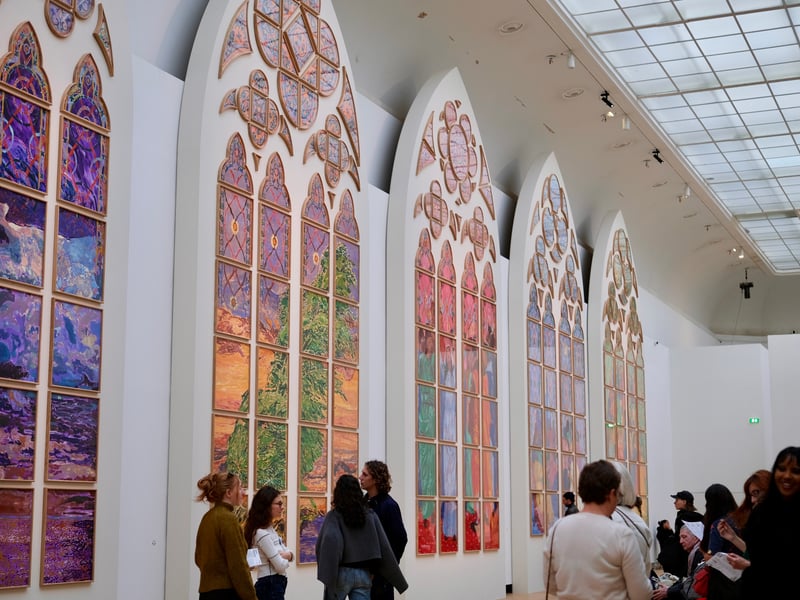
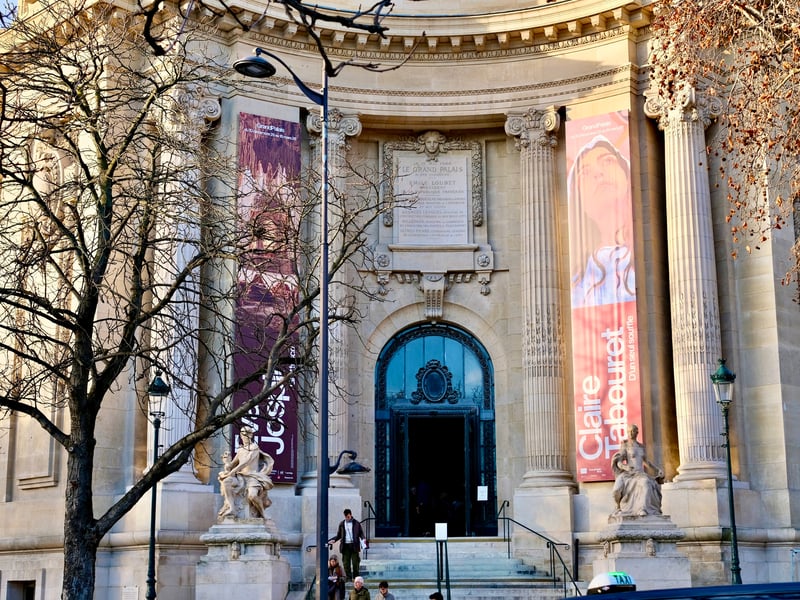
PARIS (CN) — In an airy, sunlit room in the Grand Palais in Paris, people stare at a painting of the Virgin Mary against a hot pink sky. She is not depicted as a divine figurine, but as a modern woman, full of life; her skyward gaze is full of emotion as she holds her arms upward. The twelve apostles gathered around are obscure in contrast, redirecting the focus toward her.
“The Virgin Mary is depicted as lively, expressive, not frozen in time,” Claire Tabouret, the artist behind the work, explains in the description of the piece. “Her loose hair, her posture and her presence express an inner strength.”
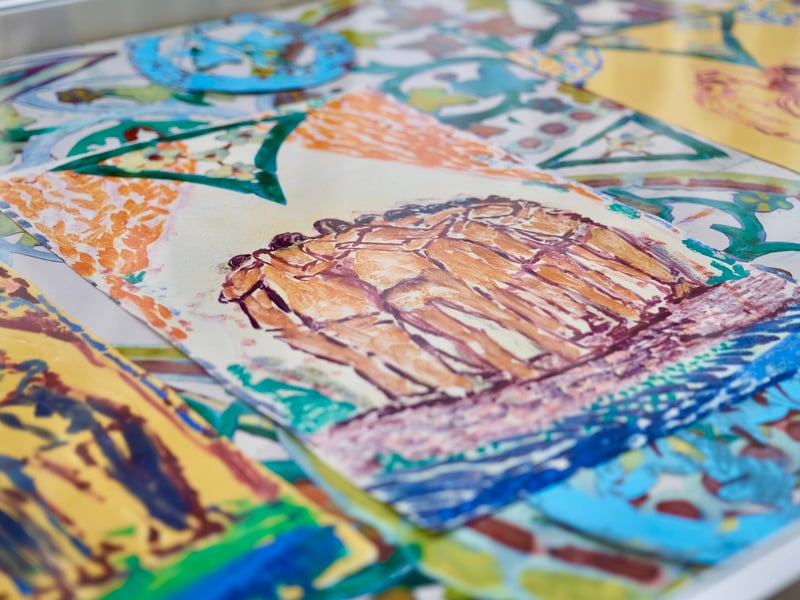
In February, the 44-year-old Tabouret won a once-in-a-lifetime competition — conceived by French President Emmanuel Macron and the Ministry of Culture — to create six new stained-glass windows for the Notre Dame cathedral. Now, the roughly 23-foot-tall models for the windows, along with scraps and sketches, are on display in the “In One Breath” exhibition at the Grand Palais in Paris, which will run until March 16.
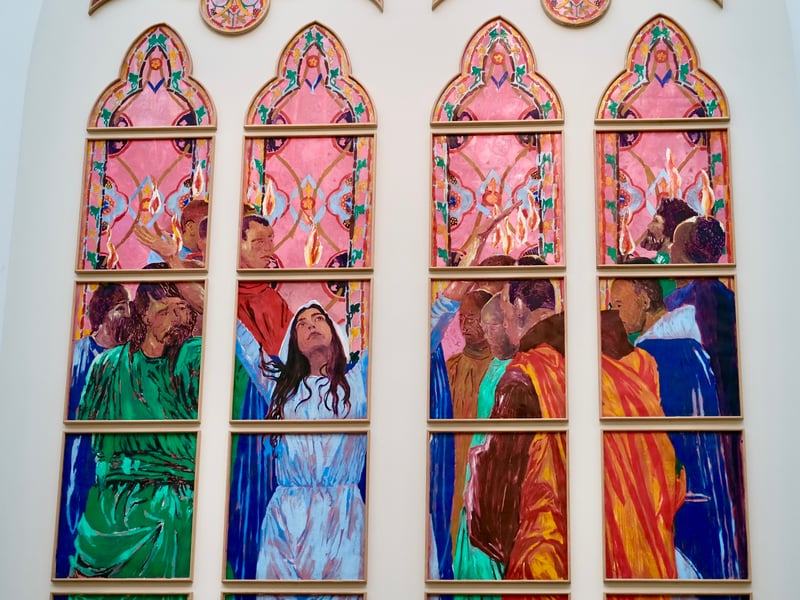
In 2026, the windows — which tell the story of the Pentecost — will be replacing the 19th century geometric windows designed by Viollet-le-Duc, which were not damaged in the 2019 fire that almost brought down the cathedral. The general consensus about Le-Duc’s windows is that artistically, they’re pretty unremarkable. But hundreds of thousands of people, and France’s National Heritage Commission, are furious about the prospect of replacing them.
“The stained-glass windows in Notre-Dame designed by Viollet-le-Duc were created as a coherent whole. It is a genuine creation that the architect wanted to be faithful to the cathedral’s Gothic origins,” organizers wrote in a Change.org petition that has reached roughly 330,000 signatures. “Emmanuel Macron wants to put the stamp of the 21st century on Notre-Dame de Paris. Perhaps a little modesty would be preferable.”
It’s easy enough to understand why people would want to keep the original, historical elements of an almost-1000-year-old monument intact. But experts argue critics may be missing the point; part of having such a long lifespan inherently involves changes, and even Le-Duc’s windows were new additions to the cathedral at the time of creation. They point to a broader resistance to change, similar to the initial distain toward I.M. Pei’s Louvre pyramid or the Pompidou museum, which have become beloved parts of the landscape.
“People are very hesitant to accept something modern or contemporary in an older context, especially in an impressive heritage building like Notre Dame,” Kitty Zijlmans, a Dutch art historian, explained. “What’s interesting is that once the new element is there and people adjust to it, they often grow fond of it and adopt it. … And if you then take it away, there’s resistance again — ‘why did you remove it?’”
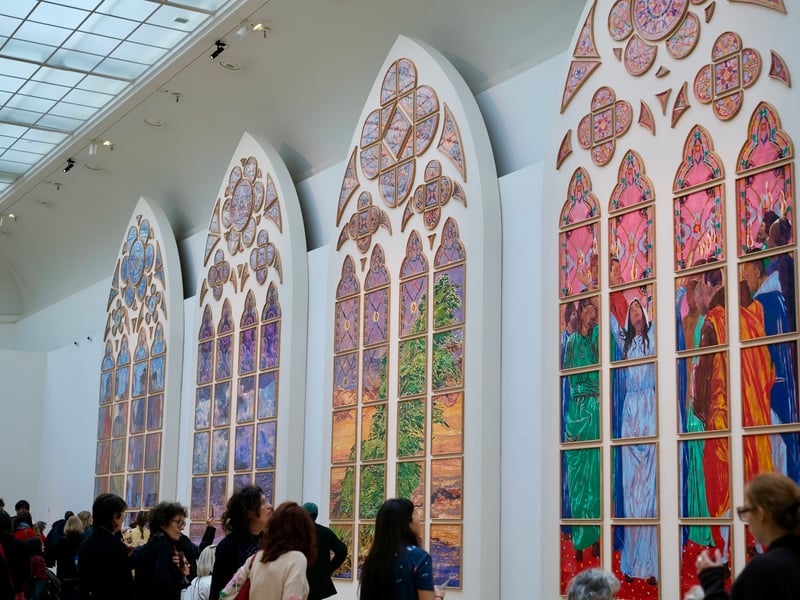
And in this case particularly, Tabouret’s designs are arguably more aligned with the traditional use of stained glass as a storytelling device, rather than the current windows, which feature abstract geometric patterns.
Dietrich Neumann, a professor of art and architecture history at Brown University, thinks the windows offer an opportunity to showcase a representational, modern interpretation of the Pentecost.
“I feel like the Viollet-le-Duc interpretation was maybe restricted by missing funds. … They’re very simple, non-representational, geometric patterns, which was much cheaper to do than having biblical scenes,” he explained. “I always felt like when you walk through Notre Dame, the windows by Le-Duc were always a little less exciting than the figurative ones and the great rose windows in the south and west.”
The new windows are full of movement. In the third model, “Saint Vincent de Paul,” a tree appears bent over from gusts of wind, almost falling over a violet stream of water. “The stained-glass window captures the sudden breath, the movement of the spirit that passes through bodies and souls,” Tabouret writes about the piece.
“The notion that the building would be ruined by this kind of new work is preposterous,” Graham Livesey, author and professor in the architecture program at the University of Calgary, said. “It completely misunderstands the history of these buildings, which are about creating a kind of spiritual environment, and they’re there to tell stories about Christianity.”
The new windows might be able to convert the biggest skeptics. On Tuesday, Beatrice Besson, a French woman, was totally captivated when she left the exhibition. The pieces reminded her of Marc Chagall’s famed stained-glass windows at the Cathédrale Notre-Dame de Reims, roughly an hour by train from Paris.
“In the beginning, I wanted them to keep the original windows of Notre Dame, but this made me change my mind,” she explained, smiling. “I loved the colors and the energy that it gives off — I feel like I’ve been taken away by the sun.”
In Zijmans’s view, it’s impossible to restore any structure exactly; materials and techniques change and have to conform to new safety standards.
“Restoration doesn’t mean erasing history and returning to an original state, it means getting as close as possible while accepting that new elements are inevitably involved,” she said. “It’s an ethical decision whether to restore it as closely as possible to what it was, but then the question becomes, what was the original building? It hasn’t been the same for 600 or 700 years.”
One woman leaving the exhibition, who asked to remain anonymous, thinks that French people are generally resistant to change and art is no different.
“I found the exhibition to be magnificent, extremely colorful, poetic with the blowing of the wind,” she said. “I’m always for modern artists because I think it’s good to renew and adapt.”
The windows will be installed in 2026.
 Follow @lilyradz
Subscribe to our free newsletters
Our weekly newsletter Closing Arguments offers the latest about ongoing trials, major litigation and rulings in courthouses around the U.S. and the world, while the monthly Under the Lights dishes the legal dirt from Hollywood, sports, Big Tech and the arts.