
 Search Articles


MANHATTAN (CN) — A federal judge invoked a President Donald Trump-touted immigration law when ordering the release of Maria Tumba Huamani, a 20-year-old asylum-seeker from Peru who has been detained for the past month 1,000 miles away from her home in New York City.
Videos of Huamani’s September arrest went viral. Masked federal agents swarmed her elevator at 26 Federal Plaza, a lower Manhattan immigration courthouse, then violently pushed reporters away who tried to board along with them; one photographer was hospitalized in the scuffle. Since then, Huamani was being held in an immigration detention facility in Louisiana, where Immigration and Customs Enforcement hoped she’d stay until her eventual removal.
But U.S. District Judge Lewis Liman thwarted those plans late Tuesday night, granting Huamani’s habeas corpus petition and ruling there is a “complete absence of any reason” for her to stay detained.
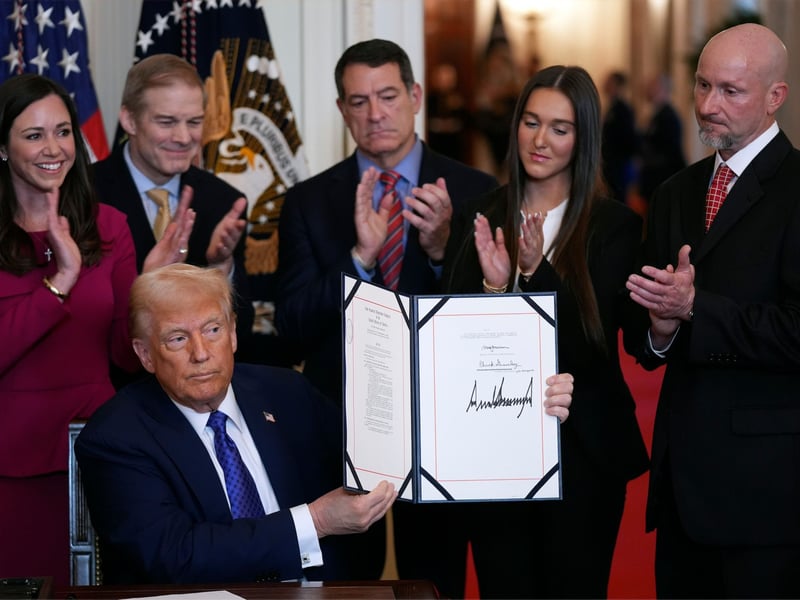
In his 19-page order for Huamani’s release, Liman cited an unexpected source: the Laken Riley Act, a GOP-led bill signed into law this year by Trump that drastically broadened ICE’s ability to detain noncitizens.
Named for a 22-year-old Georgia woman murdered in 2024 by a Venezuelan immigrant, the Laken Riley Act requires ICE to detain noncitizens who are charged, convicted or even arrested for a bevy of crimes. It was championed by Republicans, who sought a quick crackdown on what they called a nationwide immigration crisis, but criticized by many Democrats who worried the measure would strip noncitizens of their due process rights.
It ultimately passed with bipartisan support in the House of Representatives, where nearly two dozen Democrats joined the Republican caucus to get it onto Trump’s desk.
But amid the Trump administration’s broad deportation agenda, in which federal agents are detaining noncitizens who lack any criminal records whatsoever, judges around the country are citing that same law in their orders to release ICE prisoners.
In his Tuesday ruling, Liman questioned why Congress would have passed the Laken Riley Act in the first place if ICE is claiming it can justifiably detain asylum seekers like Huamani, who has not been accused of any criminal acts at all.
“Why, then, would Congress have thought it necessary to specifically add a provision making those noncitizens subject to mandatory detention if they are charged with certain crimes?” wrote Liman, a Trump appointee in the Southern District of New York. “The government has no answer.”
The government in Huamani’s case, and in many similar habeas cases around the country, argues it has broad discretion under federal immigration law to detain any person that enters the country without authorization.
But that would be “entirely inconsistent with the Laken Riley Act,” Liman found.
Months prior, another federal judge invoked the law when freeing an ICE detainee from Brazil, who was arrested in May following a routine hearing in immigration court. In that case too, the man was detained pursuant to the government’s argument that he entered the United States without authorization and can therefore be jailed.
“Such an interpretation, which would largely nullify a statute Congress enacted this very year, must be rejected,” wrote U.S. District Judge Julia Kobick, a Joe Biden appointee in Massachusetts federal court, referring to the act.
And U.S. District Judge Orelia Merchant, a Joe Biden appointee in the Eastern District of New York, similarly acknowledged in a ruling from last month that accepting the government’s broad detention discretion would render the act’s criminal conduct requirement “superfluous.”
Speaking to Courthouse News on Wednesday, New York University immigration law professor Adam Cox said these rulings illustrate just how far ICE is trying to push boundaries.
“It’s showing that the Trump administration’s interpretation of these older immigration statutes is so novel and so extreme that Congress’ more recent efforts — even though those were designed to lock more immigrants up — highlight that the administration’s views don’t make sense,” he said.
Now that the administration is claiming that it’s always had the right to detain any unauthorized entrant, the act’s comparably narrower scope is proving somewhat of a liability for ICE’s broadest arrests. In effect, the law is making it easier to free certain detainees, despite it existing to justify more detentions than ever.
Cox noted it is still accomplishing that goal too, as the law also makes it infinitely harder for those so much as accused of criminal conduct to avoid immigration jail.
“It is definitely true that it is now easier to detain any noncitizen who’s here, who’s entered without authorization and is living in this country,” Cox said of the act.
For Huamani, though, Liman ruled that her due process rights were indeed violated by her “violent” on-camera arrest. She’s in the process of returning home to the Bronx, according to her legal team, where she’ll continue fighting the government’s efforts to deport her.
 Follow @Uebey
 Follow @uebey.bsky.social
Subscribe to our free newsletters
Our weekly newsletter Closing Arguments offers the latest about ongoing trials, major litigation and rulings in courthouses around the U.S. and the world, while the monthly Under the Lights dishes the legal dirt from Hollywood, sports, Big Tech and the arts.