
 Search Articles


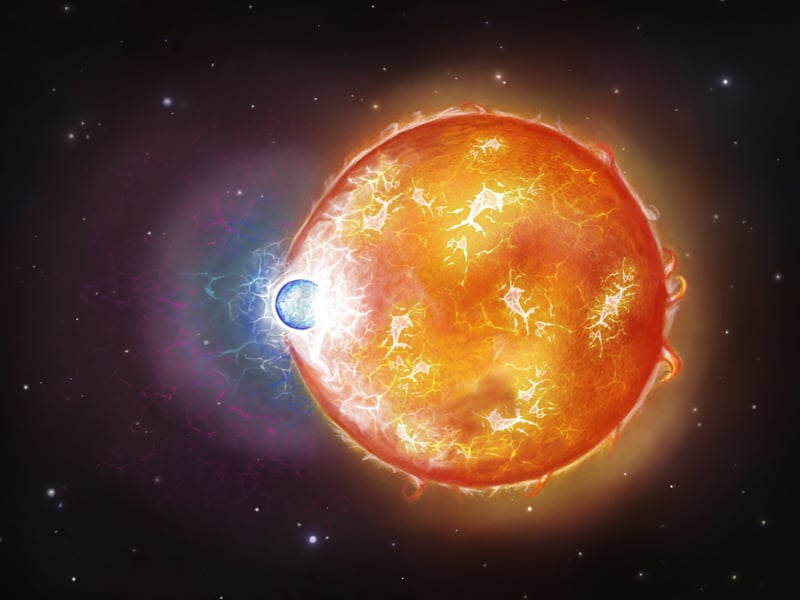
(CN) — Astronomers at the University of Warwick have found rare evidence that a nearby white dwarf formed when two stars collided and merged.
The star, known as WD 0525+526, is unusually massive and shows small amounts of carbon in its atmosphere. That detail, only visible in ultraviolet light, suggests it formed not from a single star’s collapse but from a rare merger event. The findings were published Wednesday in Nature Astronomy.
“In optical light (the kind of light we see with our eyes), WD 0525+526 looks like a heavy but otherwise ordinary white dwarf,” said Snehalata Sahu, a research fellow at Warwick and lead author of the paper, in a press release.
White dwarfs are the dense cores left behind when stars burn through their fuel. Researchers say most have thick outer layers of hydrogen and helium that keep heavier elements like carbon trapped below.
However, ultraviolet observations using the Hubble Space Telescope showed carbon in the upper layers of WD 0525+526. According to researchers, this is a sign those outer shells are much thinner than usual.
“Finding small amounts of carbon in the atmosphere is a telltale sign that this massive white dwarf is likely to be the remnant of a merger between two stars colliding,” Sahu said. “It also tells us there may be many more merger remnants like this masquerading as common pure-hydrogen atmosphere white dwarfs. Only ultraviolet observations would be able to reveal them to us.”
Researchers say the hydrogen and helium layers on WD 0525+526 are about 10 billion times thinner than normal, likely stripped away during the merger. That thin outer envelope allowed carbon from the core to slowly rise to the surface.
“We think these layers were stripped away in the merger, and this is what now allows carbon to appear on the surface,” said Antoine Bédard, a Warwick Prize Fellow and co-author of the study, in the press release.
Researchers say the star’s surface carbon level is still unusually low — about 100,000 times less than what’s seen on other white dwarfs that formed from mergers. It’s also much hotter than other known merger remnants, nearly four times the temperature of the Sun. Both signs suggest the star is at an earlier stage in its evolution.
According to researchers, since the star is still so hot, carbon isn’t rising through convection — the process of hotter material rising and cooler material sinking inside a star — which only happens at cooler temperatures.
Instead, they identified a slower mixing process called semi-convection that’s helping carbon reach the surface. This is the first time that process has been observed in a white dwarf star.
“Finding clear evidence of mergers in individual white dwarfs is rare,” said Boris Gänsicke, physics professor at the University of Warwick, in the press release. “But ultraviolet spectroscopy gives us the ability to detect these signs early, when the carbon is still invisible at optical wavelengths. Because the Earth’s atmosphere blocks ultraviolet light, these observations must be carried out from space, and currently, only Hubble can do this job.
As Hubble marks 35 years in space, Gänsicke says it’s important to start planning for a successor to maintain ultraviolet observations.
“Hubble just turned 35 years old, and while still going strong, it is very important that we start planning for a new space telescope that will eventually replace it,” Gänsicke said.
Subscribe to our free newsletters
Our weekly newsletter Closing Arguments offers the latest about ongoing trials, major litigation and rulings in courthouses around the U.S. and the world, while the monthly Under the Lights dishes the legal dirt from Hollywood, sports, Big Tech and the arts.