
 Search Articles


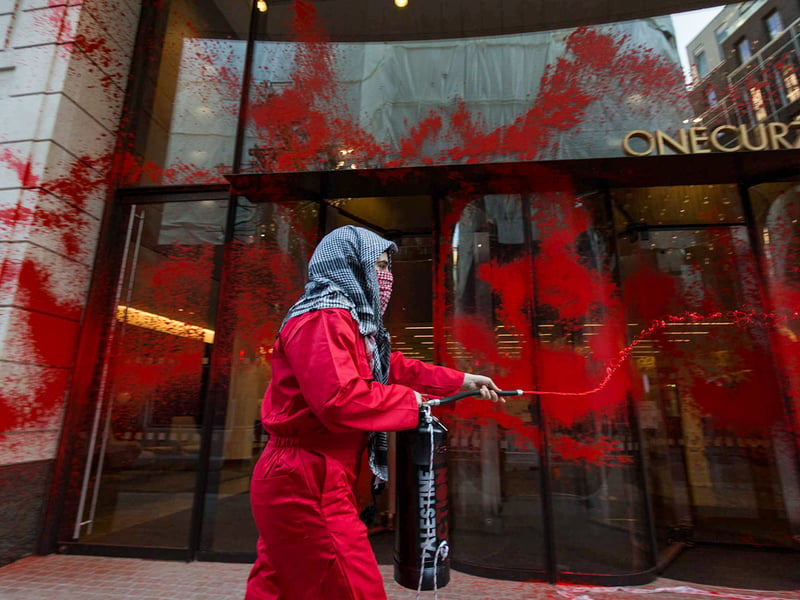
MANCHESTER, England (CN) — The U.K. government’s decision to designate Palestine Action as a terrorist organization under anti-terror legislation faces criticism from legal experts and human rights groups.
Home Secretary Yvette Cooper announced the move following an incident where Palestine Action activists broke into a Royal Air Force base and spray-painted two military planes red.
Cooper called the act “disgraceful” and said the group had a “long history of unacceptable criminal damage” since being formed in 2020.
She claimed the decision was a necessary step to protect national security and expects to send a bill to Parliament next Monday. If approved, it would proscribe the group and make it an offense to be in or support the group.
Prime Minister Keir Starmer echoed Cooper’s stance, describing the group’s actions as “disgraceful” and an “act of vandalism.”
Palestine Action called the move “an unhinged reaction” in a public statement, saying that “the real crime here is not red paint being sprayed on these war planes, but the war crimes that have been enabled with those planes because of the U.K. government’s complicity in Israel’s genocide.”
Palestine Action accused Starmer of hypocrisy, who previously defended anti-war protestors breaking into Royal Air Force bases in an attempt to prevent U.S. aircraft flying to Iraq in 2003. Working as a human rights barrister, the now-PM argued that their actions were lawful as their intentions were to prevent war crimes.
Describing themselves teachers, nurses, students and parents, Palestine Action said that it was “plainly preposterous to rank us with terrorist groups like ISIS, National Action and Boko Haram,” given their tactics of entering premises and spray-painting targets they believe to be arming and supporting Israel’s military.
Leading legal and human rights organizations such as Amnesty UK and Liberty have criticized the government’s move to ban the group. In a statement, Amnesty said that the government “risks an unlawful interference with the fundamental rights of freedom of expression, association and peaceful assembly.”
As ministers vow to ban the group, some criticism has come from within the governing Labour party. Lawmaker Nadia Whittome said that “it sets a dangerous precedent, which governments in future could further use against their critics,” while Zarah Sultana added: “We are all Palestine Action.”
Lowering bar for terrorism
Alan Greene, a reader in constitutional law and human rights at the University of Birmingham, said the decision “constitutes a significant lowering of the bar in terms of what forms of political action the government is willing to label as terrorism.”
“The U.K. definition of terrorism is incredibly broad,” Greene said, which ranges from serious acts of violence and endangering life to serious acts of damaging property and disrupting electronic systems.
Any of these acts must also be designed to influence the government or intimidate the public in order to advance a political, religious or ideological cause.
“Palestine Action is captured by this definition on the basis that their acts involve serious damage to property,” he added. Serious damage to property was included in the British definition of terrorism due to the IRA’s bomb attacks during the Troubles, which would cause property damage after the paramilitary group would warn the area ahead of time.
“The breadth of the U.K.’s definition of terrorism can result in some potentially perverse applications. It’s inherently relying on decisionmakers exercising their discretion carefully," Greene explained.
He explained that while there hasn’t been a shift in the legal definition of terrorism, “there has been a shift in is the application of this discretion.”
Beyond the right to protest, “proscription has a serious impact on freedom of expression,” Greene said, with several offenses linked to it, such as expressing support or displaying images of the support for the group.
“So proscription can have a serious chilling effect on free speech,” he added. “This will cause unprecedented damage to the right to protest and freedom of expression in the U.K.”
David Mead, professor of U.K. human rights law at the University of East Anglia, said that the concept of terrorism is moving away from the notion of “invoking actual terror among citizens by means of threats or actual politicized violence.”
Mead, whose main research is in peaceful protest and public order, warned that if legitimate protest excludes action that causes economic harm, we risk severely shrinking democratic space.
It would mean “excluding a large number of tactics that many have used in the past and would today see as legitimate forms of dissent and opposition," Mead said. He cited examples such as ripping up genetically modified crops in farmers’ fields as a protest in the early 2000s and the tearing down of a slave trader statue in Bristol in 2020 by anti-racism protesters.
“Are these what we would really term the actions of terrorists?” Mead asked.
 Follow @jayfranklinlive
Subscribe to our free newsletters
Our weekly newsletter Closing Arguments offers the latest about ongoing trials, major litigation and rulings in courthouses around the U.S. and the world, while the monthly Under the Lights dishes the legal dirt from Hollywood, sports, Big Tech and the arts.