
 Search Articles


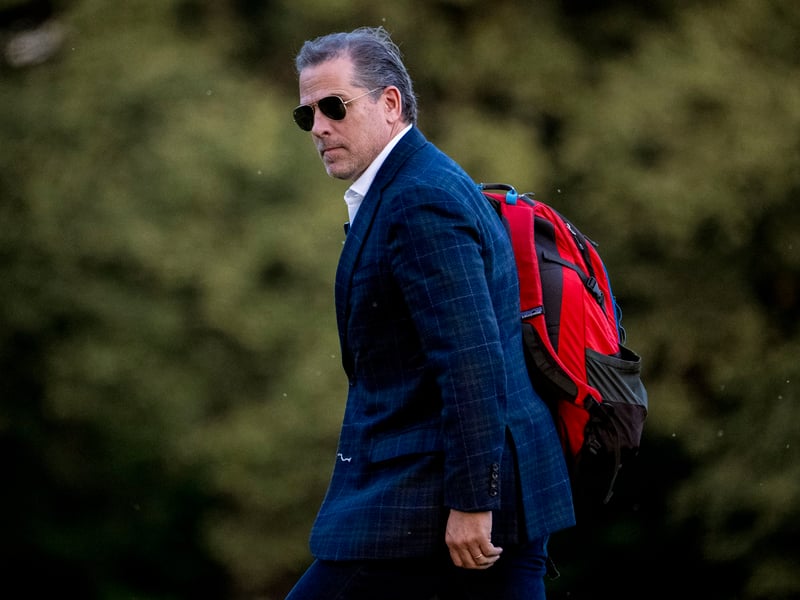
LOS ANGELES (CN) — A Ninth Circuit panel has rejected Hunter Biden’s attempt to seek review of a trial judge’s refusal to throw out the charges brought by special counsel David Weiss accusing President Joe Biden’s son of failing to pay as much as $1.4 million in taxes from 2016 through 2019.
A three-judge panel granted the government’s motion to dismiss Biden’s interlocutory appeal Tuesday night, finding the April 1 order by U.S. District Judge Mark Scarsi in Los Angeles wasn’t a final judgment or an immediately appealable collateral order.
“Contrary to appellant’s arguments, the issues he wishes to raise on interlocutory appeal do not implicate a statutory or constitutional ‘right not to be tried,’ and therefore do not fall within the collateral order exception,” the panel said in the unsigned decision.
Senior U.S. Circuit Judge William Canby Jr., a Jimmy Carter appointee, Senior U.S. Circuit Judge A. Wallace Tashima, a Bill Clinton appointee, and U.S. Circuit Judge Lucy Koh, a Joe Biden appointee, made up the panel.
Attorneys for Biden didn’t immediately respond to a request for comment on the decision.
Federal appellate courts rarely get involved in cases that are still pending in trial courts unless there are unusual circumstances. The Third Circuit Court of Appeals rejected Biden’s interlocutory appeal this month in a separate case in which Weiss charged him with violation firearm laws.
Scarsi, a Donald Trump appointee, had rebuffed Biden’s arguments that he was entitled to immunity from the tax charges under a diversion agreement he reached with the Justice Department last year for a firearms violation. Scarsi also shot down Biden’s arguments that his indictment was selective and vindictive because it was prompted by Republican lawmakers.
In his decision, the judge carefully parsed the diversion agreement, filed in conjunction with plea agreement involving two misdemeanor tax charges last year, that would have resolved the five-year investigation into Biden by federal prosecutors.
A judge in Delaware never signed off on the plea agreement, nor the Probation Department on the diversion deal. Republicans have bristled at the agreement, which many viewed as a sweetheart deal.
Scarsi agreed with Biden that the July diversion agreement created a binding contract between him and the Justice Department.
However, the judge noted, the Probation Department — which was to oversee Biden’s compliance with the agreement and whose approval was needed for the agreement to take effect — never signed off on it. Therefore, prosecutors weren’t barred from indicting Biden on the tax charges in December, the judge found.
Biden also said he was the victim of selective prosecution because, he argued, no one else who paid the IRS all taxes owed plus penalties would have been hit with three felony charges for tax evasion.
Responding to these arguments, Scarsi called Biden’s motion remarkable because he hadn’t provided any admissible evidence such as sworn declarations to support his argument.
Instead, Scarsi noted, Biden relied on internet news sources, social media posts and legal blogs — none of which is evidence — to make his point. That alone would be enough to deny Biden’s motion, Scarsi said — though he said he nonetheless reviewed the referenced internet material to decide the motion “without unduly prejudicing defendant due to his procedural error.”
Still, Scarsi wasn’t persuaded that these reports and observations were enough for him to throw out the charges.
“At best, defendant draws inferences from the sequence of events memorialized in reporting, public statements, and congressional proceedings pertaining to him to support his claim that there is a reasonable likelihood he would not have been indicted but for hostility or punitive animus,” the judge said.
Special counsel Weiss’s office hit the younger Biden with three felony and six misdemeanor charges in December, accusing him of failing to pay at least $1.4 million in self-assessed federal taxes from 2016 through 2019 and of filing a false tax return for 2018.
Hunter Biden, 54, was at the time struggling with addiction, which took a turn for the worse on the one-year anniversary of his brother’s death in 2016, according to his lawyers.
Biden paid some of his income taxes for 2016 but did not fully pay or file by the 2017 deadline. He continued to file late until he hired new accountants in 2019, who prepared and filed his late returns and helped him pay all his taxes and penalties in 2021.
 Follow @edpettersson
Subscribe to our free newsletters
Our weekly newsletter Closing Arguments offers the latest about ongoing trials, major litigation and rulings in courthouses around the U.S. and the world, while the monthly Under the Lights dishes the legal dirt from Hollywood, sports, Big Tech and the arts.