
 Search Articles


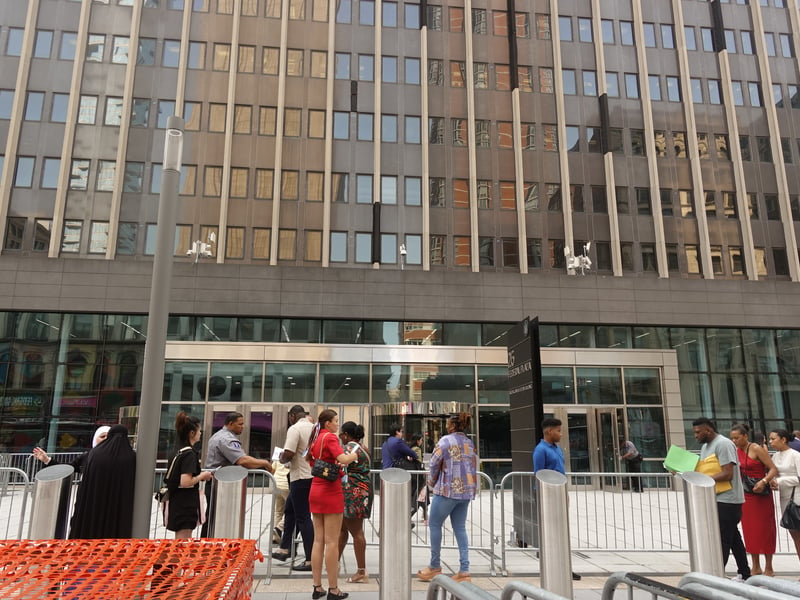
MANHATTAN (CN) — A class of immigrant detainees is moving to sanction the Department of Homeland Security, claiming the agency flouted a court order to clean up a controversial immigration holding facility in Manhattan.
In a 33-page motion filed Tuesday, the group asked a federal judge to slap the department and its secretary, Kristi Noem, with civil contempt over failing to improve conditions at 26 Federal Plaza.
“Defendants appear never to have implemented many of the required procedures, particularly those regarding attorney access, hygiene, and the provision of the Notice of Rights to all detained individuals,” the class wrote.
The latest plea comes after U.S. District Judge Lewis Kaplan issued a ruling in August demanding DHS and Immigration and Customs Enforcement to ensure that the scrutinized facility — nestled on the building’s 10th floor, just two floors below immigration courtrooms — isn’t overcrowded and that the detainees receive proper bedding, food and hygiene supplies.
The Bill Clinton appointee also ordered that the government let detainees phone their lawyers within 24 hours of their arrests, which oftentimes took place just two floors upstairs during routine appearances at immigration court.
But despite months passing since Kaplan’s ruling, the group claims the improvements have yet to take place. In fact, “certain conditions appeared to worsen” after the judge’s order went into effect.
“We were always hungry,” Carlos Chalco Chango, a blind Ecuadorian asylum-seeker, wrote in an attached filing. “I barely ate anything; I would give my portion to my son and tell him to eat instead because I knew how hungry he was.”
Chango wrote that he and his son were detained Nov. 4, nearly three months after Kaplan issued his ruling. Chango was at 26 Federal Plaza from then until Nov. 8, when he was transported to Orange County Jail in Goshen, New York. His son is now being held more than 1,000 miles away in a Texas facility.
“We stayed in the same clothes we had on when we were detained together throughout our time at 26 Federal Plaza,” Chango added. “Twice we were given small wet towels; they were cold, and I did not smell any kind of soap on them. We all wanted to wash ourselves, but we weren’t given anything to do it with.”
Fellow detainee Jose Javier Cuy Cumes was arrested on the same day. He says that he, too, was not given any soap and that “we could only wash our hands with water.”
Additionally, he said he found it difficult to phone family or an attorney, as Kaplan had required.
“I never heard any guards at 26 Federal Plaza mention legal calls or private calls,” he wrote in a filing. “I was able to call my family once a day, but there were always guards listening. … The guards also did not offer calls easily — I had to demand a call.”
In attached declarations, several lawyers expressed difficulties reaching their detained clients. One even attached an email chain with Nancy Zanello, ICE’s New York City Field Office of Enforcement and Removal Operations, informing her that she was violating the judge’s order in the underlying class action case — Barco Mercado v. Noem — by refusing to share an attorney call number for the facility.
“I am well versed in Barco Mercado,” Zanello wrote back on Aug. 22, but declined to share the number in the email.
The class of detainees is looking to force DHS and ICE to submit weekly logs of how many people are being held at the facility, as well as requiring biweekly sworn declarations from officials.
The detainees are also looking to permit their lawyers and a photographer to inspect, survey and photograph 26 Federal Plaza on any given day, with four hours’ notice.
A DHS spokesperson didn’t immediately return requests for comment.
The underlying case was brought in August by a former 26 Federal Plaza detainee, Sergio Alberto Barco Mercado, who claims he and others were denied access to soap, clean clothing, toothbrushes and showers at the facility, causing a “horrific stench” of sweat, urine and feces.
A frequent holding place for those detained at immigration court hearings in Manhattan, the facility has become a controversial symbol of the scrutinized arrest practice, which is currently the subject of its own pending lawsuit.
 Follow @Uebey
 Follow @uebey.bsky.social
Subscribe to our free newsletters
Our weekly newsletter Closing Arguments offers the latest about ongoing trials, major litigation and rulings in courthouses around the U.S. and the world, while the monthly Under the Lights dishes the legal dirt from Hollywood, sports, Big Tech and the arts.