
 Search Articles


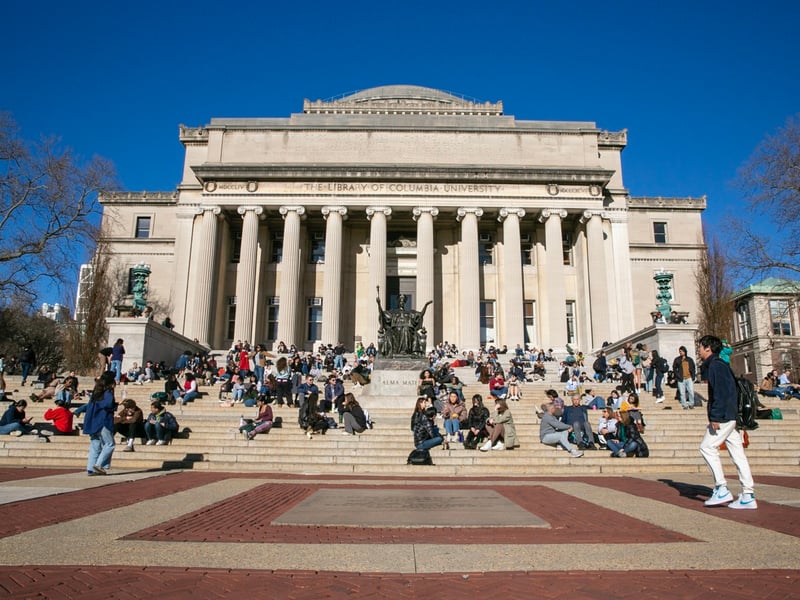
MANHATTAN (CN) — Federal immigration agents on Thursday made “misrepresentations” to enter the dorm room of Columbia University senior Elmina “Ellie” Aghayeva and arrest her, the school said, only to release her hours later amid public backlash.
According to a statement from the college, immigration agents claimed to be searching for a “missing person” when they showed up at Aghayeva’s building.
“This morning at approximately 6:30 a.m., federal agents from the Department of Homeland Security entered a Columbia residential building and detained a student,” Columbia’s acting president, Claire Shipman, said Thursday. “We are working to gather more information, working to reach the family and providing legal support.”
Just hours later, New York City Mayor Zohran Mamdani — who was in Washington, D.C., earlier that day for an unannounced meeting with President Trump — posted on social media that he “just got off the phone with President Trump,” who informed him that Aghayeva would be “released immediately.”
Aghayeva, herself, confirmed that she had been released with an Instagram post just after 3:45 p.m.
“I am safe and okay,” she wrote. “In an Uber otw home. I am so sorry but I am in complete shock over what happened.”
She’s the first student to be arrested by ICE on Columbia’s campus since Mahmoud Khalil, the Palestinian activist who was detained last March for being an outspoken critic of Israel’s bombing campaign in the Gaza Strip.
Aghayeva has a large social media presence with more than 100,000 followers on Instagram, where she posts videos about her life as a Columbia student and gives study tips to her followers. She posted a story on Thursday morning after her arrest, seemingly from the back of a car, which read: “Dhs illegally arrested me. Please help.”
It’s not immediately clear why Aghayeva, an Azerbaijani native, was targeted by this operation, nor why she was unceremoniously freed later that day.
Prior to her release, a DHS official said in a statement that Aghayeva’s “student visa was terminated in 2016 under the Obama administration for failing to attend classes.”
“The building manager and her roommate let officers into the apartment. She has no pending appeals or applications with DHS,” the official added.
After Aghayeva’s release, DHS clarified that “ICE placed her in removal proceedings and she’s been released while she waits for her hearing.”
In a petition for release, filed Thursday in the Southern District of New York, Aghayeva stated that she entered the United States in 2016 — the same year the agency claims her visa was revoked.
“No reason for petitioner’s detention has been given,” Aghayeva claims in the habeas petition. “On information and belief, respondents represented that they did not have a warrant for petitioner. On information and belief, respondents represented they were searching for a missing person to gain entry.”
U.S. District Judge Katherine Polk, a Barack Obama appointee, set a court appearance for next Friday, though the petition could be deemed moot now that Aghayeva is free.
Her arrest sparked widespread condemnation from New York lawmakers. Governor Kathy Hochul said in a statement that “a rogue deportation agenda is operating with zero transparency and even less accountability.”
“No one should disappear at the hands of the government,” Hochul added. “No student should be taken from their dorm through deception. These incidents demand an independent investigation and real accountability. New York will not look the other way.”
Manhattan Borough President Brad Hoylman-Sigal said on social media that the ICE officers used a “phony missing persons bulletin for a 5-year-old girl” and “purposefully deceived campus housing” to get into her room.
He also said it was “unconfirmed” whether they impersonated local cops to do so, a charge DHS vehemently denied.
“The Homeland Security Investigators verbally identified themselves and visibly wore badges around their necks,” an agency official told Courthouse News. “They did NOT and would not identify themselves as NYPD.”
In her statement to the Columbia community, Shipman urged students not to grant law enforcement access to nonpublic areas of the university, but to contact the school’s public safety instead.
 Follow @Uebey
 Follow @uebey.bsky.social
Subscribe to our free newsletters
Our weekly newsletter Closing Arguments offers the latest about ongoing trials, major litigation and rulings in courthouses around the U.S. and the world, while the monthly Under the Lights dishes the legal dirt from Hollywood, sports, Big Tech and the arts.