Search Articles


MANHATTAN (CN) — Immigration and Customs Enforcement is blaming protesters for its continued arrests in New York City immigration courts, a practice that has been largely banned by a federal court for the past several months.
U.S. District Judge Kevin Castel ruled in May that these arrests would only be permitted “under certain enumerated circumstances,” finding that they could deter immigrants from attending their mandatory proceedings.
Despite that, ICE claimed in a new court filing that it has made at least five arrests in Manhattan immigration courts since Castel’s May 18 order. Immigrant rights groups claim these are a blatant affront to Castel’s ruling. But ICE argues the arrests comply with the court’s ruling, which only narrowly greenlights detentions in immigration court if they involve a threat to national security or public safety.
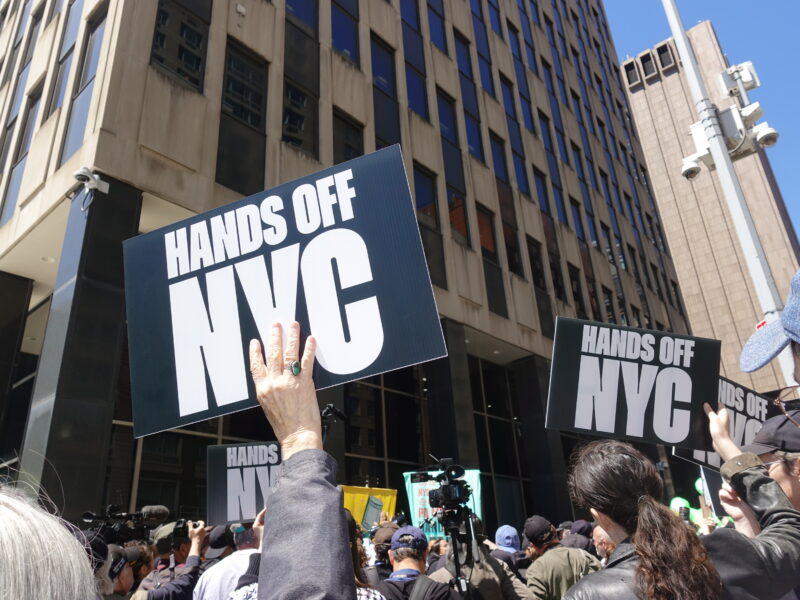
In this case, ICE claims such threats come in the form of anti-ICE protests, which have cropped up in cities around the country during these controversial immigration enforcement efforts.
“At-large arrests in sanctuary cities like New York tend to trigger protests and intervention by agitators and bystanders, making alternative locations in New York unsafe and [Executive Office for Immigration Review] the safest location for the arrests,” Roberto Rodriguez, Acting Supervisory Detention and Deportation Officer at ICE, wrote a declaration filed Monday.
Rodriguez claimed these five arrests, which took place between two Manhattan immigration courts at 26 Federal Plaza and 290 Broadway, needed to be conducted there because of these security concerns, finding immigration courts to be “one of the safest locations in which an arrest could be conducted.”
“The public, when entering 26 Federal Plaza and 290 Broadway, for example, is screened for prohibited items by security personnel and/or Federal Protective Services,” Rodriguez wrote. “Therefore, ERO can ensure both public and officer safety during an arrest at an EOIR immigration court.”
The first of the five arrests took place on May 19, when a 21-year old Honduran man named Vinyl Alexander Castillo-Norales was spotted at 26 Federal Plaza getting apprehended by ICE agents less than 24 hours after Castel issued his ruling. He was released hours later.
Rodriguez claimed in his declaration that Castillo-Norales was deemed to be a public safety threat “based on criminal history,” but did not elaborate. In a habeas petition challenging his arrest, Castillo-Norales claimed he had no criminal convictions at all.
But in the other cases, ICE repeatedly invoked the threat of protesters in their decision to make the arrests at immigration court.
In the case of Jose German Carchi Lopez, who was arrested at 26 Federal Plaza on June 25, ICE claimed in court records that “there was no safe alternative location” to carry out the arrest.
Similarly, Esdras Nehemias Velasquez Ajpop was detained at 290 Broadway on June 29. ICE officer Jose Camacho justified that arrest in a court filing by claiming that “large arrests in major urban areas like New York tend to trigger protests and intervention by members of the public that can endanger bystanders, officers, and arrestees.”
It’s unclear if this reasoning runs afoul of Castel’s order, but the judge is expected to weigh in soon. Immigrant rights groups behind the underlying suit have signaled that they’re looking for Castel to enforce his order against ICE in light of these recent arrests.
A spokesperson for the Department of Homeland Security, which oversees ICE, didn’t immediately respond to a request for comment.
Castel, a George W. Bush appointee, initially greenlit the controversial practice of ICE making these courthouse arrests based on an internal guidance memo from 2025. But he reversed course in May after federal prosecutors admitted ICE misled them about the memo, which never applied to arrests at immigration courts at all.
In June, a federal judge in California built on Castel’s ruling with a nationwide order blocking ICE from arresting noncitizens at immigration courthouses.
 Follow @Uebey
 Follow @uebey.bsky.social
Subscribe to our free newsletters
Our weekly newsletter Closing Arguments offers the latest about ongoing trials, major litigation and rulings in courthouses around the U.S. and the world, while the monthly Under the Lights dishes the legal dirt from Hollywood, sports, Big Tech and the arts.