
 Search Articles


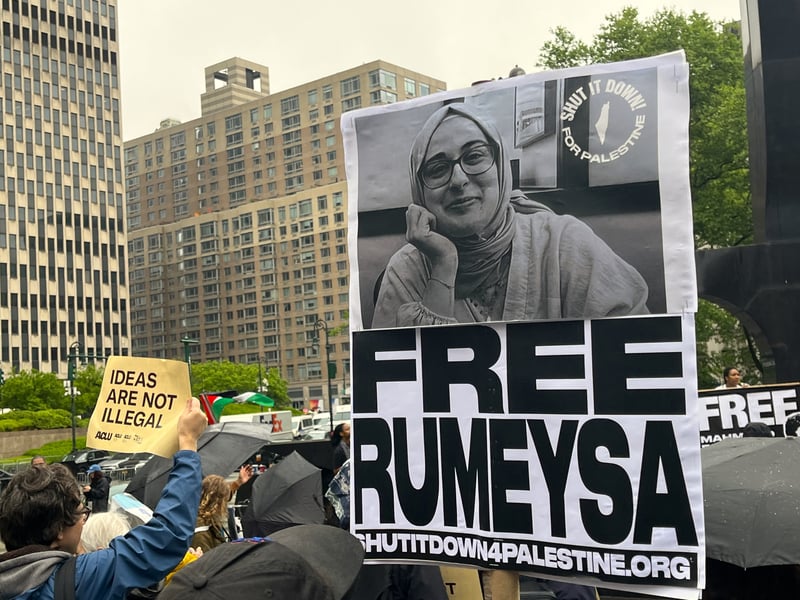
MANHATTAN (CN) — An immigration judge has rejected the Trump administration’s bid to deport Rumeysa Ozturk, a Tufts University Ph.D. student who was arrested and detained for six weeks last year for a supposedly anti-Israel op-ed in the school’s paper.
“Today, I breathe a sigh of relief knowing that despite the justice system’s flaws, my case may give hope to those who have also been wronged by the U.S. government,” Ozturk said in a statement on Monday. “Though the pain that I and thousands of other women wrongfully imprisoned by ICE have faced cannot be undone, it is heartening to know that some justice can prevail after all."
“I grieve for the many human beings who do not get to see the mistreatment they have faced brought into the light,” Ozturk added. “When we openly talk about the many injustices around us, including the treatment of immigrants and others who have been targeted and thrown in for-profit ICE prisons, as well as what is happening in Gaza, true justice will prevail.”
The specifics of the judge’s ruling are not widely known, since immigration court filings are not in the public record. But according to Ozturk, who wrote to a federal appeals court on Monday to provide an update on her case, the immigration court terminated her removal proceedings on Jan. 29, 2026.
“The immigration court held that the Department of Homeland Security had not met its burden of proving removability, and the immigration court thereby terminated removal proceedings against Ms. Ozturk,” she wrote.
Ozturk, a Turkish national in the United States on a student visa, added that the dismissal of the case highlighted “the dangers of the government’s interpretation of the Immigration and Nationality Act.”
“Under the government’s view, it could punitively detain any noncitizen in retaliation for her speech for many months, so long as it simultaneously institutes removal proceedings — no matter how unmeritorious — all without any federal court review of the lawfulness of detention at any time," she said.
The Trump administration used the Immigration and Nationality Act to justify its arrest of Ozturk by plainclothes immigration agents in Somerville, Massachusetts, on May 25, 2025. She was one of several pro-Palestine students targeted by the government amid widespread protests against Israel’s ongoing bombing campaign on the Gaza Strip, which the administration has decried as antisemitic.
Ozturk and her legal team have argued that her arrest was an unlawful affront to free speech, since it seemed solely predicated on her authorship of a 2024 op-ed encouraging Tufts’ president to acknowledge the genocide of Palestinians and to disclose its investments with ties to Israel.
Court filings unsealed in January confirmed their suspicion; a memo from the State Department revealed that Ozturk’s arrest was solely due to her writing the article. The memo also revealed that the government lacked any evidence that Ozturk had “engaged in any antisemitic activity or made any public statements indicating support for a terrorist organization or antisemitism generally.”
Homeland Security spokesperson Tricia McLaughlin previously said in a statement that Ozturk’s detention was because she had “engaged in activities in support of Hamas, a foreign terrorist organization.”
The government can appeal Ozturk’s order in immigration court to the Board of Immigration Appeals, though Ozturk is currently shielded from re-detention by a habeas corpus petition filed in federal court in Vermont.
Mahmoud Khalil, perhaps the highest-profile case of a noncitizen student detained by ICE for pro-Palestinian speech, has had no such luck. Not only did an immigration judge greenlight the deportation of the former Columbia University graduate student, but the Third Circuit ruled last month that he should never have been able to contest his arrest with a habeas corpus petition.
 Follow @Uebey
 Follow @uebey.bsky.social
Subscribe to our free newsletters
Our weekly newsletter Closing Arguments offers the latest about ongoing trials, major litigation and rulings in courthouses around the U.S. and the world, while the monthly Under the Lights dishes the legal dirt from Hollywood, sports, Big Tech and the arts.