Search Articles



RIO DE JANEIRO (CN) — Luís Eduardo da Silva, a 44-year-old merchant, left home in Rio das Ostras at 6 a.m. Tuesday and traveled 87 miles across Rio de Janeiro state to validate a bank manager’s signature.
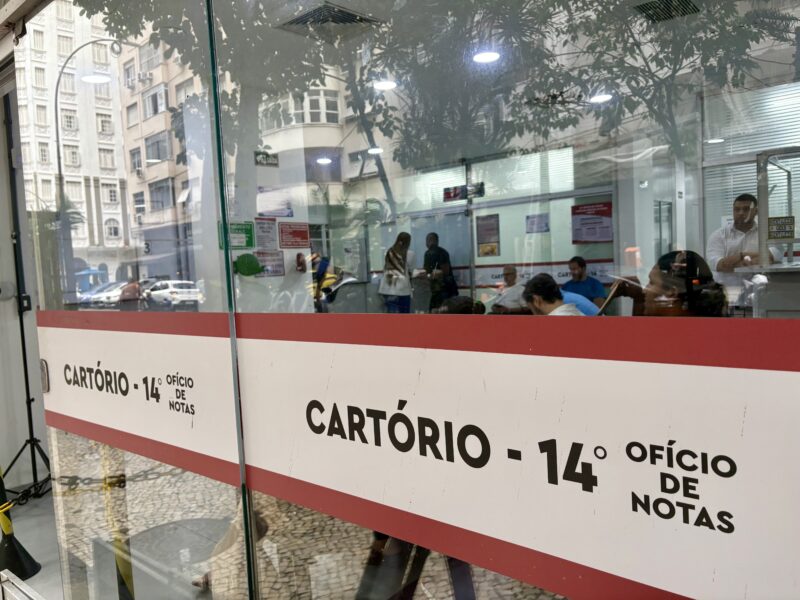
The document was tied to the settlement of a home loan after his wife’s death. The signature had to be recognized at a specific notary office in Copacabana because that was where the manager’s signature was registered.
It was a small errand inside a larger contradiction. Brazil created Pix, an instant payment system that has processed more than 313 million transactions in a single day. It has a federal digital services platform with more than 170 million users. Brazilians routinely use banking apps for transactions that once required a branch visit.

Still, acts involving civil life, property and business continue to pass through a network of extrajudicial offices known in Brazil as “cartórios.”
That structure goes far beyond American notaries, who usually have more limited functions.
Brazilian cartórios record births, marriages and deaths, formalize powers of attorney and public deeds, register real estate, protest debts and make private acts legally effective against third parties.
The model was defined by the 1988 Constitution. Cartórios provide a public service but are privately run by officeholders selected through public examinations.
Those officeholders are not civil servants. They operate under state delegation, are overseen by judicial oversight bodies and the National Council of Justice, and are paid through fees charged to users, with amounts set by state laws.
The hybrid design helps explain why cartórios are difficult to classify in Brazil. They are essential to producing legal certainty, but they charge mandatory fees for services defined by law, operate under a private regime and are not subject to the same compensation rules applied to civil servants.
“From birth to death, from buying a home to getting divorced, cartórios are present in the most decisive moments of any Brazilian’s life,” said Marco Tullyo N. R. dos Santos, a lawyer specializing in notarial and public registry law with São Paulo-based Fabio Kadi Advogados.
Santos said this is not bureaucracy for its own sake. Under Brazil’s legal model, he said, many rights depend on registration at a cartório to take effect.
“Whenever the law requires official authentication, a formal legal act or notice enforceable against third parties for something to take effect, the cartório is unavoidable,” Santos said.
According to Anoreg, the entity representing the sector, Brazil has more than 12,512 cartórios.
In a January report, Anoreg said dejudicialization has moved some court-dependent acts to cartórios, allowing some matters to be resolved without litigation and reducing costs for the state.
It estimated that consensual divorces carried out at cartórios since 2007 have saved the state 2.8 billion reais ($560 million). For estate proceedings, the estimate was 6.3 billion reais ($1.26 billion).
Through protests of federal active debt certificates, cartórios recovered 20.8 billion reais ($4.06 billion) between 2013 and 2024, according to the January report, which cited data from the Attorney General’s Office of the National Treasury.
The same structure that presents itself as a solution for reducing public costs has limited transparency around its own numbers.
Although the National Council of Justice maintains Justiça Aberta, a system that allows users to consult acts and revenue office by office, the search is fragmented.
There is no centralized, up-to-date and easy-to-use public database that allows users to track total cartório revenue, compare fees across states or automatically verify officeholders’ net compensation.
That dispute gained political weight with the administrative reform, introduced in the lower house in October 2025 as one of the year’s main legislative packages.
The package was drafted after months of work by a group coordinated by Pedro Paulo, a Rio de Janeiro lawmaker from the Social Democratic Party. It includes a constitutional amendment, a complementary bill and an ordinary bill.
The proposal has faced resistance from public-sector unions, professional associations and municipal representatives.
To move forward, the constitutional amendment still needs to pass an admissibility review, a special committee and two rounds of floor votes in the lower house before going to the Senate.
One of the provisions deals with cartórios. The proposal would cap future officeholders’ annual net compensation at 13 times the constitutional salary ceiling for public officials, or about 602,760 reais ($120,552) a year under the current cap. That would amount to about 50,230 reais ($10,046) per month.
In 2024, the 11,989 cartórios with positive revenue brought in 32.3 billion reais ($6.46 billion), with an average profit of 758,600 reais ($151,720) per office, according to figures in the reform proposal.
Under the proposal, any excess collected through fees would go to funds that finance free services and help balance the extrajudicial system, with any remaining balance sent to the relevant government entity.
At 141,884.25 reais ($28,377) per month, cartório officeholders had the highest average income among listed occupations, according to 2021 Federal Revenue Service data analyzed by economist Bruno Carazza in the 2024 book “O país dos privilégios” (“The Country of Privileges”).
Amid the dispute, in December 2025, the National Council of Justice restricted automatic public access to compensation data for cartório officeholders.
The National Council of Justice, Anoreg and Pedro Paulo’s office did not respond to requests for comment.
André Cyrino, an administrative law professor at Rio de Janeiro State University, said the tension around cartórios comes from the fact that a private activity depends heavily on public authority.
Cyrino said that although cartórios are not monopolies in a legal sense, the mandatory nature of many acts creates a monopolistic activity from an economic standpoint.
That mandatory structure, he said, raises questions about cartório fees and whether the charges are fair. The amounts vary by state and, in some cases, by type of act.
In Rio de Janeiro, a cartório charges 17.30 reais ($3.46), before any municipal tax, to recognize a signature by similarity, the procedure Silva sought. In São Paulo, the same act costs between 8.94 reais ($1.79) and 13.67 reais ($2.73), depending on whether the document has declared economic value.
The variation is also addressed in the administrative reform. The proposal calls for a national law, initiated by the Supreme Court, to standardize cartório fees across the country, ensure they are proportional to service costs, treat users equally and require active transparency over all amounts collected.

Douglas Machado, 44, a systems analyst in Rio de Janeiro, said the fee was not his main concern.
Machado also went to the Copacabana cartório Tuesday to register his signature and validate a document tied to the sale of a car in an estate proceeding.
He said he rarely uses cartórios in person and usually turns to digital services, such as gov.br and e-Notariado, the national platform for notarial acts regulated in May 2020. The system allows users to carry out powers of attorney, deeds, signature notarizations by authenticity and digital signatures by video call.
This time, Machado said, the Minas Gerais traffic department required him to appear in person because the vehicle had a registered restriction and was part of an estate proceeding.
“I was a little upset because I like to do everything digitally,” Machado said. “I think it’s more practical, safer.”
Machado said registering a signature at a cartório also creates risk because each additional office storing his signature creates another possibility for misuse.
“The more places you leave your signature registered, the more paths people have to try to recognize something in your name and commit fraud,” Machado said.
Alexandre Estrela da Silva Júnior, 42, a businessman in Rio de Janeiro, went to the same cartório to have a signature recognized on a power of attorney. He said he does not use cartórios often but still sees physical presence as a way to reduce fraud.
“I believe it is a service that still depends on presence,” he said. “Because there are many scams, a lot of forgery. So, when the person goes to the notary office, that reduces the risks.”
Rodrigo Luís Kanayama, a public law professor at the Federal University of Paraná and a lawyer for Anoreg, said legal certainty is central to the cartório system.
Kanayama said cartórios function as a privately run, state-regulated layer for keeping records of civil identity, property and legal transactions.
He said judicial oversight and the risk of losing the delegation create incentives for officeholders to act carefully.
“The disciplinary regime is so strict that it leads this delegated agent to act very carefully,” Kanayama said.
That logic, he said, does not prevent some services from moving online.
“Cartórios are absorbing the technology,” Kanayama said.
In its January report, Anoreg said e-Notariado had already recorded more than 1.8 million recognized digital signatures and 92,900 signature notarizations by authenticity.
Still, the reach of that shift remains uneven since not all public agencies accept the digital route for all acts. Silva’s case was one example.
“If I could have done it on my phone, it would have helped me a lot,” he said.
Courthouse News reporter Marília Marasciulo is based in Brazil.
Subscribe to our free newsletters
Our weekly newsletter Closing Arguments offers the latest about ongoing trials, major litigation and rulings in courthouses around the U.S. and the world, while the monthly Under the Lights dishes the legal dirt from Hollywood, sports, Big Tech and the arts.
Additional Reads
 EU moves closer to accepting Trump trade deal May 20, 2026