
 Search Articles


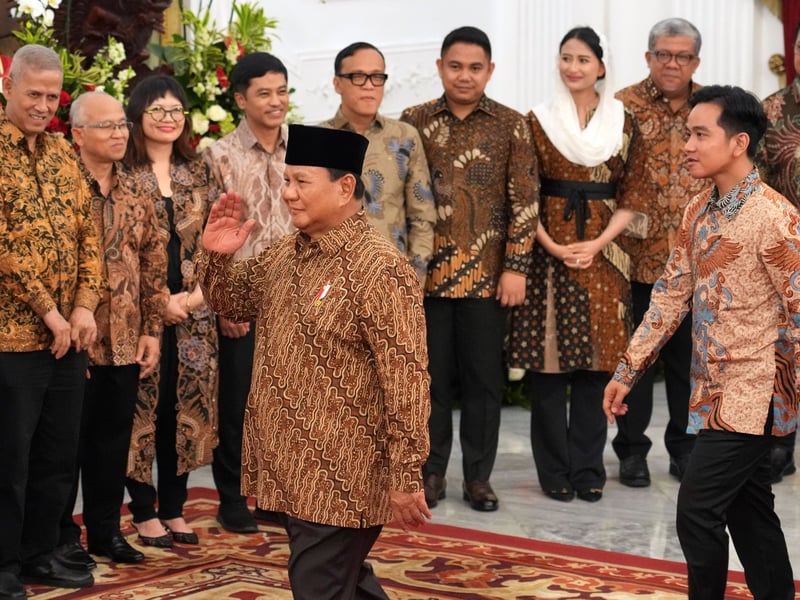
JAKARTA, Indonesia (CN) — Indonesia’s government is expected next month to publish 10 volumes of updated history accounts ordered by President Prabowo Subianto, a former army general accused of committing human rights abuses — some of which he has publicly admitted to without being convicted of any crime.
Historians have observed the project with concern, as it may provide an opportunity for authorities to sanitize Indonesia’s past. A chapter outline and draft summaries show no dedicated section to the massacre of 1998, when activists and students took to the streets in protest, eventually toppling the dictatorship of Suharto after three decades of authoritarian rule.
Several activists and students were abducted, tortured and shot to death by Indonesian security forces during the 1998 riots. Prabowo, who recently received praise from President Donald Trump after agreeing on a trade deal between the U.S. and Indonesia, served as a general at the time and ordered the kidnappings, though he continues to deny doing so. When evidence of his role in the affair emerged, Prabowo was formally discharged from the military without facing trial.
“In regard to the mass atrocities and the mass violence conducted, it seems that the state wants to erase the history from the collective memory of our people,” said Jessenia Destarini, a spokesperson from KontraS who invited Courthouse News into the Indonesian rights group’s head office in central Jakarta. Discussing the matter in a public space comes with risk.
Recent remarks from government officials have amplified worries among scholars.
One controversial comment came from Fadli Zon, Indonesia’s minister of culture and head of the history project, who told lawmakers in July that the initiative “does not discuss May ‘98 … because it’s small,” according to the AFP.
Before the remark, Zon had already faced scrutiny from the public after questioning whether mass rapes of minority ethnic Chinese Indonesians had taken place during the chaos of 1998.
“Was there really mass rape? There was never any proof,” he told the media last month. “If there is, show it.”
Following the fall of Suharto, a 1998 fact-finding report concluded that at least 66 cases of rape occurred during the unrest. Aside from confronting security forces, others took to the streets targeting businesses and homes of the Chinese minority, where gang rapes of the group’s women and girls occurred.
In addition to the official report, scholars and media have for years shared the accounts of victims, religious and medical staff, who witnessed the aftermath of the rapes.
“We say that the issue here is that the state does not take any responsibility. There’s no concrete evidence showing that the riots are systematically orchestrated by the state, but there’s clear evidence showing that they remained passive and let the sexual violence occur, showing their neglect,” said Destarini.
Not everyone among the political elite has placed the 1998 tragedy as a small note in modern Indonesian history. In 2014, former Jakarta Deputy Governor Basuki Tjahaja Purnama, commonly known as Ahok, supported the building of a monument in the capital’s east, commemorating the 1998 victims.
Ahok, who himself is of Chinese descent, served 20 months in prison for a two-year sentence, convicted in 2017 of blasphemy after using a Quran verse during an election campaign in 2016. He was the capital’s first non-Muslim governor in 50 years and one of the few top Chinese Indonesian politicians.
Since the Dutch colonization of the archipelago, citizens of Chinese descent have faced scapegoating in Indonesian society. A common stereotype is that the Chinese minority holds the majority of Indonesian wealth.
After U.S.-backed dictator Suharto seized control of the country on top of a nationwide anti-communist purge in the 1960s, which killed millions of innocent Indonesians during the Cold War, one of history’s most corrupt leaders introduced laws to aggressively assimilate the Chinese minority.
Chinese language schools were banned, public display of Chinese characters and cultural expressions were discouraged and pressure for individuals to adopt Indonesian-sounding names emerged. Much of this was lifted after Suharto’s resignation in 1998.
“The fact that most of the victims are Chinese women again captures the bigger picture of the situation,” Destarini said about the crimes of 1998, highlighting that the Chinese Indonesian communities continue to be unfairly questioned about their loyalty to the state.
“You can imagine what the victims felt at the time that they were burdened with two things, their gender discrimination and racial discrimination,” she added.
In a video interview with Courthouse News last year, Ken Setiawan, senior lecturer in Indonesian Studies at the University of Melbourne, said that previous government initiatives to shed light on Indonesia’s dark past have “enabled those who are responsible, who need to be held to account, to actually be shielded from accountability.”
Prabowo, who was Suharto’s son-in-law, is not the only current government official who played a role surrounding the 1998 tragedy. His defense minister, Sjafrie Sjamsoeddin, another former high-ranking military figure, is also accused of participating in the kidnappings of activists. He is not convicted of any crimes either, but was likewise dismissed from the military over the issue.
The purpose behind the new history books, expected to be released on Aug. 17 on Indonesia’s Independence Day, remains unclear. Activists speculate that the downplaying of 1998 might benefit those sitting in power today, who justify the human rights violations as a necessary bump that benefited the nation’s well-being.
While Destarini sees a decline in human rights progress and Indonesia’s acknowledgment of past crimes, she remains optimistic for her fellow citizens.
“I’m actually hopeful regarding the people, because they are becoming more creative these days to at least counter the narratives and becoming more critical, questioning what the state is trying to teach us,” she said.
 Follow @LasseSrensen13
Subscribe to our free newsletters
Our weekly newsletter Closing Arguments offers the latest about ongoing trials, major litigation and rulings in courthouses around the U.S. and the world, while the monthly Under the Lights dishes the legal dirt from Hollywood, sports, Big Tech and the arts.