
 Search Articles


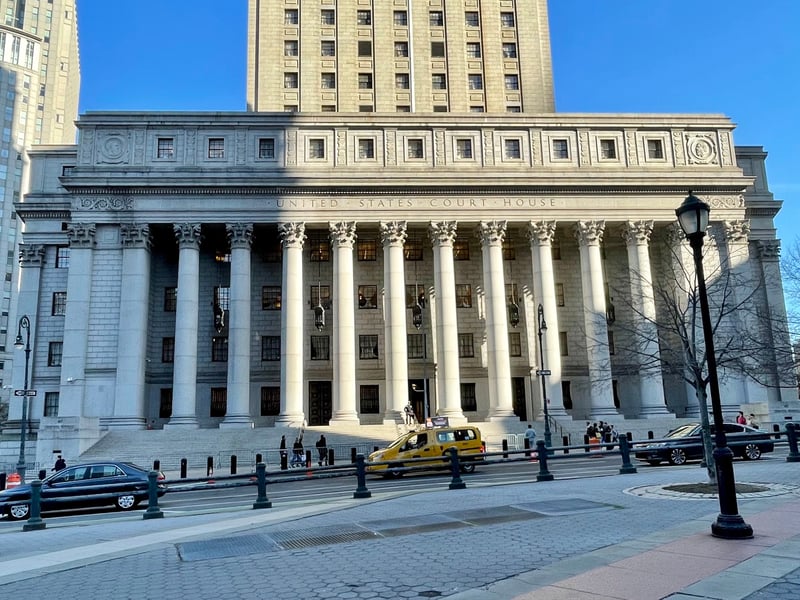
MANHATTAN (CN) — A group of investors argued to a Second Circuit appeals panel on Monday that popular Chinese media aggregator Qutoutiao lied about its ability to detect illegal advertisements on its platform in their attempt to revive their securities claims against the company.
James Pappas is the lead defendant in the class action against Qutoutiao, which supposedly promised investors that it had robust and effective compliance measures to prevent advertisements deemed illegal in China — such as gambling sites and breast enhancement procedures — from appearing on its platform with a “high degree of accuracy.”
In reality, Pappas and the other investors say that more than a few illicit advertisements slipped through the cracks, costing them millions when Qutoutiao’s stock price plummeted in response to inevitable government intervention.
But Pappas’ case was dead in the water as of last summer, when a lower judge disposed of all claims — ultimately not buying that the investors’ reliance on language as vague as “high degree of accuracy” justified the securities claim.
On Monday, Pappas’ attorney, Richard Cipolla of Freedman Normand Friedland, asked a three-judge panel to revive the complaint, reiterating that Qutoutiao touted a slew of tools like “AI technologies” to lull investors into a false sense of security about its advertising compliance.
Cipolla almost immediately hit resistance when restating his clients’ issue with the “high degree of accuracy” statement from Qutoutiao.
“What should it have been, ‘medium?’” U.S. Circuit Judge Michael Park, a Donald Trump appointee, inquired with jest. “These are vague terms. This is also the kind of thing that we consider puffery, isn’t it?”
Cipolla hit back that since Qutoutiao boasted specific technology to back its claims, it bolstered his clients’ case that the company misled its investors.
“They specify exactly what makes it effective,” Cipolla said. “It’s not simply that, ‘We’re best in class,’ or, ‘We do the best we can.’ They say, ‘We have these specific technology and controls that bring us to this line.’”
Qutoutiao’s attorney, Bryan Jin of Simpson Thacher & Bartlett, argued Monday that the investors’ claims about the illegal ads were vastly exaggerated, and thus rightfully dismissed by the lower court.
“Plaintiff alleges that at the time of the IPO under the SPO, there were substantial portions of advertisements on QTT that were illegal and QTT failed to disclose that,” Jin said, “Well, that naked statement in itself is certainly insufficient.”
“The complaint goes on to allege that the government stepped in because of the quantity of ads,” U.S. Circuit Judge Denny Chin, a Barack Obama appointee, replied. “Isn’t that a plausible inference that there was a substantial number of offending ads?”
Jin shot back that the supposed revenue drops all took place well after the plaintiffs claimed, making the entire securities claim implausible.
Park and Chin were joined on Monday’s panel by U.S. District Judge Lewis Liman, a Donald Trump-appointed federal judge in the Southern District of New York. The panel didn’t immediately issue a ruling on Monday.
Qutoutiao, which translates to “fun headlines” in English, was founded in 2016 by Chinese billionaire Eric Tan. By 2018, the mobile content aggregator amassed more than 17 million daily active users and nearly 49 million monthly active users, according to reports.
The investors initiated their consolidated class action in 2020, after Qutoutiao was forced to “remove misleading or inappropriate advertisements from [its] applications,” which caused revenues to plummet by around 20%, Pappas wrote in an appellate brief.
Pappas added that Qutoutiao specifically targeted those in rural Chinese towns, who were typically “underserved” by digital advertisers, but also less likely to report the unlawful ads.
“While QTT targeted users in smaller, provincial Chinese cities who were starting to have more disposable income, advertisers selling illicit advertisements knew those users were also less aware of their rights and less likely to report such advertisements,” Pappas wrote.
 Follow @Uebey
 Follow @uebey.bsky.social
Subscribe to our free newsletters
Our weekly newsletter Closing Arguments offers the latest about ongoing trials, major litigation and rulings in courthouses around the U.S. and the world, while the monthly Under the Lights dishes the legal dirt from Hollywood, sports, Big Tech and the arts.